VISTA obtains a new infrared image of NGC 6357.
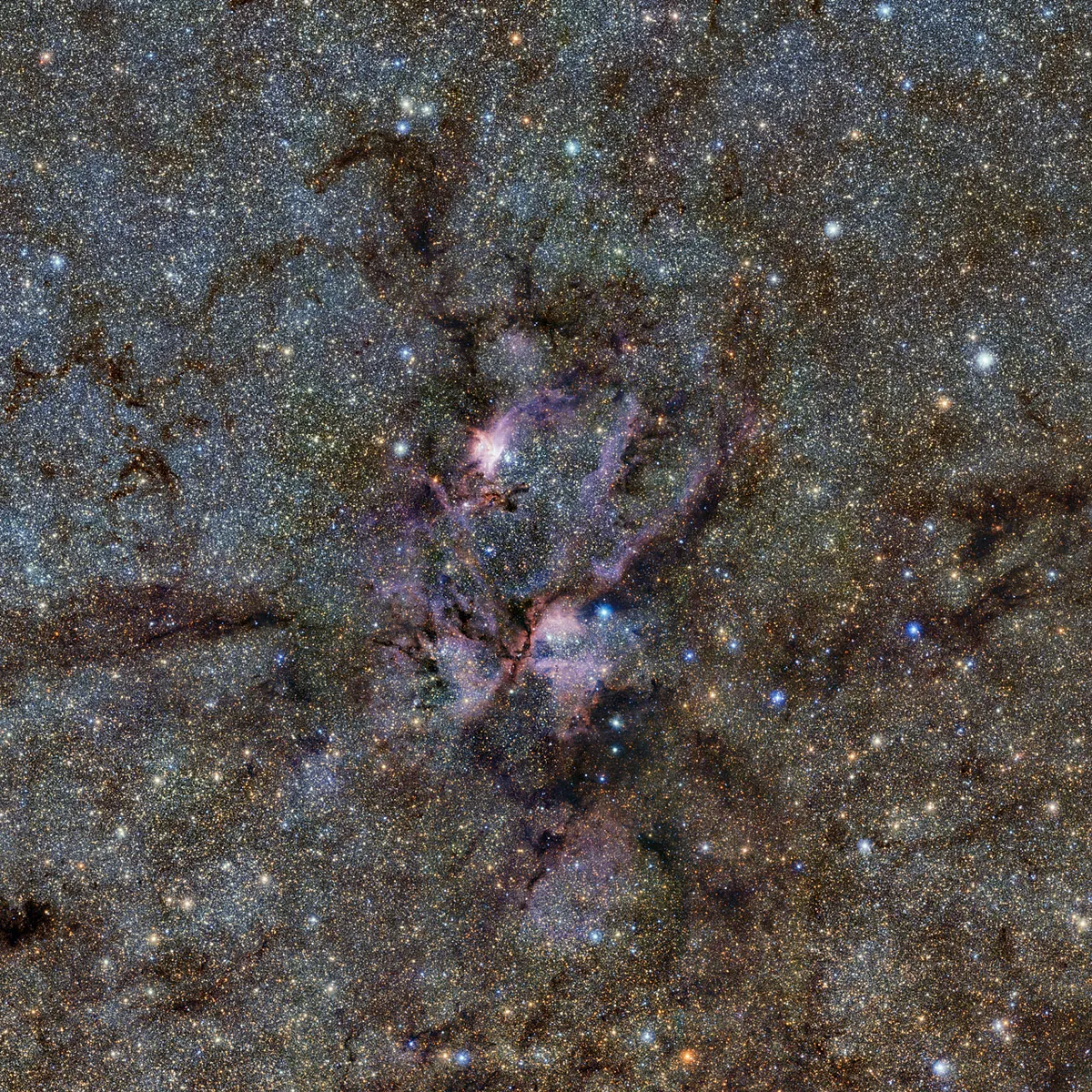
This new image from ESO's VISTA telescope captures a celestial landscape of glowing gas clouds and dust loops surrounding hot young stars. This infrared image reflects the stellar nursery known as NGC 6357 in a new and surprising light. It was obtained as part of a VISTA survey that is currently scanning the Milky Way in order to provide a map of our galaxy's structure and explain how it formed.
Located about 8,000 light-years away, in the constellation of Scorpius (The Scorpion), NGC 6357 — sometimes nicknamed the Lobster Nebula due to its resemblance to this animal in images obtained in visible light — is a region full of vast clouds of gas and dark dust loops. These clouds are forming stars, including hot massive stars that, in the visible range of light, shine with intense blue-white hues.
This image uses infrared data from ESO's VISTA telescope (Visible and Infrared Survey Telescope for Astronomy), installed at the Paranal Observatory in Chile. It is just a small part of a huge survey called VVV (VISTA Variables in the Vía Láctea) that is imaging the central part of the Galaxy (eso1242). The new photograph presents a completely different picture from what can be observed in the visible range — such as in the image taken with the Danish 1.5-meter Telescope at La Silla — since infrared radiation can penetrate much of the dust covering that envelops the object.
It was once thought that one of the bright young stars in NGC 6357, known as Pismis 24-1, was the most massive star known — until it was discovered that it is actually three large stars, each with a mass one hundred times less than that of our Sun. Still, these stars are heavyweights — among the most massive in our Milky Way. Pismis 24-1 is the brightest object in the Pismis 24 star cluster, a handful of stars believed to have all formed at the same time within NGC 6357. (Argentine astronomers studied the cluster a few years ago).
VISTA is the largest and most powerful survey telescope ever built (the primary mirror is 4.1m) and is dedicated to surveying the sky in infrared light. The VVV survey is exploring bulges in the center and plane of our galaxy to create a huge database that helps astronomers learn more about the origin, early stages, and structure of the Milky Way.
The NASA/ESA Hubble Space Telescope (heic0619a) and ESO's VLT (Very Large Telescope) (eso1226a) have also observed parts of NGC 6357. Both telescopes have produced images in visible light of various parts of this region — comparing these images with this new infrared image we see the impressive differences. In the infrared, the large pillars of reddish material are greatly reduced, with loops of pale purple gas stretching out from the nebula in different areas.
Cosmic pareidolia
Sometimes we see what we want to see. Humans are capable of finding patterns in the shape of clouds or in coffee cream.
In astronomy this is very common, which is why many astronomical objects have different colloquial names of known objects that are believed to be seen in the cosmos. NGC 6357 has stirred the fertile imagination of astronomers and the general public.
The informal name Lobster Nebula is also sometimes applied to the spectacular star-forming region Messier 17 (eso0925), although it is more commonly called the Omega Nebula.
NGC 3657 was dubbed the War and Peace Nebula by scientists from the Midcourse Space Experiment (MSX). Their idea was that in mid-infrared images, the bright eastern part resembled a dove, while the western part looked like a skull.
The story is told in the 2MASS gallery of its images of the week number 25, among which are both nebulae.
Fans of the anime Puella Magi Madoka Magica have asked MSX researchers to change the object's name to Madokami Nebula. It must be said that the proposal is unnecessary. The naming of deep-sky objects follows what is indicated by the IAU working group on designations (Astronomical Designations) which is part of that organization's commission 5. Normally an acronym (catalog name, object type, instrument) is used followed by a sequence number that may be a date or a coordinate. That is the "scientific" way to name those objects. But there is no restriction on the general public using "colloquial" forms to refer to them. NGC 6357 will continue to be called that because it is part of the New General Catalogue. Nicknames like "Lobster Nebula" or "War and Peace Nebula," even if they originated from astronomers, are "vulgar" names and not their scientific designation. So there is no problem with the object also being known as the Madokami Nebula.
VISTAs of the galaxy
Recently the astrophysics department of the Pontificia Universidad Católica de Chile published a book with images from VISTA. The principal investigator, Dr. Dante Minniti, says: "This is a book that tells the story of an astronomy project. The VVV is a new and unique project that contains so many images that we want to share them. The good thing is that they are original images, just as we use them for scientific projects. Although we cover that entire sector of the sky for the first time with such depth, we selected the most representative sectors of some interesting objects and tried to discover the astronomical processes of each of them."
It is possible to take a look at the book on a PUC page, and acquire the work at Librería Antártica.
It is worth remembering that although Minniti is working in Chile, he is originally from Santa Fe, Argentina and had the honor last year of being inducted into the Academia Nacional de Ciencias of our country.
Sources and related links
About the images
- Credit: ESO/VVV Survey/D. Minniti. Acknowledgement: Ignacio Toledo