It is Dr. Hugo Levato, who will receive the distinction in October.
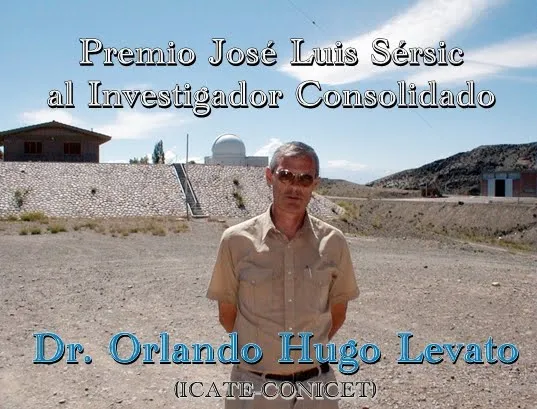
According to the Prize's Ruling and Verdict: "The 'J.L. Sérsic Prize for the consolidated researcher' is a prize awarded biennially by the Asociación Argentina de Astronomía in order to recognize and promote research and development activity in astronomy and astrophysics in the Argentine Republic. This prize aims to recognize a consolidated researcher based in Argentina and belonging to the Argentine scientific system, who has demonstrated great productivity in astronomy and astrophysics, has trained human resources and whose work has had a great international impact".
For this year there were two nominations: that of Levato and that of Dr. Leandro Gabriel Althaus.
The ruling explains that "Quantitative criteria were prioritized, avoiding arguments about accessory background. The criteria considered were, among others: the number of publications with international refereeing, the number of citations, the h-index and its variations, the number of undergraduate and doctoral theses, the formation of research groups, administrative and management tasks, number of invited plenary lectures, outstanding works and participation in high-level scientific committees.
In a second stage, the members individually studied the background presented, in addition to deepening the investigation on the internet to complement that data, and drew up the academic merit orders.
Next, in the third stage, the Jury deliberated to share the individual rankings, exchange opinions and explain the arguments, in order to agree on a ruling. Again, the decision was difficult due to the excellence of both candidates despite the disparity of their trajectories. However, there was agreement both in the individual rankings of the Jury members and in their reasons, so the final merit order must be considered a consensus".
Dated July 7, 2011, the Jury composed of Drs. Felicitas Arias, Gustavo Romero and Dante Minniti resolved to award the prize to Levato, but also to especially highlight the merits and projection of Althaus.
The prize honors the memory of José Luis Sérsic, a distinguished Argentine astronomer, who died in 1993.
About Dr. Hugo Levato
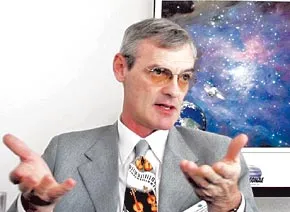
Orlando Hugo Levato was born on February 15, 1948 in Capital Federal, Flores neighborhood. He studied teaching at the Mariano Acosta. He could have had a future as a soccer player, but he preferred astronomy upon entering the University of La Plata, in 1966. After the Licenciatura he obtained his doctorate there, in 1973 with a study on axial rotation in double stars.
Between 1975 and 1976 he worked at the Kitt Peak National Observatory, Tucson, Arizona, United States. Fellowship Director: Dr. Hemult Abt.
He entered the CONICET Research Career as an adjunct in 1977 and today is a Principal Investigator.
He was the first Director of the El Leoncito Astronomical Complex, in 1984 and Vice President of the Asociación Astronómica Argentina between 1985 and 1988.
He is a member of the IAU (Divisions IX, XII, IV) and of the Astronomical Society of the Pacific.
He is currently part of the Institute of Astronomical, Earth and Space Sciences (ICATE) and a professor at the Universidad de San Juan.
He is the author of hundreds of papers. The NASA ADS repository returns more than 200 in the most important journals. Among his works of recent years are publications in Astronomy & Astrophysics, Solar Physics and The Astrophysical Journal.
He is married, has five children, a Racing fan and likes classical music and tango.
"A Stain on the Management"
The November 25, 2003 edition of the newspaper Página/12 headlined thus a note in which it reported that CONICET delegates were asking for Levato's resignation for having defended the 1976 dictatorship in statements published in Nature.
The case dates back to July 22, 1976 (Vol 262 No 5566 pp243-328). That day, the journal Nature published a letter titled "Plea for Argentinians" (DOI:10.1038/262253a0) signed by seventy Italian scientists, warning about the havoc that the Law of Prescindibilidad, recently enacted by the military junta, was causing in the Argentine scientific community.
There is also an editorial on the subject in: "Out of work in Argentina" (DOI:10.1038/262243a0).
"Almost a month later, on August 19, '76, in the correspondence section of the same magazine appeared a response also written in English and signed by Hugo Levato from Tucson (Arizona, United States), where he was taking postdoctoral courses," notes the Argentine morning paper.
In Vol 262 No 5570 pp635-724 of Nature, "Scientists in Argentina" (DOI:10.1038/262642a0) is published, in which Levato pointed out that: "Subversion in Argentina can be found in every department and government institution. Subversives are not only those who plant bombs; they are also those who in different ways support the guerrilla... Argentina is fighting for its survival against these groups and fortunately is winning. Of course, there may be unjustified cases in which an innocent person is relieved of his responsibility, but many more innocents lost their lives in terrorist attacks".
The morning paper, in the same note, quotes the then Secretary of Science and Technology, Tulio del Bono: "Levato advises me on scientific matters and he fulfills that function correctly. I cannot start evaluating what each one thought 27 years ago. Levato presented me with a defense acknowledging that he had been wrong and I passed all the information to the Secretariat of Human Rights so that they could advise me on what is best to do."
In that defense, Levato acknowledged that the letter was shaped by his inexperience "but fundamentally by the informational environment he had." He also added: "I was not and am not a supporter of violence... in particular when this violence is illegally exercised by the State."
That note gave rise to a parliamentary proceeding presented by the late Luis Falcó, of the UCR, in the National Senate as a Communication Project to request reports on those statements.
Other reactions were also generated, such as that of Néstor Gaggioli (Conicet researcher, vice president of the International Commission for Optics) from December 9, 2003.
Last year there were more: after an interview by Leonardo Moledo with Levato, the Página/12 journalist had to account for a number of emails received and in the same edition an opinion by Carlos Girotti of ATE-CONICET is published.
To set things straight: I was born in 1973, so I did not "live" through the military dictatorship since I was very young. There is no way, today, yesterday, since I have been of sound mind, to accept military behavior or to think in terms of a "two demons" stance. There is no way, for me.
Judging with the benefit of hindsight is always much easier. How would I have informed myself back then if I had been of the appropriate age? What would I have thought about that moment in the country's history?
What is Levato being accused of? Of thinking differently? I certainly do not agree with his statements, but can only one's own ideas be admitted?
I am not unaware of the significance of the issue, of the pain it has caused and that continues to tear apart the families and victims of the disappeared. But we cannot judge someone for what they think. Even if we completely disagree with it. And, above all, if their -public- function is not at all implicated by those ideas.
Girotti accuses Levato of being an accomplice in that Página note in March 2010. But I did not see any letter from Girotti in the June 23 edition of that year, when Timerman assumed the foreign ministry, who also has his past.
The J.L. Sérsic Prize is awarded, I understand, by the AAA by virtue of the merits as a consolidated researcher of Dr. Levato. Not for his personal ideas. Whoever thinks that is wrong should ask themselves if, then, candidates for a scientific prize should be consulted about their ideas on the dictatorship before evaluating their work. Because Levato wrote that note -and regretted it-, but others said nothing.
Sources and related links
- Asociación Argentina de Astronomía
- Dr. Hugo Levato –Astrónomo, by Nina Galván
About the images
- Initial photo of Dr. Hugo Levato in front of CASLEO. Credit: Doings online, from the David Dunlap Observatory.
- Photo of Hugo Levato. Credit: Clarín.