ESO's Very Large Telescope captured this stunning view of the nebula around the star cluster NGC 1929. The image was created by ESO from astronomical data found by Manu Mejías, from Argentina, who told me about the experience.
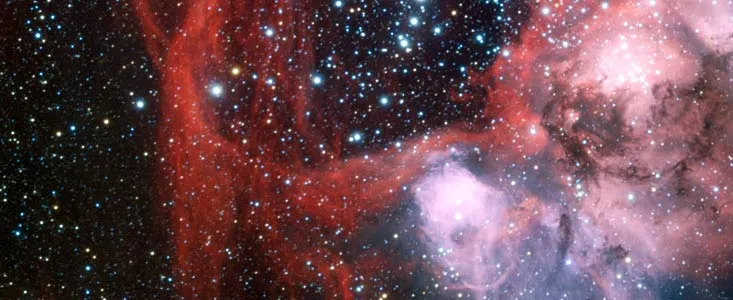
Today, the European Southern Observatory publishes this magnificent image of NGC 1929, a star cluster in the Large Magellanic Cloud, a satellite galaxy of our Milky Way. This stellar nursery is dominated by a colossal specimen of what astronomers call a superbubble. Its shape is being sculpted by the winds of bright young stars and the shock waves from supernova explosions.
The Large Magellanic Cloud is a small neighboring galaxy to the Milky Way. It contains many regions where clouds of gas and dust are forming new stars. One of these regions, around the cluster NGC 1929, dominates this new image obtained with ESO's Very Large Telescope, located in the Antofagasta Region in Chile.
This nebula is officially known as LHA 120-N 44, or simply N 44. Young, hot stars in NGC 1929 emit intense ultraviolet light that makes the gas glow. This effect makes the so-called superbubble stand out, an immense globe of material about 325 by 250 light-years in diameter. For comparison, the closest star to our Sun is just over four light-years away.
The superbubble N 44 was produced by the combination of two processes. First, stellar winds - streams of charged particles from very hot and massive stars in the cluster - cleared the central region.
Subsequently, the massive stars in the cluster exploded as supernovae, creating shock waves that pushed the gas outward and formed the bright bubble.
Although the superbubble is born from destructive forces, new stars are forming around the edges, where the gas is compressed. Like cosmic-scale recycling, this new generation of stars will bring fresh life to NGC 1929.
The data for this image were selected from the ESO archive by Manu Mejias, as part of the Hidden Treasures contest. Three of Manu's images were among the top 20; his image of NGC 371 obtained sixth place in the contest. That image was used in a press release in March of this year: The Crimson Glow of Star Formation.
The image of Abell 1060 obtained ninth place and number 14 is this one that the Observatory publishes today of NGC 1929, N44.
Who is Manu?
Manuel Mejías is 28 years old, an electronics technician, and he repairs desktop computers at a specialized shop.
"I come from a family that always instilled in me a taste for the sciences. With my grandfather, we would spend hours with a pair of binoculars each from a tiny patio at his house looking at the stars. My taste for astronomy has always been related to the need to understand immensity, infinity, the size of things (I'm still trying, haha!)."
Manuel participated in the contest thanks to ESO's promotion on social media. "As for the contest, I found out through ESO's Twitter, and without hesitation (and without knowing much, to be honest) I went to the page and started downloading observations of objects that didn't appear in ESO's image lists. I processed quite a few, many more than I submitted, until I more or less got the hang of processing those awesome FITS and understanding the filter system and the functions of the different telescope instruments."
Astronomical images
The images obtained by professional astronomers are not like how they are finally presented to the general public through pages like those of ESO, Hubble, or Chandra. On the contrary, they are usually in black and white, taken with different filters and then edited. See: The Power of Colors in the Cosmos. Those images, in FITS format, include a large amount of data (metadata) linked to the physical processes detected by the instruments in cosmic objects. Editing the images can result in a color image, by combining images from different filters, and they are often "false color." Humans can only detect a small fraction of the electromagnetic spectrum with our eyes. For example, we cannot see in X-rays. But the images contain data from a variety of wavelengths. That is why that data is colored. Here we have explained how to perform that type of image processing, at least to get started (see below).
Manuel told me that among the software he uses for image processing are: Deep sky stacker, Pinxinsight LE, GIMP, and FITS liberator.
Manuel's example is extraordinary. He himself points out that, without knowing much beforehand, but with a bit of practice, he managed to understand how to do the processing. His testimony, then, can be motivating for the interested public to approach that world that mixes photography, astronomy, and computing. It is also an example of how valuable astronomy outreach programs and the use of social media are. ESO is one of the observatories that has best understood the 2.0 dynamic.
"I tell you that I feel very proud of the results I achieved in the contest, beyond the ranking, it's a pride to know that one can be at that level," commented Manuel, puffed up with pride like a cosmic superbubble.
Sources and related links
- A cosmic superbubble
- ESO's Hidden Treasures contest.
- The FITS liberator
- The OpenFITS project
- OpenFITS: The colors of the remnant
- OpenFITS: the pulse of the Crab
- Deep Space Astrophotography Forum
About the images
- Image credit: ESO.