Interview with Dr. Sergio Aldo Cellone (FCAGLP-CONICET) on what it's like to be an Argentine astronomer. The training, the work, some of his contributions, and the importance of the Argentine Gemini Office.
The idea of interviewing professional astronomers is to give a better idea of what a researcher's work is like, specifically in Argentina. What studying is like too. Is it as difficult as it might seem? Is it easy? While these categorizations are relative to each person (due to interest, effort, etc.), it is possible to try to approach a more realistic concept than those created by stereotypes.
Profile
Sergio Aldo Cellone graduated with a degree in Astronomy in 1988 from the Universidad Nacional de La Plata (UNLP), Argentina. He then obtained his Doctorate in 1994 by studying dwarf galaxies in the Fornax Cluster, based on CCD images obtained at the Cerro Tololo Inter-American Observatory (CTIO), Chile.
During 1996 and 1997 he worked as a Resident Astronomer at the El Leoncito Astronomical Complex (CASLEO). He works on research into low-luminosity galaxies in groups in the local universe, and the study of optical microvariability in active galactic nuclei (AGNs).
At the same time, he is a Professor of a Stellar Systems course for 3rd-year students of the degree and an elective subject in the 4th year, Extragalactic Astronomy, at FCAGLP. He is currently listed as technical secretary of the Argentine Gemini Office, although there was a change in the organization (not yet official) and he will serve as Coordinator of the Office.
-We have to start at the beginning. High school.
-Conditioned a bit by my father's activity, who had a mini-industry, I went to a technical school. It served me to work for a while and I value some teachers who posed problems for us and helped us think. But the idea of astronomy comes from elsewhere.
-Where does it come from?
-From reading things, from some book I came across as a kid.
-And was that enough to enroll in the university?
- Let's say, I did my military service. When I finished I had free time and then I took a course at Amigos de la Astronomía, over there in Buenos Aires, and I talked with Pedro Saizar, who taught the astrophysics course, he was still studying here at the university. And, can you make a living from astronomy? Yes, you can, and I started.
-And you got your degree.
-Yes. During the degree I was a bit like, what do I like more, astrophysics, astrometry? The topic of galaxies always appealed to me. But well, studying a topic is not the same as working on a topic. It's a bit like what one talks about with young people.
-Defining the topic is an important step.
-In our time it wasn't so complicated because the degree was a bit more rigid. The specialization was only in the fifth year. Now it starts in the fourth.
I had to look for a professor then who would guide me in the specialty and I approached Dr. Juan Carlos Forte and told him I would like to do something with galaxies, thinking about Andromeda or similar objects. Ah, yes, he says, I have some data here on dwarf galaxies... And even though they are objects without spiral arms, which seem boring, I started studying and got excited. Later, in the doctoral thesis, I continued with the topic.
-They say a researcher becomes such during the doctorate.
-And it's a bit like that. The degree gives you the tools, but in the doctorate one encounters the serious problems and starts having to solve them. One realizes what tools one doesn't have. It really opened my mind to go to a conference in Brazil, in '91, and see where things were going and what tools to use. I had data, observations of dwarf galaxies and how do you interpret that? And there were the people who had the models and all that.
-We get to the doctorate. On that path, what requirements must a person meet to get to that place? Must they know a language, be a genius at mathematics, computing?
-If you know all that, it helps a lot. If you're not a genius, like most of us who aren't, well you have to put in quite a bit of effort. I noticed the change between high school and university. I realized I had never studied. In high school I had 8s, 9s and 10s and I hadn't studied.
-Well, in your degree you obtained an average of 9.41.
-Averages in astronomy tend to be high because they are used to compete for scholarships. So one takes the trouble to do the final exams well, especially in the later years. You don't prepare for finals in a week. But it's not a condition, it helps, but it doesn't guarantee anything. There are people who without a wonderful average have shown themselves to be excellent researchers.
-Let's go to some specific studies carried out by you: NGC 5044 and AGN microvariability.
-Well, I liked galaxies, Forte points me to dwarf galaxies which are important for a series of reasons like galaxy evolution. Dwarf galaxies are the majority, they are vulnerable to interactions. I study the elliptical type that have no star formation, like the Magellanic Clouds.
They are also important for their chemical evolution. The dwarf galaxy forms stars, the most massive ones explode as supernovae, throw their enriched gas into the medium and since there is no sufficiently intense gravitational potential to retain it, that gas can pass into the intergalactic medium. That is another importance of these galaxies as enrichers of the medium.
-One can estimate, from the brightness profile of these galaxies, their distance.
-There was a whole controversy about that. Dwarf galaxies, the elliptical ones, have a characteristic. For example, one studies a galaxy cluster and in principle one sees in projection everything that is in the line of sight so you don't know if they are all at the same distance. But dwarf ellipticals, due to their own morphology and their brightness distribution, are quite easy to discriminate from background galaxies. Just from an aspect of perspective, background galaxies look smaller and more compact. So already upon visual inspection, without further data, they are easy to identify as belonging to the cluster under study.
Then, with a more quantitative analysis, what is called the brightness profile, how the light is distributed from the center of the galaxy outward, that can be fitted with this mathematical law proposed by José Luis Sérsic, an Argentine astronomer. Now everyone uses that profile. The exponent N of the law correlates with the luminosity of the galaxy.
In my thesis, with Forte, we were the first to show that correlation for dwarfs. For bright ellipticals, other people had shown it a year earlier.
The measured brightness depends on distance and that index could be used as a distance indicator. And a whole controversy erupted because just when we were publishing the 94 paper (Note #1), people came out saying this could be used as a distance indicator, we were saying one had to be careful with selection effects and a controversy erupted.
I had published a paper in 99 (Note #2) where I somehow took sides between two groups that were "killing" each other. The Binggeli-Jerjen group and the Young & Currie group. And I fell in the middle and the A&A editor asked me if I wanted to participate in the debate and that's how the paper with Buzzoni came out, saying one had to be careful with the relation so that distances wouldn't be miscalculated.
-And among other things, you point out some extrinsic interference from environmental conditions.
-Right, in the 99 paper (Note #3) I showed how the seeing, the atmosphere issue, could affect the parameters of the Sérsic Law.
-There you use FWHM a lot, the full width at half maximum.
-It's a way to quantify the effect the atmosphere produces on stellar images.
-This point, regarding seeing, is something that is taken up again in AGN microvariability studies.
-Yes, I like the telescope, observation, and so beyond astrophysics I was very interested in data acquisition and how instrumental problems affect it.
-Whoever does astrophysics will use that data and if it's wrong...
-That happened to us with the other topic. I was a resident at CASLEO and Romero writes to me, who knew me from when we were student assistants in exactas, and asks me if I wanted to do a paper on microvariability.
We were observing a blazar that was in a galaxy and of course, here something is happening...
-In the same field they had a galaxy and a blazar. What is a blazar?
-It's a particular type of active nucleus. There are galaxies that have active nuclei. Almost all galaxies are thought to have a supermassive black hole at the center, but some are inactive because they don't have gas nearby and others are accreting gas and that produces the activity. There are different types of AGN. Blazars are the most active, the most spectacular. It is assumed there is a jet, a stream of particles along the observer's line of sight.
-And BL Lac objects?
-A subtype of blazar.
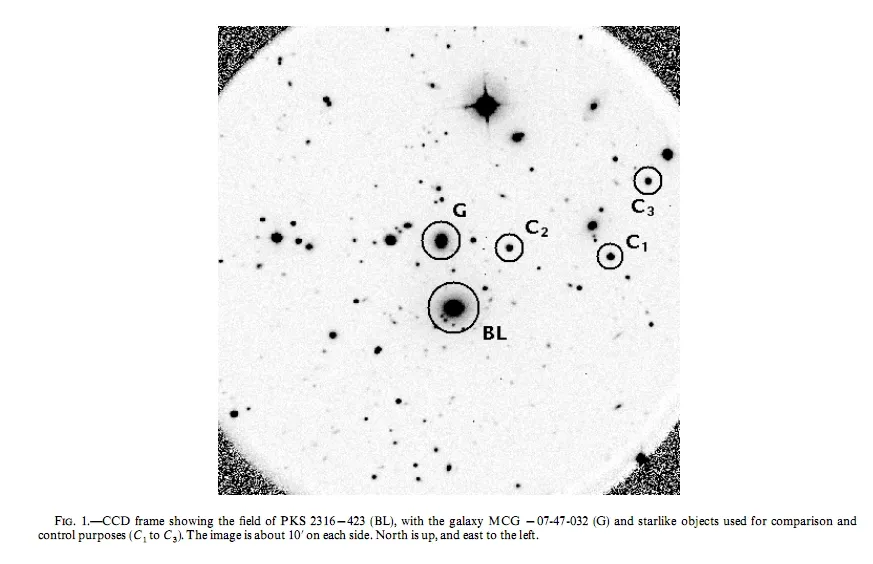
-And in that same field, what was happening?
-Active nuclei are nuclei of galaxies. In this case the galaxy was quite noticeable and when doing photometry in the usual way I found variations that indicated something was happening. The galaxy has to be a nuisance. If the seeing changes, the image size changes, it won't affect the active nucleus, which is a point source, the same way as the galaxy, which is extended. There were people who after doing similar studies said the galaxy wasn't a nuisance. And everyone cited them, with that criterion, that the galaxy isn't a nuisance.
-Carini and others, 1991 (Note #4) They said extrinsic sources of brightness weren't a nuisance because in differential photometry, in the process, they were eliminated. What is differential photometry?
-One measures the luminous flux of an object compared to another object in the same field, observed at the same instant. What's the advantage? Any faint little cloud that passes or other similar problem will affect both equally. So when the magnitude difference is made, which is the flux ratio, variations due to weather conditions are eliminated. Otherwise, one would have to observe on photometric nights, which is very complicated. Instead, by doing differential, these differences can be eliminated, reaching a precision of up to two hundredths of a magnitude, two percent.
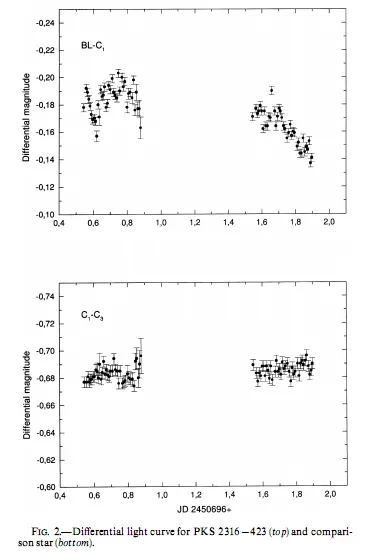
-At the same time many frames are taken.
-Right, a bunch of images of the same field and what we have is temporal resolution. That is, magnitude differences at instant one, two, three, instant n and then a light curve is built, how the object's luminous flux varied over time.
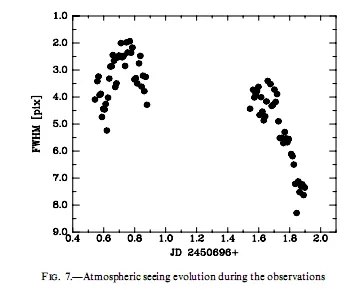
-And a curve of meteorological conditions is also made.
-Right, and what we showed was that precisely those conditions quantified by the image size had a curve similar to the supposed variation of the blazar and we said this is wrong. And since there was a galaxy in the field, when doing the same process, the galaxy also varied, which is absurd, a galaxy of a hundred billion stars cannot vary on such a fast timescale. The active nucleus varies because it has a very small spatial scale, it's a very compact object. The galaxy, which is enormous, cannot vary like that.
-We're talking about microvariability.
-That active nuclei vary has been known for a long time. For example the first quasar found, 3C 273, in 1963, later they start looking for it in previous photographic plates and find that over a century it had varied.
Microvariability is on a scale of hours, within the same night. And that was discovered in the 1980s.
-How was the process of this research?
-Starting from the choice of the topic, you have to choose the sample through the catalogs according to brightness, declination and a series of things: what has been published about each one. You put together a project, what am I going to do, how am I going to observe it, why these objects and not others, literature search and the project is justified. What am I going to do with the data when I have it? and all the technical part.
-And what are the data like? They are not jpg.
-We do CCD photometry and also spectra. We also did polarimetry. We obtain the data in digital format, through media like CDs or we download them directly from the internet, as in the case of Gemini.
-And to analyze the data you use software.
-Specific software.
-In this case, basically IRAF on Linux was used. I mention it so that whoever likes astronomy knows that today astronomy is computing.
-And it's constant. Someone told me, what is the instrument the astronomer uses the most? It's not the telescope, it's the computer.
-That's a title.
-And I have a tower of CDs there. Each night at CASLEO was one of those CDs.
-That needs to be cleaned up.
-Of course, then it's months of work. First there is the calibration, the raw data, a FITS image, monochromatic, one for each color (if it was decided that way at the time) and doing all the processing.
-Some algorithms already exist for that.
-It's done, in IRAF it is, but you have to do some things in Fortran for example.
-When the conclusions arrive, you are sure when you have them.
-The conclusions, not at all (laughs)
-Those conclusions are in some way discoveries, although there aren't always "Eureka" moments
-I wish that would happen and we were on the cover of Nature. But there are large areas of astronomy that maybe were never on the cover and yet what we know is so detailed. For example the topic of binary stars. There are a hundred years of people making these small contributions and the level of detail with which the astrophysics of binary systems is known is impressive.
-Does that matter? For example, would Sérsic have lived that experience?
-Look, I know the one who was Dr. Sérsic's last thesis student and he told me that it didn't matter much to him.
-Romero is seen involved in a great number of things. But you too. Galaxies, AGN, but you have also studied asteroids, Centaurs.
-I am a mercenary of astronomy (amid laughter)
-Another title! You have studied a great number of topics. There are astronomers who always study the same thing, which is valuable of course, although perhaps it can be a bit boring.
-Perseverance is valuable, of course. The asteroid thing came up while I was at CASLEO and a colleague proposed it to me and suddenly I found myself with a pile of papers on asteroids. But I liked it, the topic of the Solar System always appealed to me.
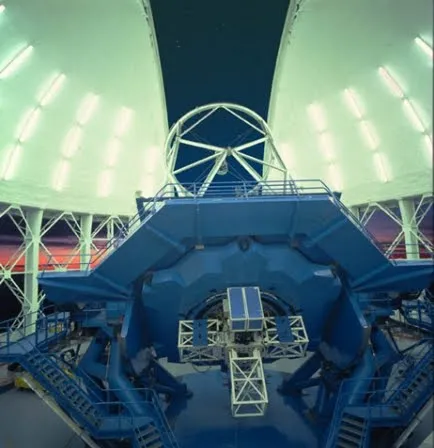
GEMINI and the search for sovereignty in astronomy
I asked Cellone about the post-paper: the impact and implications of the number of citations, of the evaluation of scientific work. It was a good opportunity to learn about the evaluations in relation to local researchers in Gemini.
-I am now the Coordinator of the Argentine Gemini Office. What I have been doing until now is the technical evaluation. Then there is the evaluation of the National Time Allocation Committee (NTAC). I participated in three or four. And yes, there one evaluates proposals.
-In Gemini, do Argentine astronomers have 2% of observation time?
-A little more.
-How many nights?
-It's about 30 hours between the two telescopes, per semester. About 60 hours a year.
-In Argentina there are about 200 astronomers?
-On that order.
-Is it enough, is it too much?
-It's like you tell me, is there enough disk space? You double it and you fill it just the same. We proposed the doubling of time in Gemini.
-Do we have to double the money?
-We have to double the money.
-Today, about how much is allocated?
-On the order of a million dollars annually.
-And at some point nothing was paid.
-And we were penalized with the loss of time.
-At least in that sense, can it be said that astronomy in our country, in recent years, is doing better?
-Since 2007 Gemini became institutionalized, the Ministry of Science took it over, there is a user committee that represents the four institutions with the largest number of users, there is an office and from there the contribution of funds normalized and no more time was lost. There was support of all kinds. This very faculty contributed so that people from here could go learn at Gemini South, a Workshop was held that was sponsored by the ministry.
-Professional astronomers must learn how to use it.
-Of course, it's a significant qualitative leap.
-If we compare Gemini with the instruments in our country?
-CASLEO is 2.15 meters and it never functioned as such, but as one of one meter and a bit. Jumping to one of eight meters...But it's not just a matter of diameter. Gemini's instrumentation is something spectacular. It's unimaginable. Chatting with a colleague, Guillermo Bosch, who did a job with the most used instrument, the multi-object spectrograph (GMOS) with optical fibers that carry the light from each object to a laser-cut mask. It allows you to take thirty, forty spectra at once. And they told me: this is a job we did in three, four hours of Gemini. If we had done it on a 2-meter telescope with a conventional spectrograph, one little star at a time, it would have taken us how long? Three days? No. All the clear nights of the year. The difference is tremendous. Not to mention the instruments in the infrared, something completely new. There are groups in the country that started learning that because it's a completely new wavelength range. Each of the two Gemini telescopes has five instruments that cover the entire optical-infrared range and each in different modes. GMOS has four different modes: image, spectrum, multi-object and integral field. The leap is important. Our proposals are good. Obviously we don't have the same resources as an American or a European who can access other resources. The doubling of time would be perfectly justified.
-Is it the most advanced instrument that local astronomers can use?
-It is the instrument we can use, let's say, without requiring collaborations with foreigners. There are people working with the VLA, radio telescopes in Australia, with the space telescope. But that 2.5% is ours.
-Three days ago was Independence Day. This has to do with a certain scientific sovereignty.
-That's the point. The advantage is each country's sovereignty over what to do with its time.
-Does the country need any other instrument?
-There are several proposals, very interesting ones, and it's very auspicious that the ministry is evaluating them and I believe there is a commitment to push them forward. In the case of radio astronomy, it's been a long time coming. The IAR radio telescopes completed their cycle a long time ago and it would be good for the Llama project to be realized.
-The last question is a prickly one, assuming the devil's advocate position. Is it justified to allocate a lot of money to build telescopes while there are people with Chagas or hunger?
-In the countries that spend the most on science are the ones with the least hunger.
-But does that mean there will be fewer hungry people if more is spent on science?
-Argentine politics showed that when we didn't spend on science we had the worst poverty rates.
-When they sent researchers to wash the dishes.
-That was a scientific policy. They didn't privatize CONICET because they had no one to sell it to. It's no coincidence that the worst moment for science coincided with people rummaging through garbage bins.
-Someone would say that in the nineties the Auger Project began.
-Gemini also started. But why. Because Todman told Menem "you have to sign here". Matera was the Secretary of Science and Technology. There was no minister at that time. And, from what I know, Matera at first didn't want to sign.
I believe the country is not made of watertight compartments. And it has been shown that the money that didn't go to science or education didn't go to the hungry kid or the one with Chagas either.
If we have any hope that things will improve, it will be if there is harmonious development of everything, and then the scientific system has something to contribute to this. To think about developing vaccines or research that once and for all eradicates Chagas without CONICET researchers working on that is ridiculous.
-We have to do it with CONICET researchers on Chagas disease, but why binary stars? What's the use? What's the use of astronomy?
-It's a question analogous to a person who wants to build a house and says "You're budgeting a lot of money for the foundations. I want the walls and the roof". Yes, but if I don't build the foundation the house collapses on you. And it's the same. Basic science is the foundation of the scientific-technological system. Where will you have the best engineers? At the University that does research in hard sciences.
-Applied science stems from basic sciences.
-To think about developing an applied science for a technology without having the basic science is like a house without foundations.
-There are also examples of technology transfer. Radio astronomy, optics.
-CCD cameras. They can tell me that the country never had a relationship, that basic science was kept there as a watertight compartment and more or less money was given to it and somewhere else people were dying of Chagas. Let's build a country project where everything develops harmoniously and virtuous links will begin to occur. The case of the satellite that has my initials (laughs), the SAC-D. CONAE, I don't know if it would be possible in a country without basic science in astronomy. A person I know who works there (Hugo Marraco), before used to do polarization of the interstellar medium. And it doesn't seem like it, but it's related.
-For that conjunction of things to exist and for basic science not to be a watertight compartment, does there have to be State involvement?
-Totally. Here and anywhere in the world.
-Even though institutions in our country are quite autonomous and researchers want to preserve that independence.
-Well, universities are part of the State. But the policy of the National State and the provincial ones is fundamental as a coordinator of all those efforts and as a guide. Without taking away from any of the branches, to visualize the areas that can produce knowledge that improves the entire socio-economic environment and see how that links with society. It is fundamental and that difficult vision is hard for a researcher to have. For me, the Ministry of Science and Technology is fundamental. For decades we had been saying that Brazil had it and we didn't. Brazilian astronomers recognize themselves as children of Argentine astronomy and yet they are better in terms of number of people and other things, but they have had the ministry for a long time and they coordinate these things.
-And in Argentina something of that has been happening with the creation of the Ministry.
-It's a fundamental step, yes. If proactive policies continue to be promoted, we will have better astronomy and quality of life, which is what matters.
Sources and related links
- Note #1:A morphological and color study of Fornax low surface brightness galaxies in the Washington system
Cellone S. A., Forte J. C., Geisler D.
1994, The Astrophysical Journal Supplement Series, 93, 397-424
DOI: 10.1086/192059
1994ApJS...93..397C - Note #2: Surface brightness profiles of dwarf galaxies in the NGC 5044 Group: A critical revision of the luminosity - shape relation as a distance indicator
Cellone S. A.
1999, Astronomy & Astrophysics, 345, 403-413
1999A&A...345..403C - Note #3: Optical microvariability of southern AGNs
Romero G. E., Cellone S. A., Combi J. A.
1999, Astronomy & Astrophysics Supp., 135, 477-486
DOI: 10.1051/aas:1999184
1999A&AS..135..477R
and The incidence of the host galaxy in microvariability observations of quasars
Cellone S. A., Romero G. E., Combi J. A.
2000, The Astronomical Journal 119, 1534-1541
DOI: 10.1086/301294 - Note #4: The timescales of the optical variability of blazars. II - AP Librae
Carini,M. T.,Miller, H. R., Noble, J. C., & Sadun, A. C. 1991, AJ, 101, 1196
DOI: 10.1086/115756
1991AJ....101.1196C
About the images
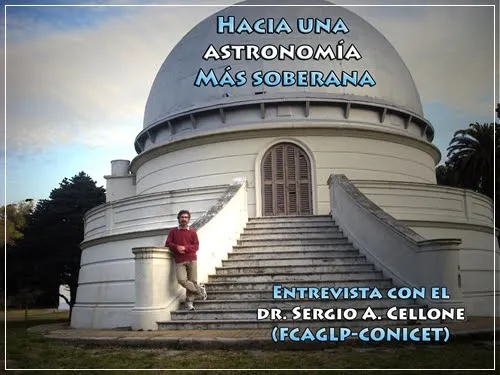
- Photo of Sergio A. Cellone in front of the Niëmela Telescope at the FCAGLP.
- Fig. 1 to 3: Credit:Cellone, Romero, Combi, AJ, 2000. Copyright: American Astronomical Society.
- Fig. 4: Gemini South, Cerro Pachón, Chile. Credit: Gemini Observatory.