A collection of links to music, images and videos relating art and science. Today: A decade ago: X-rays in the Galaxy; Mars: 3D Dunes. This week: A cosmic exclamation; The Necklace Nebula. Music: Quantum Sound from Mar del Plata. Video: Are we alone in the Universe?

Images of the decade
X-rays in the Galaxy
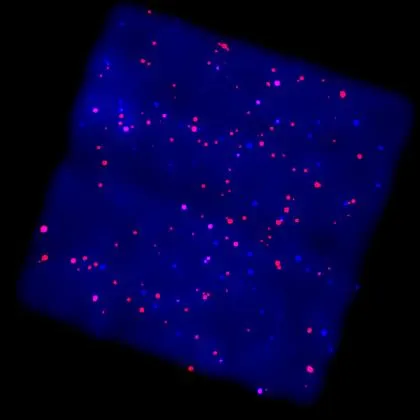
Through layers of gas and dust extending over more than 30,000 light-years, astronomers, using the Chandra X-ray Observatory, took a long and deep look at the plane of the Milky Way and found that its X-ray glow comes from hot and diffuse gas.
The observation was the deepest in those wavelengths of the so-called "zone of avoidance," a region of space behind which no optical observations were made due to the thick gas and dust in the galaxy's spiral arms.
The observation was made in February 2000 and took 28 hours. The team discovered 36 bright and distant galaxies hiding there.
Most of the red and reddish dots in the image are active stars in our galaxy. The blue objects are those emitting more energetic rays and are distant galaxies.
The image was made public on August 9, 2001. It was also the Astronomy Picture of the Day on August 14 and on Observatorio.
Credit: NASA/GSFC/K.Ebisawa et al.
Mars: 3D Dunes
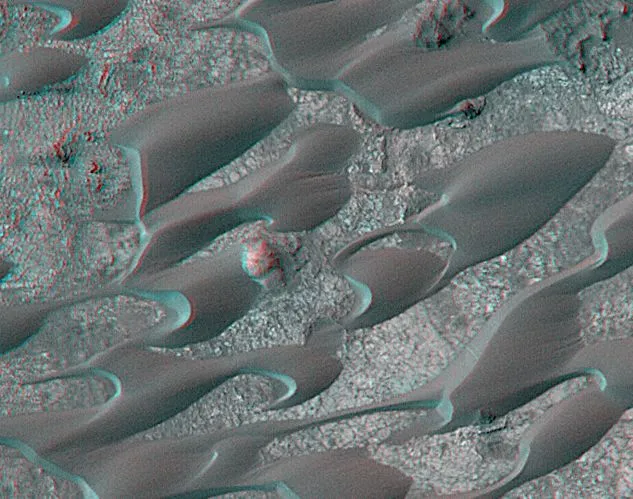
Take your anaglyph glasses and enjoy this dramatic "three-dimensional" view of the dunes of Mars. The scene corresponds to the volcanic depression called Nili Patera, in Syrtis Major, the "black spot" of the Red Planet. With two different images from the Mars Global Surveyor spacecraft combined, this stereo image was made. One was taken in March 1999 and the other in April 2001. Sculpted like sand dunes on Earth, these particular Martian dunes show no changes in shape over the time separating the images, a period equivalent to one Martian year. This shortened version of the 3D image extends and covers an area of about 2 kilometers in diameter. Walking would take 20 minutes to cross it.
It was the Astronomy Picture of the Day on August 15, 2001. Also on Observatorio.
Credits: MSSS, JPL, NASA
Images of the week
A cosmic exclamation
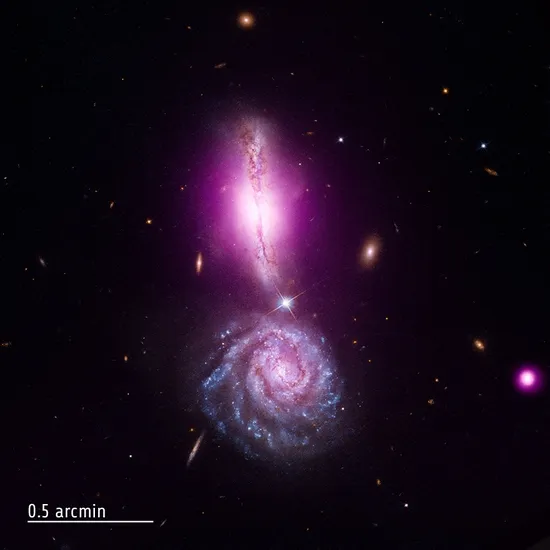
VV 340, or Arp 302, is a classic example of colliding galaxies in the early stages of interaction. The edge-on galaxy, above, is VV 340 North, and the other, below, is VV 340 South. The image combines X-ray data from Chandra in purple, optical data from Hubble in red, blue and green. VV 340 is located 450 million light-years from Earth. The image above is in X-rays. The one below, in optical wavelengths.
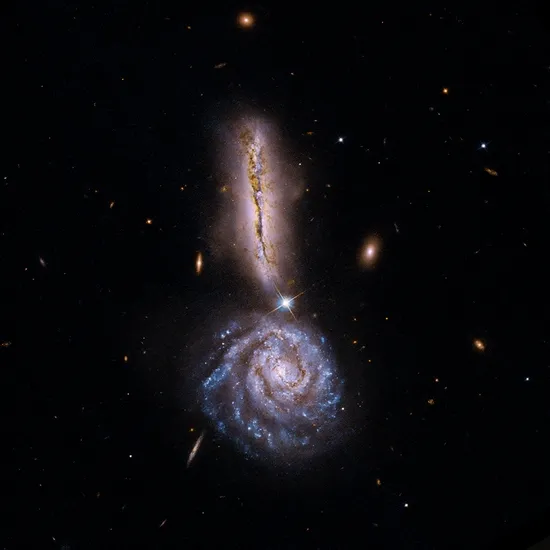
Due to its bright infrared light, VV340 is classified as a LIRG (Luminous Infrared Galaxy). The observations are part of the survey called GOALS which combines data from Chandra, Hubble, Spitzer, GALEX and ground-based telescopes.
The image was published on August 11, 2011 by Chandra.
Credits: X-ray NASA/CXC/IfA/D.Sanders et al; Optical NASA/STScI/NRAO/A.Evans et al
The Necklace Nebula
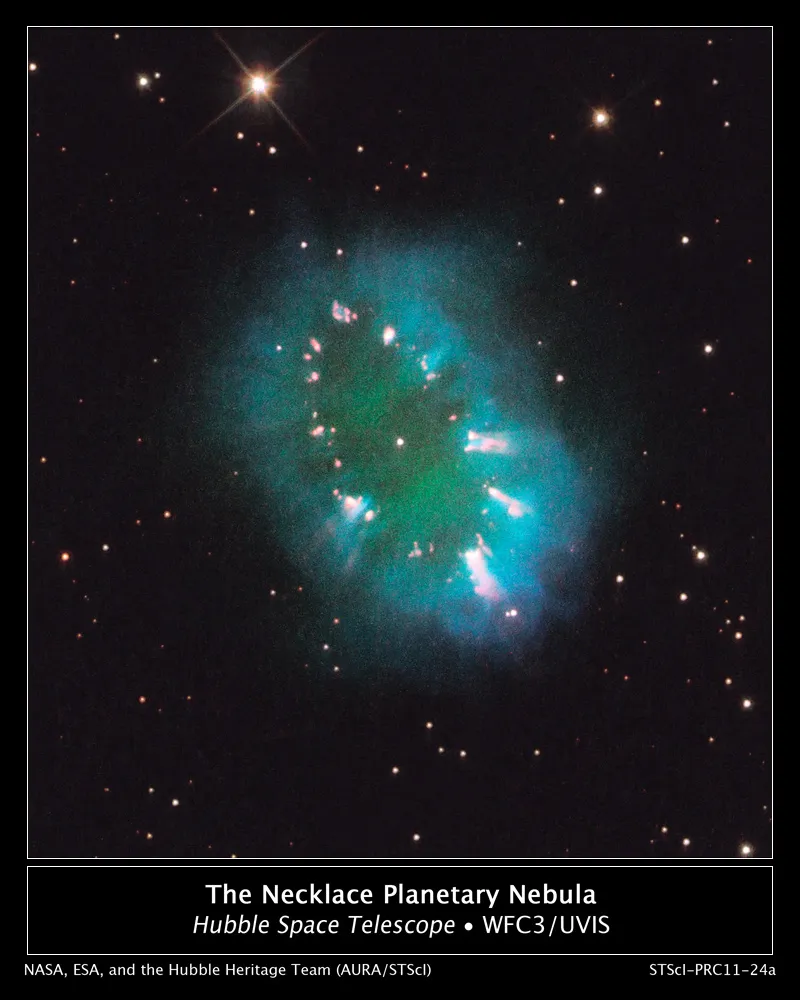
A giant necklace shines in the cosmos, in this Hubble image. The object is a recently discovered planetary nebula, the remnant of a star like our Sun. The nebula consists of a bright ring, measuring 19 trillion (19x1012) kilometers in diameter, with "knots" of gas that make it look like a necklace. The knots glow from absorbing ultraviolet light from the central stars.
The nebula is located 15,000 light-years from Earth, in Sagitta. The composition was taken on July 2, 2011 and published by HubbleSite on August 11, 2011.
Credits: NASA, ESA, and the Hubble Heritage Team (STScI/AURA).
Space Music
Quantum Sound from Mar del Plata
Pablo Javier Piacente was born in La Plata, Argentina, on August 7, 1977. He currently resides in the city of Mar del Plata, Argentina. He is a poet, journalist, musician and cultural manager. He graduated as a Journalist in 2000 (IERES, Mar del Plata, Argentina) and as a University Technician in Cultural Management in 2005 (Universidad Nacional de Mar del Plata, Argentina). He created and currently directs the consulting-producer Puente Prensa and the netlabel Sonido Cuántico.
He has published the independent poetry collections “Laberinto de quimeras” (1994) and “Realidad de espejos enfrentados” (2006), in addition to participating in different anthologies and winning awards in various literary contests, both in Argentina and Spain.
In addition to his dynamic professional activity as a journalist and cultural manager, which he carries out independently for media and organizations in several Spanish-speaking countries, and his literary activity, he has self-published the musical productions “Evasión” (1997), "Cenizas" (1998), “Ostranemia” (1999), "Equinoccio en Pompeya" (2000), “Anamnesis 1” (2009), “Anamnesis 2” (2009), “La hora de color violeta” (2010) and "Baladas para un exoplaneta" (2011), together with the Argentine musician and writer Mauro De Angelis, and “El pulso del universo” (2009) and "Magia circular" (2010), as a soloist and with the collaboration of Constanza Alfaro.
Sonic poetry and experimental song, made with electronic means, are the main streams developed in these creations.
He is currently working on new literary and musical productions, to be released soon.
Two of Piacente's productions are, in some way, related to space:
Baladas para un exoplaneta (2011) Piacente & De Angelis
La hora de color violeta (2010) - Piacente & De Angelis
Pablo Piacente - El pulso del universo (2009)
Conceptually speaking, «El pulso del universo» attempts to be a reflection (through the weapons of music and literature) on the human condition and the course our civilization has taken in this era we live in. The question is: are we living in harmony with our deepest dreams? Are we fulfilling ourselves as people or are we just following a crazy wheel of competition and materialism? Do we live according to our cosmic nature, in tune with the universe?
These and other productions can be downloaded for free from the websites of Piacente and Sonido Cuántico. It is also possible to donate some amount, if we like the music and his project seems interesting to us.
Latest tracks by sonido.cuantico
Piacente's productions can be accessed from:
Espejos enfrentados: http://pablopiacente.blogspot.com/
Sonido cuántico: http://sonidocuantico.blogspot.com/
Soundcloud: http://soundcloud.com/pablopiacente
Interview on Rock and Pop (on Youtube) and its second part, in which he tells his origin, the Sonido cuántico netlabel and projects.
Downloads are made through compressed files containing the tracks, an information file, front and back cover images, and the poetry of each song. Interestingly, the last track of "La hora..." (Sonido cuántico) and the last track of "El pulso..." (Triste mortal en lo infinito) contain the same lyrics (although the songs differ in length):
Point in all points
Light flowing from all things
Magnetic moon that draws us to the center
Green sky within your eyes.
Concentric circle after concentric circle
Black hole that consumes time
Energy traveling toward nothingness to be reborn in your body
Infinite like mathematics progression of days
Endless like the becoming of life that revives microscopic in the depths of red oceans.
At the same time, death carries out its daily ceremony, of antediluvian birds that travel through secret mud caverns.
But there, invisible and potentially perfect, is life swimming in a dead memory, making a moment that is all moments perennial, in the electrical impulses of a neuron that populates your tormented brain of sad mortal.
Science in motion
Are we alone in the Universe?
Flying saucers, unidentified flying objects, UFOs, have their detractors, but also their believers. But what does science say about those unidentified space phenomena? Is there extraterrestrial life? These are the topics in this Euronews space report.
To access previous editions of this section, consult the Multimedia Selection Series.