New videos made by combining images from the Hubble Space Telescope provide new details about the process of new star formation, showing in great detail Herbig-Haro objects formed by young stars.
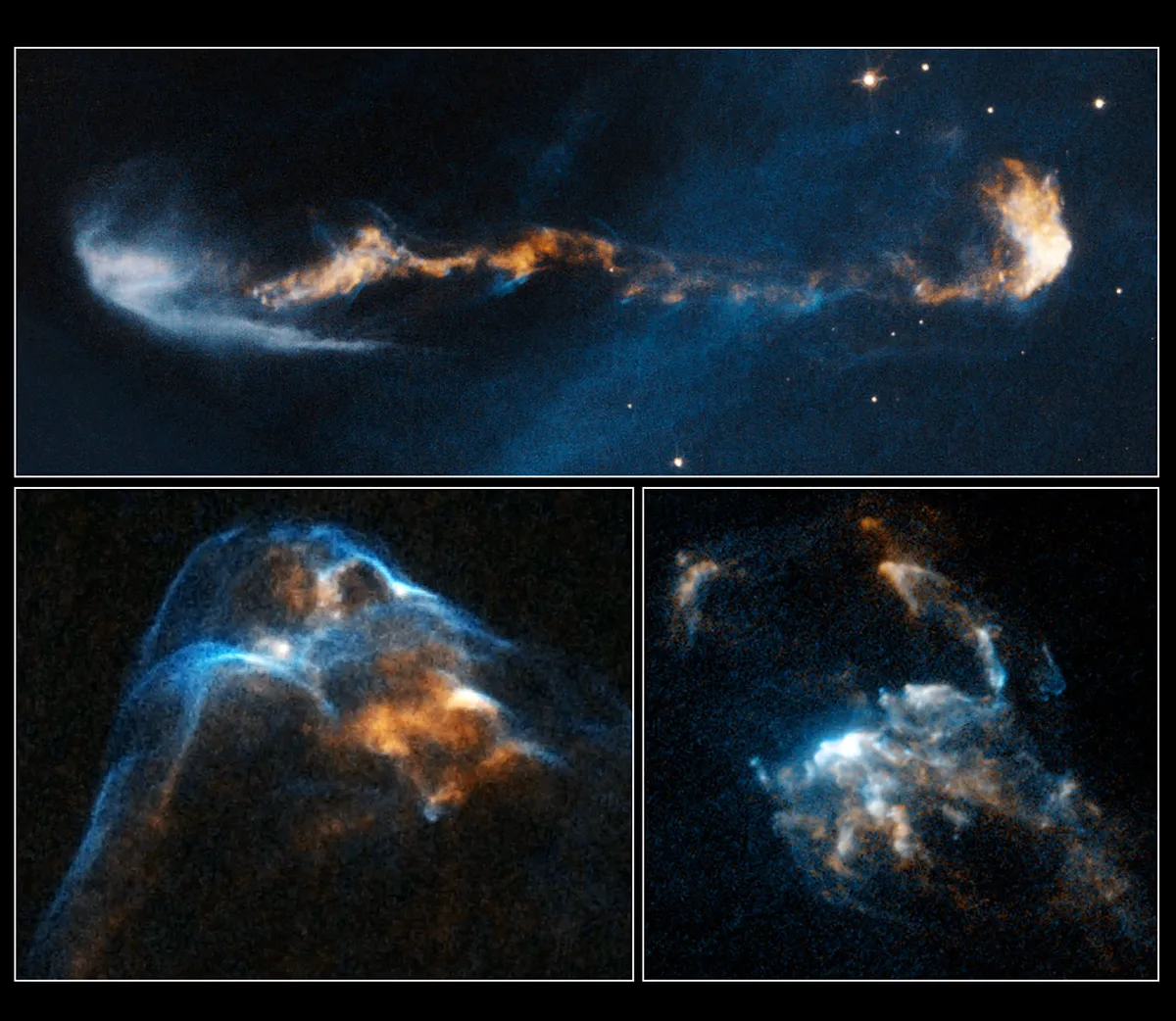
The jets of gas or jets are a byproduct of the accretion of gas around stars that are forming and that eject that gas at supersonic speeds of 100 miles per second in opposite directions through space.
The phenomenon provides new clues about the final stages of star formation, allowing us to spy on how our Sun would have formed.
Over time, Hubble's sharp vision allowed the collection of high-resolution images over 14 years that were combined to form videos.
"For the first time we can observe how these jets interact with their surroundings by watching these movies," said astronomer Patrick Hartigan of Rice University, leader of the team that collected the images.
"Those interactions tell us how young stars influence the environments in which they form. With videos like these we can now compare jet observations with those produced by computer simulations and laboratory experiments to see which aspects are understood and which are not," explained the researcher.
These jets are part of an active but short phase of star formation, lasting about 100,000 years. Astronomers do not know precisely what role they play in the process or how the star releases them exactly. They seem to work in concert with magnetic fields. Stars form from a cloud of hydrogen and as the star grows it attracts more material, creating a large disk of gas and dust around it. Material from the disk gradually spirals toward the star and escapes as high-speed jets along the star's rotation axis. These gas jets could, initially, be confined to narrow beams by the star's powerful magnetic field.
The new videos reveal the motion of the fast jets with details such as knots of gas that glow and become diffuse and collisions between material at different speeds, creating arrow-shaped structures.
With Hubble's WFPC 2 camera, researchers studied a pair of jets (HH1-HH2 and HH46-HH47) emanating in opposite directions from a single star. In addition, it studied another jet (HH34). The monitoring was during three epochs: the first pair in 1994, 1997, and 2007. The second in 1994, 1999, and 2008. And the solitary jet in 1994, 1998, and 2007.
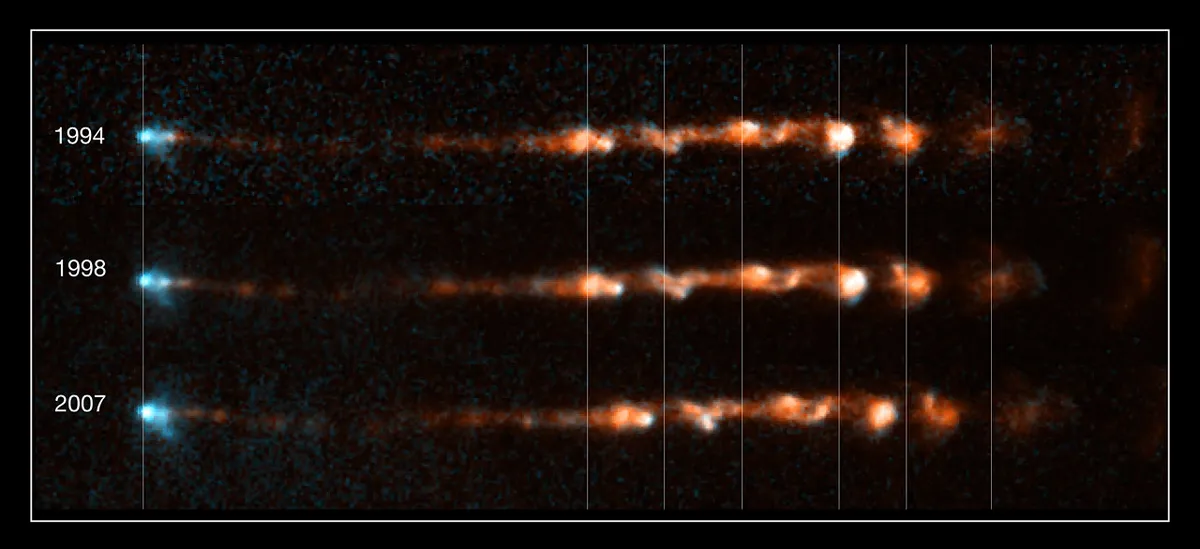
These jets have a size almost ten times greater than the diameter of the Solar System and have speeds greater than 700,000 km per hour.
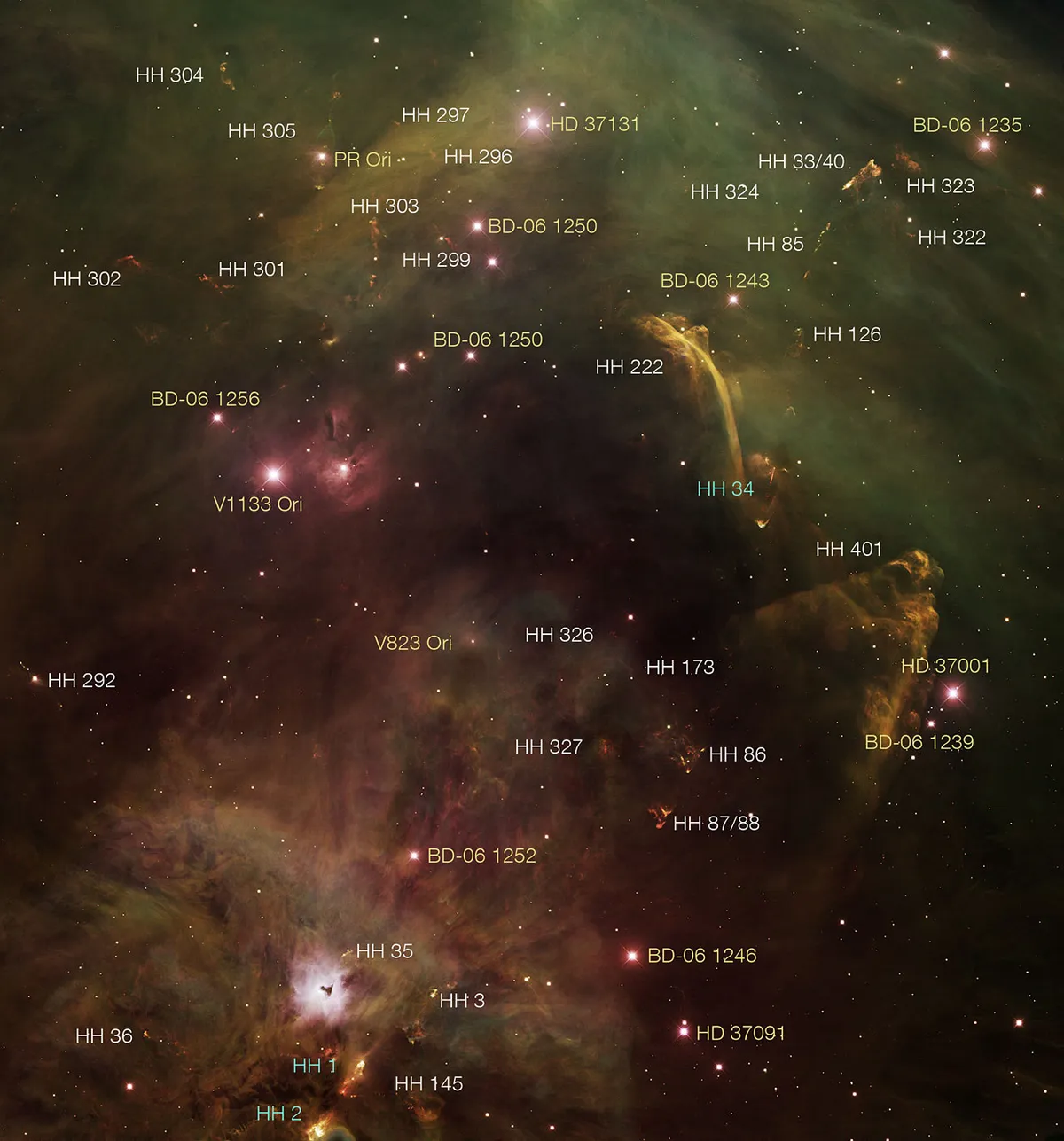
All these jets are almost 1,350 light-years from Earth. HH 34, HH 1 and HH2 reside near the Orion Nebula, while the other two are in the constellation Vela.
These HH objects are also known as Herbig-Haro objects, in honor of astronomers George Herbig and Guillermo Haro (from Mexico) who studied them in the 1950s.
The videos show that the gas in the jets moves at different speeds. When two of these nebulosities collide, bow shocks arise as the material heats up. These arcs are bright waves of material similar to the waves produced by the bow of a ship cutting through water.
The details revealed by Hubble were so complex that Hartigan consulted fluid dynamics experts at Los Alamos Laboratory in New Mexico and other entities, as well as specialists at the University of Rochester. Motivated by the results, the team is now conducting experiments at the Omega Laser Laboratory in New York to understand how these jets interact with the environment.
Video: HH Objects Hubble
http://www.youtube.com/watch?v=II9vNLOfUz4
"The fluid dynamics experts noticed an aspect of the physics that astronomers normally overlook and that led to different interpretations for some features of what we are seeing. The scientists from each discipline brought their own unique perspectives to the project and having that range of expertise has been invaluable for learning about this critical phase of stellar evolution," narrated the astronomer.
The work of Hartigan's team appears in the July 20 edition of The Astrophysical Journal.
Below, a report by Mary Estacion (STScI) in which the astronomers tell what the videos are about and what else they are doing to understand this important phase of star formation.
Video: HH Hubble Report
http://www.youtube.com/watch?v=jrjhuXvtXUs
Sources and related links
- HubbleSite: Hubble Movies Provide Unprecedented View of Supersonic Jets from Young Stars
- SpaceTelescope: Hubble Movies Provide Unprecedented View of Supersonic Jets from Young Stars
- Fluid Dynamics Of Stellar Jets In Real Time: Third Epoch Hubble Space Telescope Images Of Hh 1, Hh 34, And Hh 47
P. Hartigan et al. 2011 ApJ 736 29 DOI: 10.1088/0004-637X/736/1/29 - Herbig-Haro Jet Movies from HST
About the images
- Fig.1: Images of HH 47 (top) and HH 34 and HH 2 (bottom). Credit: NASA, ESA, and P. Hartigan (Rice University)
- Fig.2: NASA, ESA, and P. Hartigan (Rice University)
- Fig.3: Z. Levay (STScI), T.A. Rector (University of Alaska Anchorage), and H. Schweiker (NOAO/AURA/NSF)