The Hubble Space Telescope shows us how a young star alters its original hydrogen cloud as it advances toward the main sequence.
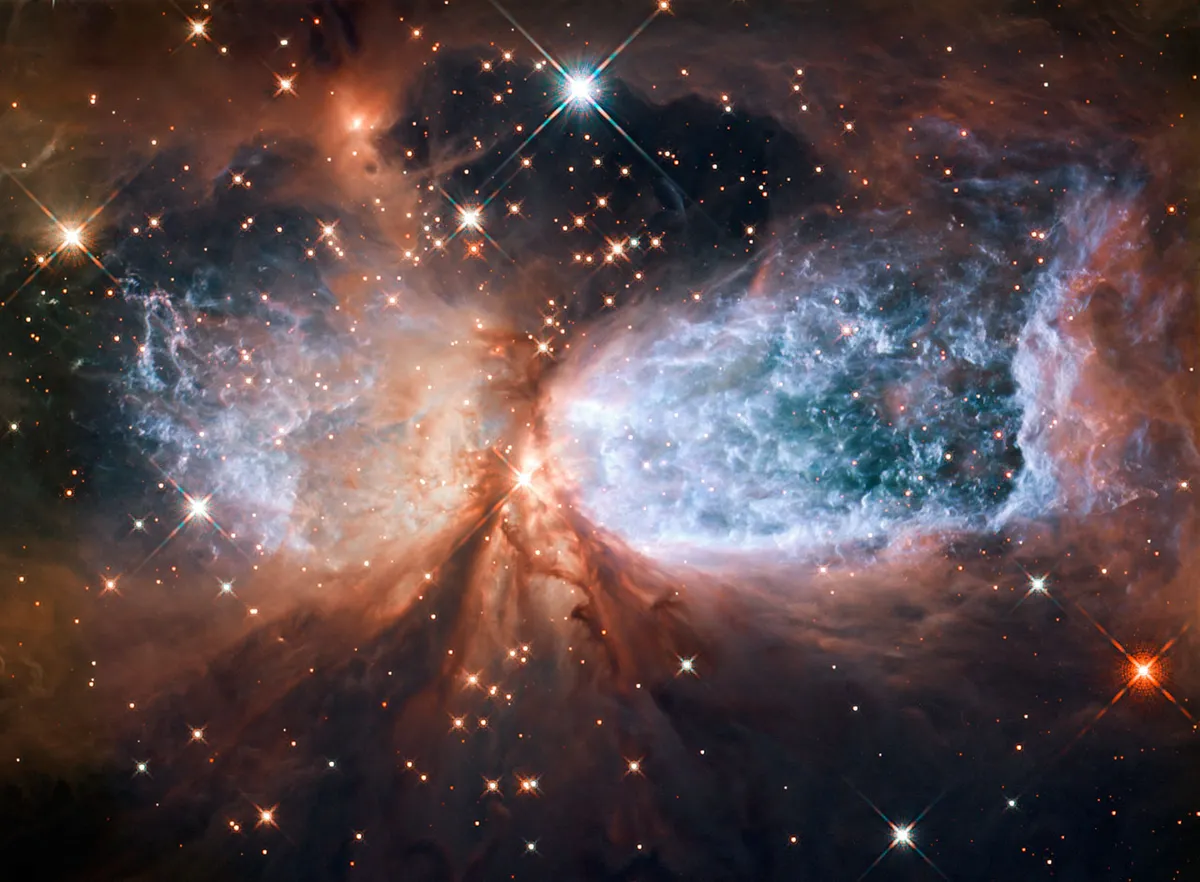
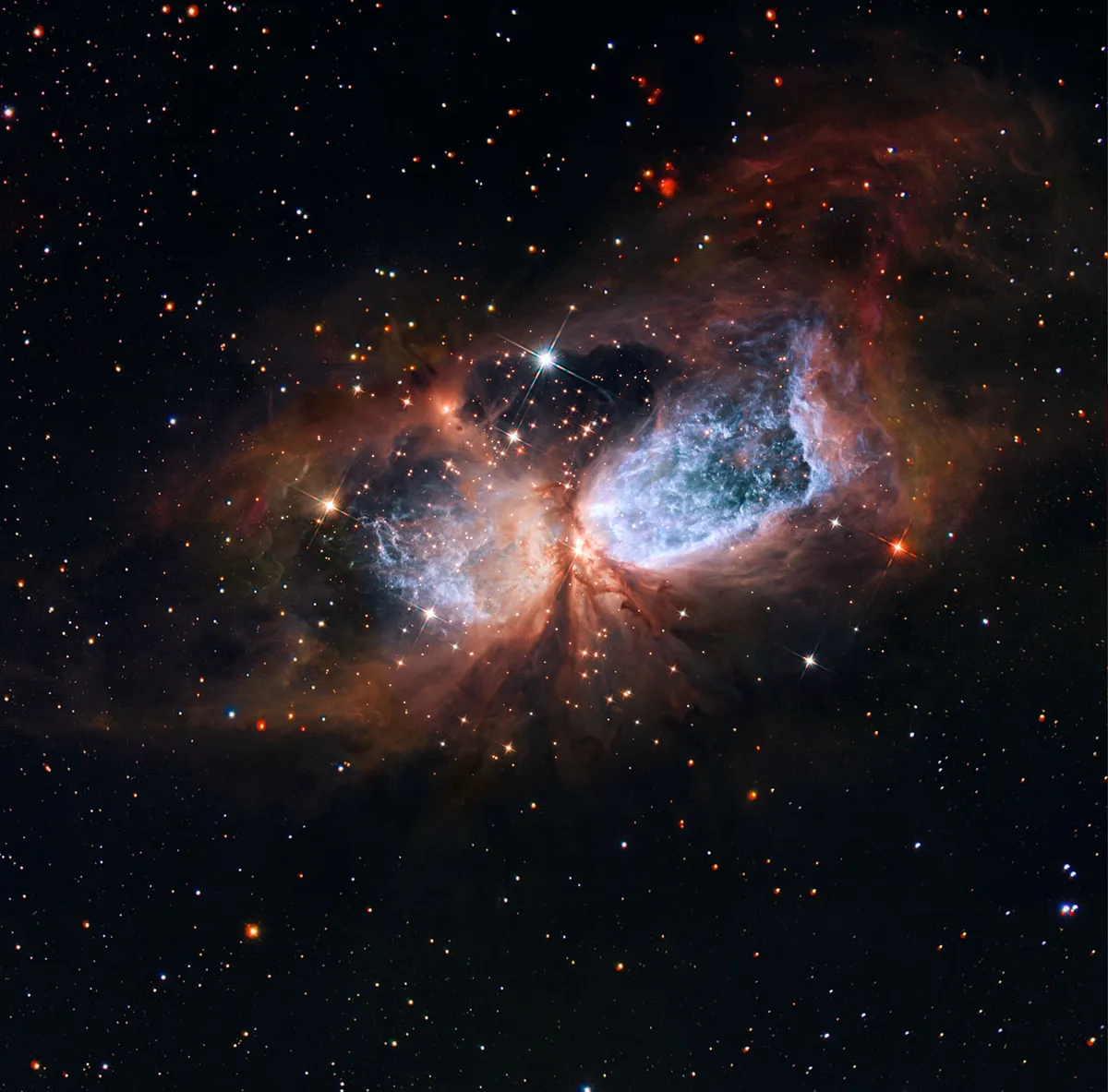
A Hubble camera captured this image of a gigantic hydrogen cloud illuminated by a bright, young star. Despite the "celestial" colors of the image, there is nothing tranquil about this star-forming region known as Sh 2-106 or S106. The star S106 IR lies here and ejects material at very high speed, which alters the gas and dust around it. The star has a mass about 15 times that of our Sun and is in its final stages of formation. It will soon quiet down upon entering the so-called "Main Sequence," the adulthood of stellar life, where it will possess equilibrium.
For now, S106 IR remains integrated into its birth cloud, but it is rebelling against it. The ejected material not only gives the gas cloud its hourglass or butterfly shape, but also makes the hydrogen gas within it hot and turbulent. The intricate resulting patterns are clearly visible in this Hubble image.
The young stellar object also heats the surrounding gas to temperatures of 10 thousand degrees Celsius. The stellar radiation ionizes the hydrogen lobes, making them glow. The light from this bright gas is colored blue in the image.
The video presents a visualization (45 seconds) of the star-forming region known as Sh 2-106 or S106. This three-dimensional view (seen here as two-dimensional) helps us interpret that many of the objects contained in astronomical images are not at the same distance but, in fact, extend across light-years in space. The Hubble image was augmented with additional material from the Subaru Telescope. The stars and gas lobes from the Subaru image were separated using scientific knowledge and artistic license to create depth in the video. It is worth clarifying that the relative distance between stars and the nebula was highly compressed. Then another 25-second visualization of Sh 2-106 is presented.
Credit: heic1118b: NASA, ESA, and G. Bacon, T. Borders, L. Frattare, Z. Levay, and F. Summers (Viz 3D team, STScI) - heic1118e: M. Kornmesser.
http://youtu.be/guQjrTPp3n0
Separating these regions of glowing gas is a path of colder, thick dust, which appears in red in the photograph. This dark material almost completely hides the star, but the young object can still be seen by peeking through the widest part of the dust path.
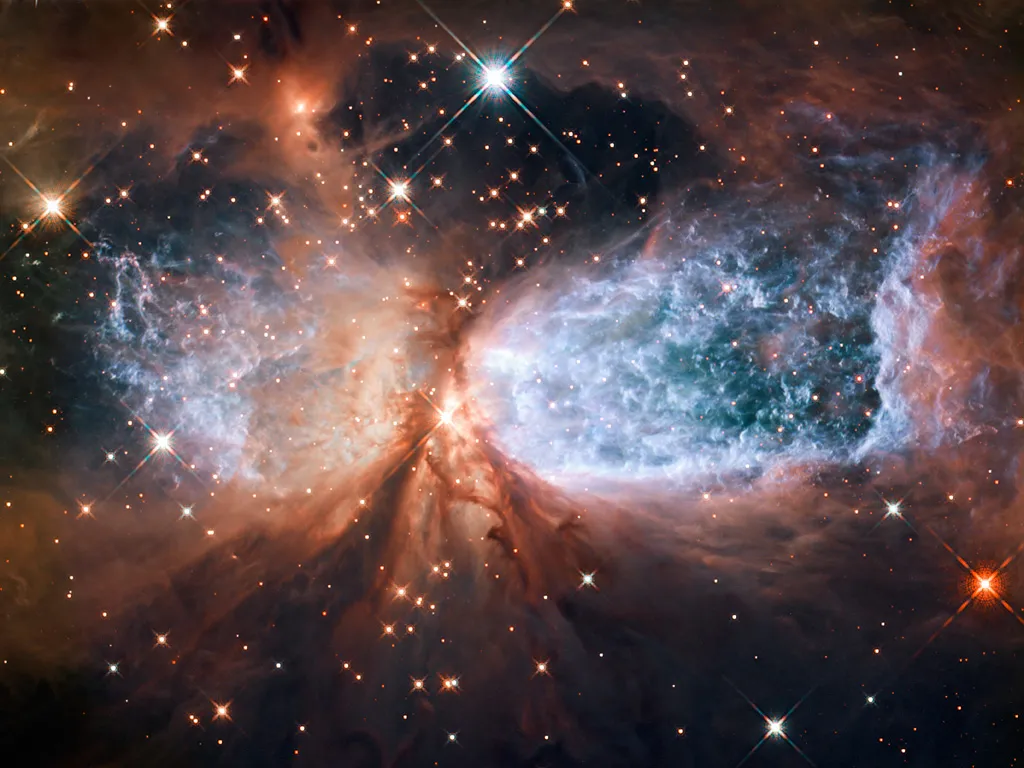
S106 was entry 106 in the catalog made by astronomer Stewart Sharpless in the 1950s (Sharpless Catalog). It is a few thousand light-years away from Earth, in the direction of the constellation Cygnus (the swan). The cloud itself is relatively small by star-forming region standards, about 2 light-years in diameter along its longest axis. This is almost half the distance between the Sun and Proxima Centauri, our closest stellar neighbor. Although some study done many years ago calculated a distance of 2,000 light-years, more recent work places the region at about 3,300 light-years away. *1.
The image composition was obtained with the Wide Field Camera 3 (WFC 3) of the NASA/ESA Hubble. It is the result of combining two images taken in infrared light and H-alpha. The H-alpha filter isolates light emitted by hydrogen in the gas clouds, while infrared light can shine through the dust that usually obscures these regions.
A photo of this same region was NASA's Astronomy Picture of the Day (APOD) on November 4, 2011.
Sources and related links
- Spacetelescope: Young star rebels against its parent cloud
- HubbleSite
- *1: New results on the massive star-forming region S106 by BEAR spectro-imagery
2005A&A...436..569N
Noel, B.; Joblin, C.; Maillard, J. P.; Paumard, T.
A&A 436, 569-584 (2005)
About the images
- Fig.1 and 2 NASA, ESA and the Hubble Heritage Team (STScI/AURA) and NAOJ.