Earth, seen from space, looks like a fragile oasis. We can explore the cosmos, build a space station among various countries—how could we not, all together, make this world a better one?

When we access a website, we might enter another world, as if jumping from Earth to Mars. Perhaps we come into contact with another point of view, as if observing the planet from 36,000 km high. And maybe we gain energy by colliding with some data that illuminates us.
Thus arises Orbital Jump which after such a presentation is nothing more than a link recommendation.
In June 2008, Ron Garan flew aboard Discovery to the International Space Station. He performed three spacewalks during the two-week mission.
There he became aware of the fabulous human achievement that this structure in space constitutes, but also of how beautiful our world is. And how fragile it is, seeing it from there, in the lonely blackness of the cosmos.
Thinking, at the same time, about people without drinking water, without enough food. About situations of social injustice and poverty that exist in the world is, without a doubt, moving.
"Each of us has the responsibility to leave this planet a little better than we found it," says Garan, a NASA astronaut, creator of the site in question, which has the support of the U.S. agency as "an investment in the future. We want space to inspire creating a positive impact here on Earth. Let's see what we can do," the organization states at the bottom of the page.
Fragile Oasis is a web 2.0 site where it is possible to "follow" its members and aims to spread projects of various kinds, linked to energy, water, communication, food, health, research, education.
The members, people from anywhere in the world who can register easily, can vote on the different listed projects. Only one vote per day is allowed. Just as it is possible to follow members, the same can be done with projects. Each one has a description and a link to the corresponding website.
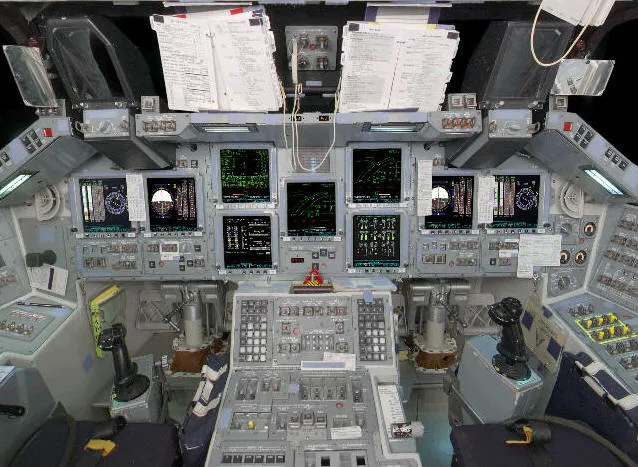
There are several interesting projects and only a few are related to space exploration, like the Space Shuttle Guide, whose idea is to document every light, every knob and button of the shuttles Enterprise, Atlantis, Columbia, Discovery, Endeavor, and Challenger so that the information is not lost. So here is a double orbital jump: let's first jump to this highly recommended site for its photos, but which in the future may contribute much more. At www.spaceshuttleguide.com, sit in front of a space shuttle without getting dizzy from so many knobs!!
On the site, besides Garan, other astronauts participate, such as Nicole Scott, Don Petit, Doug Wheelock, and cosmonaut Dmitry Kondratiev.
What do the astronauts talk about there?
In Garan's case, he shows videos of Earth from space, or photos like the one he took of the Moon over Afghanistan, he created a music playlist with suggestions from the public and took a photograph of the sunrise after the audience voted. Thus, on August 27, he took this photo of the sunrise while the ISS passed over Buenos Aires and Rio de Janeiro.
Finally, it must be noted that the site will award medals for contributions in Education, Humanitarian Service, and Peace, which will be announced next month.
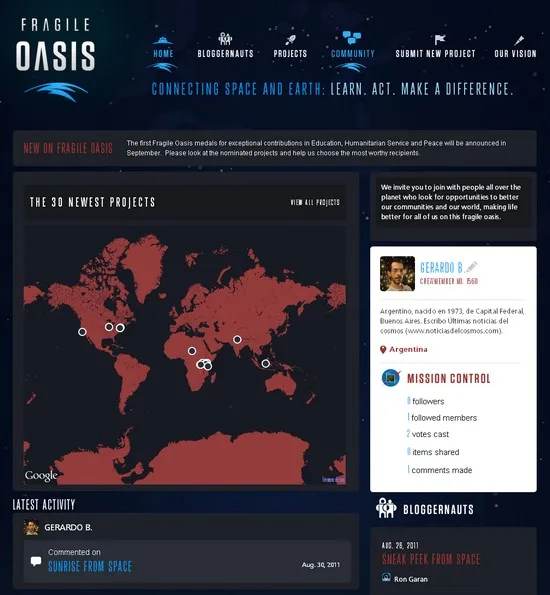
Fragile Oasis is written entirely in English. But perhaps soon it will have the possibility for each page to be easily translated into any language.
Another thing that could benefit the site is for members to be able to make suggestions on a special page for that. Although it is possible to create Projects from the site, perhaps users only have small ideas that, over time, might become a project or just be contributions to improve the site. Meanwhile, members can, however, leave comments on the posts of the blogernauts.
All that remains is to jump to the orbit of FragileOasis: fragileoasis.org/