Using its infrared vision to spy nine billion years back in time, the NASA/ESA Hubble Space Telescope discovered an extraordinary population of small, young galaxies brimming with star formation. A Spanish astrophysicist participated in the research.
The star formation rate in these galaxies is such that they would double their number in just ten million years. In comparison, the Milky Way required thousands of times more time to double its stellar population.
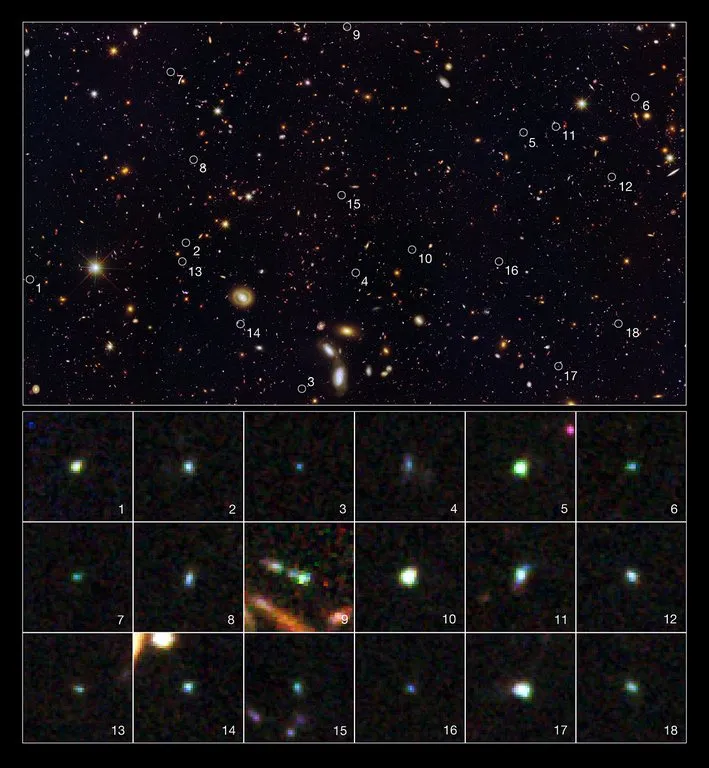
These recently discovered dwarf galaxies are a hundred times smaller than our Milky Way. (Between 108 and 109 Solar Masses). Their star formation rate is extremely high, even for the young Universe, when most galaxies were forming stars at higher rates than today. They were detected in Hubble images by the radiation from the young, hot stars which caused the oxygen in the gas surrounding them to light up like a fluorescent signal.
This type of galaxy is also called EELGs (Extreme Emission Line Galaxies) and they have a cosmological redshift of z=1.6-1.8.
Astronomers think this star birth rate represents an important phase in the formation of dwarf galaxies, the most common in the cosmos.
"The galaxies have been there all this time, but only recently have astronomers been able to probe small regions of the sky with the necessary sensitivities to detect them," said Arjen van der Wel of the Max Planck Institute for Astronomy in Heidelberg, Germany, lead author of a paper to appear in Astrophysical Journal. "We weren't specifically looking for these galaxies, but they stood out because of their unusual colors," he added.
Close-up of dwarf galaxies in the GOODS field
http://www.youtube.com/watch?v=aO-T9QbWQ9E
The observations were part of the Cosmic Assembly Near-infrared Deep Extragalactic Legacy Survey (CANDELS). The acronym refers to a study of the deep cosmos in the near-infrared and was surely specially thought out to match the word "Candles" (Candels, in English). It is an ambitious three-year survey to analyze the most distant galaxies, the first census of dwarf galaxies in such an early epoch of the universe's history. One of the members of the CANDELS team is Adam Riess, recently awarded the Nobel Prize in Physics, along with Brian Schmidt and Saul Perlmutter.
"In addition to the images, Hubble captured spectra from a set of these galaxies that show us the detailed physics of what is happening inside them and confirm the nature of their extreme star formation," said co-author Amber Straughn of NASA's Goddard Space Flight Center.
The observations of these ancient galaxies are somewhat at odds with recent detailed studies of dwarf galaxies that are currently orbiting the Milky Way.
Dwarf galaxies in the UDS field
http://www.youtube.com/watch?v=SbF5j7yxLJ0
"Those studies suggest that star formation was a relatively slow process, stretching out over billions of years," explains Harry Ferguson of the Space Telescope Science Institute (STScI), one of the principal investigators of the CANDELS survey. "CANDELS' finding of similarly sized galaxies forming stars at very rapid rates at such early times is forcing a re-examination of what we think about the evolution of dwarf galaxies."
Anton Koekemoer, also of STScI, adds: "As our observations continue, we should find many more of these young galaxies and gather more details about their star formation history."
The CANDELS survey discovered 69 young dwarf galaxies in infrared images taken by Hubble's WFC3 camera and ACS. The observations focused on two regions of the sky: the Great Observatories Origins Deep Survey-South (GOODS) and the UKIDSS Ultra Deep Survey, efforts to observe portions of the deep sky at different wavelengths.
The observations suggest that the discovered galaxies were very common 9 billion years ago. But it is a mystery why their star formation rate is so high. Computer simulations show that star formation in small galaxies would be episodic: the gas cools and collapses to form stars. The stars heat the gas, for example through supernova events. After a while the gas cools and collapses again, restarting the cycle.
If, despite budget cuts in the United States, the construction of the James Webb Telescope, an infrared "successor" observatory to Hubble, is completed, researchers will be able to investigate these faint galaxies even further in the past to see the glow of the first generations of stars, providing detailed information on the chemical composition of the galaxies.
A Spaniard among the researchers
The article accepted by ApJ, linked on arXiv below, includes a certain G.B.Calvo. My intuition made me think that such a surname could be Ibero-American. And I was not mistaken. Guillermo Barro Calvo, a graduate of the Complutense University of Madrid and currently at the University of California Santa Cruz, participated in this study. At 20:00 h Argentina time (15:00 in California) I contacted the researcher by telephone, who attended me and granted me an interview that I publish next in “Astrophysicists are the modern librarians of the cosmos”.
.
Sources and related links
- Extreme Emission Line Galaxies in CANDELS: Broad-Band Selected, Star-Bursting Dwarf Galaxies at z>1
A. van der Wel et al (2011)
arXiv:1107.5256v1 [astro-ph.CO] - Hubble Uncovers Tiny Galaxies Bursting with Starbirth in Early Universe: http://www.spacetelescope.org/news/heic1117/, last accessed: 10-11-2011.
HubbleSite
About the images
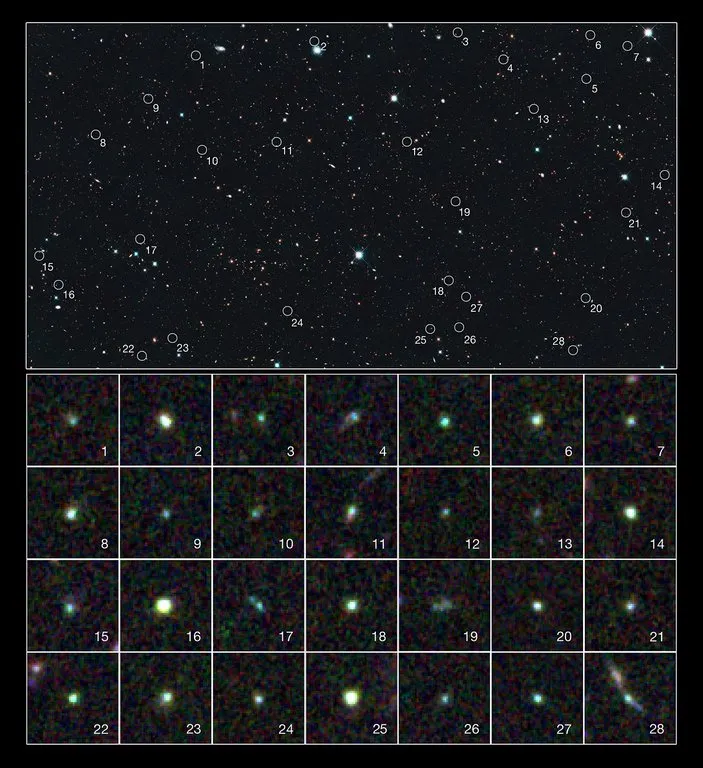
- Fig.1: Initial image: This image reveals 18 small galaxies discovered by Hubble, which existed 9 billion years ago and had high star formation. The individual images were taken between November 2010 and January 2011. The larger top image shows the location of the galaxies.
Credit: NASA, ESA, A. van der Wel (Max Planck Institute for Astronomy), H. Ferguson and A. Koekemoer (Space Telescope Science Institute), and the CANDELS team - Fig.2. 28 galaxies from the study. Credit: NASA, ESA, A. van der Wel (Max Planck Institute for Astronomy), H. Ferguson and A. Koekemoer (Space Telescope Science Institute), and the CANDELS team.