Who have been our most ancient ancestors and what differences did they have with us? In search of our roots.
When we access a website, we might delve into another world, as if jumping from Earth to Mars. Perhaps we make contact with another point of view, as if observing the planet from 36,000 km high. And maybe we gain energy by colliding with some data that illuminates us.
Thus arises Salto de órbita which, after such an introduction, is nothing more than a link recommendation.
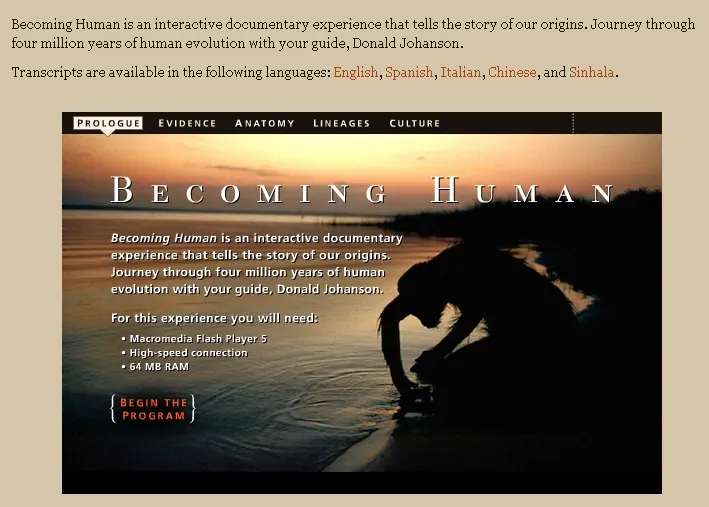
The page in question is from the Institute of Human Origins (IHO) at the University of Arizona. The organization was founded in 1981 by Donald Johanson. The site BecomingHuman.org was created by IHO in the year 2000 and a major update took place in 2009 to adapt a bit more to new technologies.
On BecomingHuman.org we can find:
An interactive documentary, an also interactive timeline, a learning center, news, and resources.
Let's review the features:
The interactive documentary, in Flash, is in English, but it is possible to download the Spanish translation. We can also download the documentary, in an executable file format. The documentary has five parts -each with three episodes-, in each of which extra related content is proposed (in Related exhibits). It is also possible to access hominid profiles from the bottom bar of the documentary, with general information, anatomy, and key sites. In some cases (from Australopithecus afarensis onwards), to the right of an image, the legend 360º Skull rotation will appear, allowing you to rotate the skulls with the mouse.
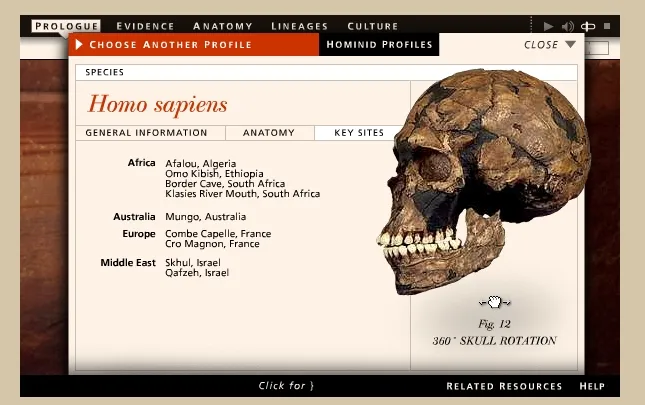
The interactive timeline allows you to learn about ancestors from six/seven million years ago, from Sahelanthropus tchadensis to Homo sapiens. In each case, it is possible to know where the fossils were found and what their characteristics were.
In the learning center we have classroom materials, as well as games and activities.
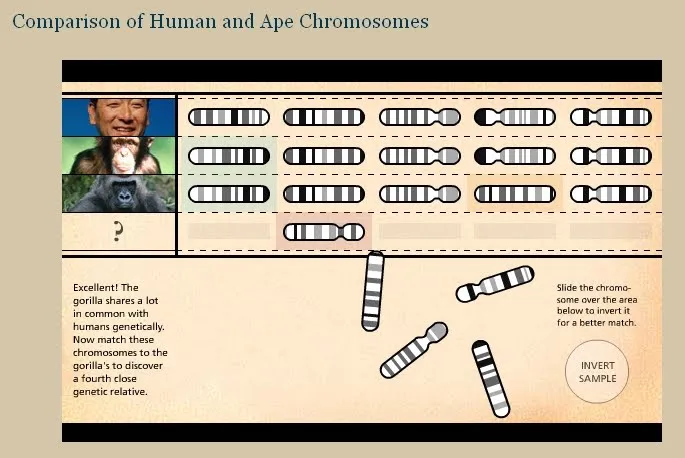
For example, it is possible to do an interactive activity where you need to arrange chromosomes, with the idea of visualizing the incredible similarity between apes and humans.
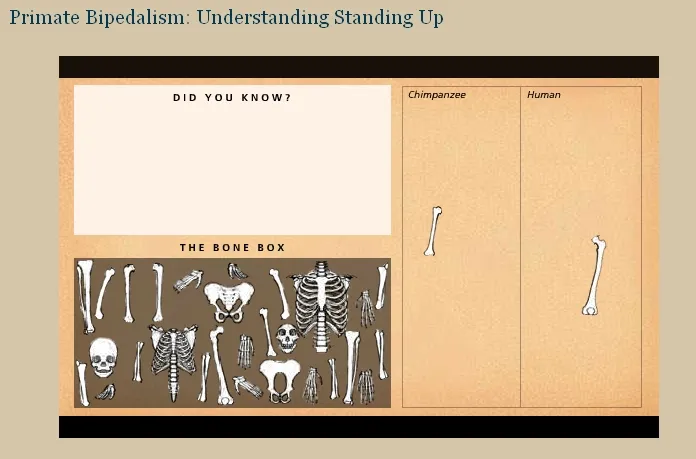
In Building Bodies we will have monkey and human bones mixed up and we must assemble the corresponding skeletons.
In the resources we can access book reviews, a glossary, and resources by topic.
Before jumping, I suggest you watch and listen to the latest production from Symphony of Science, with Spanish translation:
Video: Symphony of Science: Children of Africa - The Story of Us
http://youtu.be/irZEjmKGMFw
Now, let's travel the journey of human evolution on BecomingHuman.org.