Lost in the galactic center? Despite the gas and dust, astronomers were able to make a map of the center of the Milky Way, using data from Herschel.
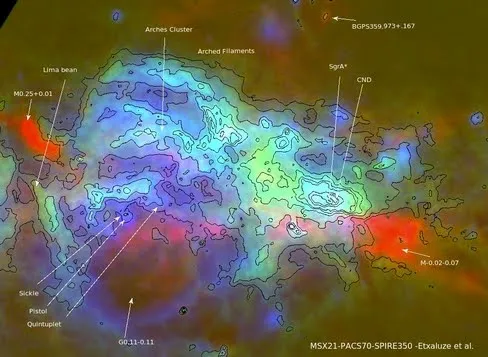
The center of our galaxy is located 27,000 light-years away, in the direction of Sagittarius. At the center lies a black hole of about four million solar masses (Sgr A*). And around it there is a donut-shaped structure about eight light-years in diameter that surrounds the inner volume of neutral gas and stars. It is called the circumnuclear disk (CND). A dense molecular zone spanning up to 700 light-years surrounds all of this, with star clusters, giant molecular clouds and other less-known regions.
There is a lot of dust that obscures the area between us and that region. But it is possible to know what is there thanks to infrared wavelengths.
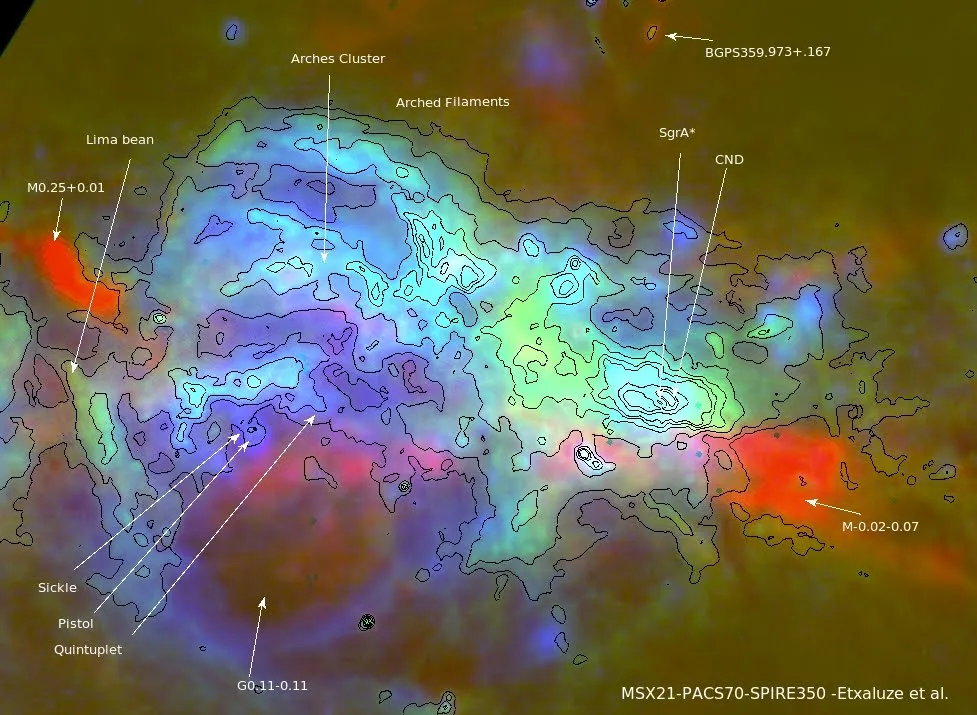
Astronomers from the CfA, Mireya Extaluze (University of La Laguna, Tenerife), Howard Smith, Volker Tolls, Tony Stark, and Eduardo González-Alfonso (University of Alcalá) used archival data from Herschel of the region to publish the first complete far-infrared image of the interior of the galaxy. These images reveal star clusters, and clumps of material, most of them previously known from radio observations, but now all seen in the emission of light from the dust they contain. The astronomers modeled the dust emission and found that previous observations had been unable to detect a cold but massive component of gas and dust whose temperature is only 23 degrees above absolute zero. The team also found that the emission varies across the region and that the total radiation output of the inner zone is two million solar luminosities. These results mark the beginning of a detailed analysis of the various dusty structures found near the galactic nucleus.
As they point out in an article, they used data from Herschel's PACS and SPIRE and supplemented it with unpublished observations from the Infrared Space Observatory Long Wavelength Spectrometer (ISO LWS) and the Midcourse Space Experiment (MSX).
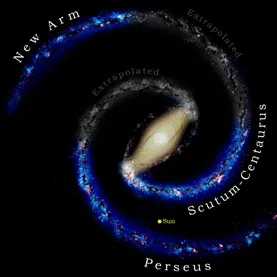
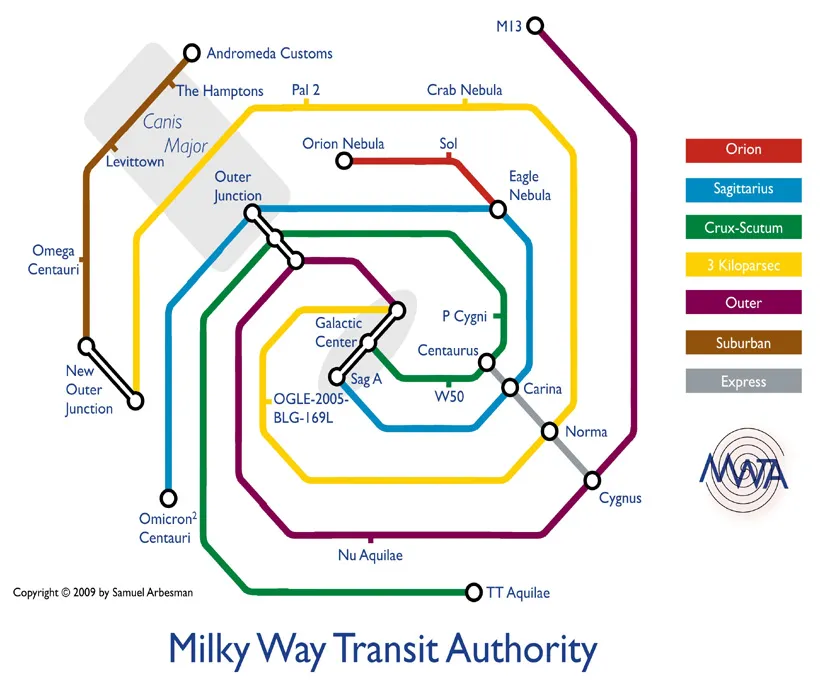
If we ever go there and get lost in the gaseous galactic labyrinths, we can consult this map of the infrared radiation from the gas and dust of the Galaxy or consult the Milky Way Transit Authority (Milky Way Transit Authority) to find out how to get back home. Just in case, let's leave a trail of thread...
Sources and related links
- The Galactic Centre in the Far Infrared
M. Etxaluze, H. A. Smith, V. Tolls, A. A. Stark, E. Gonzalez-Alfonso
arXiv:1108.0313v1 [astro-ph.GA] - CfA: The Central Region of the Milky Way
About the images
- Fig.1: Credit: NASA; ESA and M. Etxaluze
- Fig. 2: Samuel Arbesman.