Interview with Dr. Marina Rieznik, Doctor from UBA with a mention in History, about the creation of the Argentine observatories, but particularly the National Observatory of Córdoba.
The story goes that the Astronomical Observatory of Córdoba was inaugurated on October 24, 1871, that is, 140 years ago. If we were to trace back the course of time, what could we say about that founding, its intentions, its ways of producing content, its importance in society?
For that, I met with Dr. Marina Rieznik, who specifically dedicated herself to the historiography of 19th-century Argentine astronomy through a large number of works.
-In the past, to justify the creation of observatories, the idea of progress was appealed to.
-Yes, especially associated with the idea of disseminating and teaching the sciences.
-Was that immediate or later, the idea of associating observatories with education?
-The first arguments in congress at the end of the 19th century were linked to the issue of teaching.
-In La Plata it happened faster than in Córdoba.
-In La Plata it was more associated with the issue of the Observatory as a school, but not from the beginning either; one has to wait until 1905 when it was incorporated into the University and until 1935 when the astronomy school was established. And in Córdoba the initial plan was never realized. Nothing that was done, as a central activity, at the Observatory of Córdoba was oriented towards teaching. And yet in the speeches of Sarmiento and the others - Avellaneda and other parliamentarians - the idea was very strong that the Observatory was a school of astronomy that would teach future Argentines about this advanced science.
-Is there an idea of autonomy or sovereignty there?
-There is an idea of autonomy, but it is very associated with a knowledge that is disconnected from the materiality that this knowledge needs. Because in reality, to be autonomous, I don't just need to know what others produce as science, but I need to have the material conditions to be able to produce on the same scale as is produced in other places.
When talking about astronomy as a 'school of', this issue is being ignored.
The materiality of the work processes of science that are necessary to start thinking about autonomy.
-And this can be said if one reconstructs history and documents it. Could that be one of the objectives of doing historiography?
-To begin with, an objective can be, yes, a good diagnosis, fundamental for any type of planning.
-But the diagnosis has interpretation.
-It has interpretation as everything does, any science, from Galileo to any current observation that interprets what is seen through the telescope; there is always interpretation. Which does not mean that you can say just anything.
And in the case of history?
-In the case of history there is interpretation and you cannot say just anything.
-And what does it rely on?
-On sources. What happens is that in history, in sociology, there are people within those disciplines who assume that what they do is not science, in the sense that you can say just anything: pure essay, pure interpretation or construction. In the hard sciences it's a bit harder to find people who think you can say just anything. But I believe the activity itself is not so different in nature. Because in both cases, if done as I believe it should be done, it needs to be based on research, materials, documents, investigation of spaces, of instruments, of work processes, etc., that do not allow you to say just anything.
-But there is an important problem, I think it is intention. A photon, an atom, do not have intentions.
-You say that because you haven't read Latour.
-Bruno Latour says very interesting things, but I don't think a photon has intentions.
-We agree. But how would that modify things?
-In the why someone did this and not that. When I have to understand it, I have to try to understand the intention. How do I go about knowing a person's intention?
-You have the advantage of being a person, for starters, and not a photon. And, above all, those intentions manifest in matters that you can trace. Your actions will leave a trace.
-So one goes to the congressional speeches of that time...
-It's always a going back to question the determination of the source you have in front of you.
-There are better sources than others.
-Of course, but even the inaugural speeches, which are a classic source of history, which one doesn't like, why? Because of how they are interpreted. But if you go to those speeches, you find a series of conflicts there. Because when Sarmiento speaks, he is answering someone. In the inaugural speech he says: 'They tell us that...' Who tells us? So then we go to the parliamentary speeches. And there too things appear that need to be traced. They talk about the price of land to put an observatory. And you have to go see what happens with the price of land, where, why they choose to put the observatory in Córdoba, etc. There is always a going back because what the protagonists say their intentions are is not enough.
-In the speeches, at least, Sarmiento alludes to astronomy and its importance in a way somewhat similar to Plato's (Socrates') discourse in The Republic in its Book VII.
-I see a point of contact regarding the high valuation of science as knowledge. Anyway, when Sarmiento promoted knowledge, he was thinking about economic and social development and the great capacity the State had to structure and develop society.
So it is very associated with a potentiality that he grants to the State as a transformative actor of the social, in a sense that would not be so Platonic, but associated with social, technological, economic, productive development.
-And why would putting an observatory go in that direction?
-Well, he says it in his speeches. He associates, if you watch the parliamentary debates... well, actually what happens is that at some point they get stuck because they don't know that science well enough to say exactly what economic purpose it is associated with, but they try. He says: 'Here we need to catalog stars.' Then, Avellaneda, who is his spokesperson, starts getting tangled up in what this star cataloging is for and says that in the end we will be able to teach astronomy, which is what's important.
-If we transplant the situation to today, if a debate about installing or not an observatory were to occur, the situation wouldn't be very different.
-That's why I say that rather than thinking of those who make political decisions as those who are pushing astronomy forward, what we should think about is what international work networks, what concrete activities of that science are needing or pushing towards setting up an observatory in Argentina. Rather, these gentlemen speaking in parliament are being pushed by this other type of dynamic, which has to do with international work networks and with certain individuals within those networks, Gould in the case of Córdoba [Note 1], or on the side of French astronomy in the case of La Plata, people who in the international sphere have a certain interest in setting up an observatory in Argentina.
-International interest. Two ideas come to mind. That we Argentines decide only through foreign impulses and the idea of division of labor. Argentina can do something that others cannot and there we are needed. Was there something of that?
-Something of that certainly happened in the 19th century. It starts to happen less, as telescopes can go into orbit, but we would have to see what happens with the necessary spatiality in relation to the division of labor.
But both in astronomy, geography and other sciences that need this spatial division, the need for international work to settle in some points of the globe and not others is very strong. So it was not by chance that the Germans had cataloged an enormous number of stars in the north and very few below the Equator.
-The general public, and more specifically, high school students, don't have much notion of the history of science. Rather something very reduced and simplified. To what extent would it make sense to teach more about it?
-It would make sense, for starters, so they can see that scientific activity is work. That the scientist is a worker. Therefore, the ideas that reach students in textbooks have to do with the formation of a job and as such must be understood.
Many historians of science try to show how untouchable science still is, how particular this type of knowledge is. I think we should show a bit of the other side: how much of the scientific work is not particular and unspecific. How much of it touches other human activities, linked to production, to commerce.
-Because there are commercial interests. Patents...
-Or how many of the objects of science are trafficked like any other commodity. How the production of knowledge is, among other things, production of commodities.
-Returning to the Córdoba Observatory, which around this date -in 1871- was inaugurated. It had some directors working at the beginning and for several years who were not Argentine. How was that? Just as Sarmiento brought teachers, also astronomers because there weren't any?
-With the first one you could say that, with the rest you have to look for another type of explanation. That has to do with policies that were sustained which, as I said before, are not policies sustained in thin air, but reflect certain activities and materialities that develop in the international sphere. For that, one would have to answer what interest Gould, the first director of the Córdoba Observatory, had in training Argentine disciples: none. What he was doing was a part of the international division of labor that had to do with cataloging stars in the Southern Hemisphere, which had to do with following certain work patterns, instructions and standardization of tasks carried out by certain German astronomers. Therefore, the first directorships of the Observatory must be understood as inserted in those work networks and that explains why they were American teams.
If we go to La Plata, we find a first French director, but who -for the same reasons actually- because they are inserted in international work networks, in this case French ones, have a very different way of moving and are more related to the French ways in which the directors of these institutions (the Paris Observatory, the Bureau des Longitudes) are characters who become much more intertwined with the local state bureaucracy. That makes Beuf [Note 2], if you look at the first tasks, already relating to engineers from the provincial engineering department, he is part of training at the local military school, he has a role more inserted in the local state networks.
-What is a work network, a term we've already used several times?
-It is a group of professionals or amateurs dedicated to a coordinated task with a certain division and organization of work processes, who are collaborating, exchanging production, ways of working, instruments, etc.
-How did society back then view astronomers?
-What we can trace are written sources or spaces that still survive but to which it was not most of the population that had access. Analyzing those sources what we can do is account for levels of popularization of science back then. That's why I work with El Mosquito, with the daily press, with certain levels where those who are not in those work networks are informed.
-How will historians do it in the future, having the internet today?
-It will be much more complicated for them. There is an over-excess of information.
-If today we wanted to know how Argentine astronomy stands in the international context, would we have to follow the same path you followed for the late 19th century?
-It is the same path and it is not. It is in the sense that I have to go to the sources, that is, to current scientific productions and see what determinations they lead me to. But you will probably find very different things than those I found in the 19th century.
-And does the result matter? I mean, back then, the different catalogs, how they were made, the level of precision.
-Yes, without a doubt, because it's a bit of what we were talking about regarding autonomy. If I don't analyze what is produced and I only stick with what is said, I completely lose sight of what potential that activity has or does not have in international competition and therefore I am left without the possibility of knowing what I am talking about regarding scientific autonomy, about the potential of scientific work. By analyzing the products I am seeing what was happening in those work processes and the products are not only the finished catalogs. It is going to see the daily work reports of the director, the notes that are discarded, if I find them it would be fantastic, all those issues tell me a lot about how the activity is organized.
-Hence the importance of what you delve into quite a bit in your book, which is the personal equation.
-The personal equation, which is this difference that astronomers began to notice at some point in their observations, between different observers, which was initially considered a problem of errors to be solved with averages and approximations and which later becomes an object of research in itself. This error, the personal equation, the different way in which each astronomer perceives the position of the star when making the record, is an interesting problem for the historian because they begin to discuss what the role of the observer is, what the role of the instruments is to solve observation errors. And then you see that while they try to solve that problem they propose modifications to the instruments and to the materialities of the activities they carry out. And how they run into different problems in the attempt to solve it. And they never quite solve it.
-So if we look today, when many of those problems might seem solved by the use of more precise, digital instruments, software, perhaps we will find them again.
-Others will appear, of course. The clearest example is when, at the beginning, the first hope they had was that incorporating the chronograph into the observation and recording mechanism would eliminate this difference between observers. And they find that in reality the difference reappears, but transferred to the moment when the chronograph button is pressed.
I don't mean to say that problems are never solved, but rather that it's not as simple as solving it with a machine, but that it creates another one or complicates a task that has to be readjusted to established patterns of observation.
-So the exact sciences are not so exact.
-They are not.
-And perhaps one could say: thank goodness.
-Why?
-Because what distinguishes us as human beings is imperfection. Who knows what it would be like to be perfect...
-At the same time, throughout an entire era, what drives scientific activity is this ideology of precision. Something never achieved and it is what makes the movement continue behind something.
-Imperfection, in any case, is a carrot.
-It is something to go after.
-Well, actually, perfection, that which we don't have and motivates us.
-And in the sources we find many allusions to exactness, to precision. That when we leave the discourses of those who are narrating their own activity and go to the activity itself, we find all these other issues.
-And the future of Marina Rieznik?
-Well, now I am doing work on spatio-temporal organization in Argentine territory. That is, about how time is organized in the territory.
The hour. It wouldn't be the first time she has addressed the topic of time. And it was almost 60 minutes that I recorded of conversation with the historian, although the conversation extended a bit longer. Much longer if we think that we "traveled" to the end of the 19th century. A friendlier -and effective- way of traveling to the past than what Superman would have done by spinning the Earth backwards to re-construct current time. And although as a child I sang like a hymn that Vox Dei line that you have to live in the present, today I believe that the now is not this moment and nothing more.
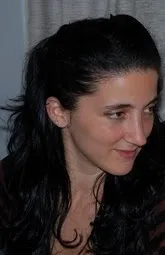
Profile.
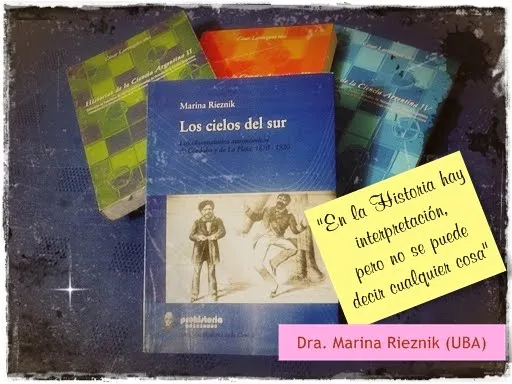
Marina Rieznik was born in 1975 in Capital Federal. She studied at the Colegio Nacional de Buenos Aires and then pursued a degree in History at the Facultad de Filosofía y Letras of the UBA. She has postgraduate studies in the Master's in Science, Technology and Society from the Universidad Nacional de Quilmes and a doctorate from the Facultad de Filosofía y Letras of the UBA with a mention in History. She was a doctoral and postdoctoral fellow and is now a CONICET researcher. She has been a visiting researcher at the Ibero-American Institute of Berlin and directs the projects "Astronomical observatories: spatial, temporal and climatic organization of Argentine territory 1870-1920" (FONCYT) and "Social studies of Science and Technology. Critical approach from Political Economy" (UBA). She is also an undergraduate and postgraduate professor at UBA and UNQ. She has been a speaker at several international congresses and at the Jornadas de Historia de la Ciencia Argentina, organized by the Universidad Nacional de Tres de Febrero together with the Argentine Group for the History of Science. She is the author of several publications, including "Los cielos del sur. Los observatorios astronómicos de Córdoba y de La Plata, 1870-1920", Ediciones Protohistoria, Rosario, 2011, ISBN 978-987-1304-72-1. Scribd.
Sources and related links
- [Note 1] Refers to Benjamin Apthorp Gould, American astronomer who was the first director of the Córdoba Observatory.
- [Note 2] Refers to Francis Beuf, first director of the La Plata Observatory.
About the images
- Photograph of the books Los cielos del sur (on whose cover a drawing by Francis Beuf that appeared in El Mosquito, 1882, is shown) Credit: Protohistoria; and of three copies of Historia de la ciencia argentina (II, III, IV) from UNTREF.