Are renewable energies a myth? Or is saying that trying to create a myth in favor of other interests that no longer know how to renew their arguments?
I read in Amazings a summary of an article by Dawn Stover in The Bulletin of the Atomic Scientists about "The myth of renewable energy".
The article is based on arguing that so-called renewable energies are not renewable, or at least not as much as one might think. Solar energy, to be harnessed, requires the construction of solar panels for which silicon is needed, and thermal energies require water, as well as the availability of rare earths for electronic components.
The idea, with this argument, is to show that environmentalists' concepts are too simplistic and that there are no technologies to achieve COMPLETELY clean and renewable energy.
The article and its commentary in Spanish make sense because there are still in our societies those who idealize any topic. And sometimes they go from white to black with astonishing ease.
When the Fukushima event occurred this year, the mass media exploded with articles trying to prove that nuclear energy was extremely dangerous, to the point that it should no longer be used. A widely watched Argentine television evening news program opened a broadcast with several of its hosts and reporters making reckless statements with music appropriate for the upcoming apocalypse. In fact, they used that little word, based on certain statements that had been made that day within the framework of the news about the Japanese plant.
No one died, directly at least, from radiation due to the Fukushima incident. Meanwhile, we take the bus, taxi, subway, plane, or train every day, and it is very easy to find fatal accidents with varying numbers of victims almost daily.
How ambivalent we are that a few months later, in Argentina, announcements were made about Atucha II and everyone applauded the scientific advancement, job creation, and the return to the nuclear forefront, completely forgetting about Fukushima!
It is clear that Japan is NOT Argentina. But in the treatment of the first topic, that went unnoticed. Was it perhaps taken into account with the second topic? Is the probability of an earthquake in Argentine soil greater than the forecasts and ending up in a situation like Japan's ZERO? Even without an accident of that type, do nuclear waste represent NO risk whatsoever?
The same media that two months earlier proclaimed the end of the world by nuclear holocaust now applaud Argentine scientific development, forgetting the terrifying radiation leaks with which they bathed their reports.
How to understand and evaluate risk? It is a difficult question to answer.
However, trying to equate apples with oranges is not a good path. The argument of the article I allude to is certainly weak and easy to reject.
My context
But first, let's set a context: what follows is an opinion, personal and surely subjective. The reader should know that I collaborate with Greenpeace, the NGO alluded to in that article: "It's a shame, but I'm afraid that finding a solution to the double ecological-energy problem is not as simple as shutting down nuclear plants, abolishing thermal power plants that burn coal or natural gas, and throwing ourselves completely into the alternatives we have right now. If it were, everyone should join Greenpeace."
It should also be said that my collaboration is in no way a "membership" in that NGO. In the same way, I collaborate economically with other organizations and not for that reason must I share each and every one of their positions.
However, many people distrust Greenpeace, as well as other environmentalist organizations.
That is why I think it appropriate to add two points to this conversation.
1st NGOs
1.a) Distrust
Distrusting an NGO, let's say Greenpeace, is neither good nor bad. It is a right we have, as well as doing the opposite. It would be good for those who distrust to ask themselves what the reasons are for doing so. In some conversations, I found absolute silence in response to this question. There is a "climate" regarding the idea that established and somewhat large organizations must hide something, whether it's an ecological, political, computer, banking group, etc.
Now, if one distrusts a green NGO, like the one mentioned before, then what about other organizations, for example the Fundación Vida Silvestre, to name another well-known one. But I could list many more.
Well, most of those who distrust one seem to distrust all because they do not participate in any. At least that's what it seems to me from my little experience and personal environment.
If that is the case, is the problem distrust in an NGO or is it another problem? Could it be a lack of interest?
And it's not wrong to have no interest in something. We have no obligation. But then let's not be hypocrites.
I particularly disagree with Greenpeace on several points.
There are social organizations that collect money (supplies, materials, etc.) and then distribute them among the most needy. It is possible that in some cases what is collected "gets lost along the way." So what do we do, nothing?
Do we distrust an organization based on concrete evidence or unfounded rumors? If we disagree on something, what percentage of that NGO's discourse does that represent?
1.b) The Interference of Green NGOs
The second point is about the interference of green NGOs in environmental issues. These groups DO NOT MAKE DECISIONS, except internal ones, of course. But it is not their directors who legislate and execute. The three branches of the State, in democratic countries, are the ones that can or cannot do that. And they do so with great caution the vast majority of the time. If 10 is demanded, 1 will be achieved. For various reasons. Because they will consult the scientists specialized in that topic, the builders, engineers, and will ask them for an evaluation that, yes, certainly, is more "realistic" in many cases. At that point it is true, green NGOs are "less realistic" or "more simplistic or utopian." It's true. But who pushed to achieve that 1 if not those NGOs? Without those demands, we would have achieved, in many topics, ZERO.
In Argentina there is a Forest Law, a Glaciers Law, a bill on the management of electronic waste. The forestry industry, nor mining, nor electronics will not end. But progress is made. Because from what is demanded, a small percentage of change ends up being generated.
At the same time, collectively, a citizen awareness on certain issues is developing. That synergy allows the common citizen to now be the one who begins to demand solutions. Not magical, not ideal, but advances regarding outdated situations. Nothing is ideal, but science and technology allow us to move towards more sustainable solutions. Of course, one must not be naive and think that by passing three laws we will be saved.
An exemplary issue, but not the only one, is that of tobacco smoke. Slowly, an awareness on the issue developed and today there is a strong social sanction that, together with recent legislation, restricts certain individual freedoms in favor of others (and of oneself). How did we get to this situation? Was it perhaps the tobacco companies, aware of the damage their products cause, who asked for smoke-free spaces? Of course not. For tobacco companies, smoke-free spaces would not be a solution, just as renewable energies are not for a nuclear scientist, a position similar to Stover's in the article in question.
If smoke-free spaces were achieved, it was thanks to the citizenry, helped by small groups that grew and demanded until changes gradually occurred.
Tobacco is still produced and marketed in Argentina. That industry was not closed due to the demands of non-smokers (sufficiently supported by scientific studies, although some arguments may seem somewhat biased). Our grandchildren will find it unbelievable to think that once you could smoke in an elevator.
2nd: Non-renewable renewables? Or Better, though not perfect, but it's not convenient for me to say so?
The argument used is weak in several ways. For example, suppose your child has to do homework for kindergarten and for that requires grains (of salt, of sand, of rice, whatever). Suppose you have a salt shaker in your kitchen and, furthermore, you live meters from a beach full of sand.
In both cases we are not going to count the grains, they will seem "infinite" both in the salt shaker and in the sand, but we know they are not infinite. They start and they run out. In both cases they are "non-renewable." But if you don't want your grains to run out, which would you choose? Is it the same?
It is true, however, that not all so-called renewable energies are equally renewable. No, they are not perfect.
But it is not the same. Furthermore, there is no need to choose just one. They can be combined. Environmentalist demands do not require that the burning of coal, oil, gas and nuclear energy end tomorrow. But even if they did, that is not going to happen. Environmentalist demands, on the other hand, favor the proliferation of new forms of energy generation, somewhat more sustainable than the previous ones, although not pure or ideal.
Instead of getting into an intellectualistic brawl, we should seek solutions that allow not us, but future generations, to live better. The search for harmony with Nature is more than difficult. The preservation of biological diversity, the generation of energy diversity, the search for greater efficiency in the management and consumption of natural resources should be increasingly prioritized, because so far quite little has been done.
Green demands are not going to change the world overnight. They haven't done so until now and it won't happen. It is an inconvenient true truth. And it is increasingly so. Let us assume that discomfort of also wanting to preserve our lifestyle, sources of work and depth of knowledge. And, I agree, let us assume there is no "magic," it's not a matter of blowing and making bottles. Wind, solar, geothermal energy are not THE perfect and ideal solution. If someone thought so, wake up and read the aforementioned article because you really need it. But if, on the other hand, we use the arguments of that note to sit back with our arms crossed "since there's nothing to do because nothing is completely renewable," we are worse off than before. This is MY central argument, my nuclear argument.
To conclude, it occurred to me a few days ago that we are increasingly further from a certain happy world where there is a single language, a single currency, a world flag, a single administration of the world that gives us a true sense of humanity.
That idea that we could once hold is unsustainable. Among other things because we want to preserve our cultural identities, because we need economic flexibility and sovereign autonomy. At the same time we trade and communicate and the idea arises that doing so with a single currency of exchange and a single language would be more efficient.
These two apparently antagonistic ideas between globalization and autonomy of peoples could be a function that evolves over time, approaching not the collapse of the Towers of Babel and of Paper Money, but towards a global search, in different languages and in diverse ways, to find a better balance between resources and consumption. For that curve of responsibility to work, the experts, the scientists and technologists must be there. But environmentalists are also needed, the organizations of people who push to gradually remove bureaucratic obstacles and unnecessary stubbornness. Because these also exist.
The limit of this function is the Earth.
Sources and related links
About the images
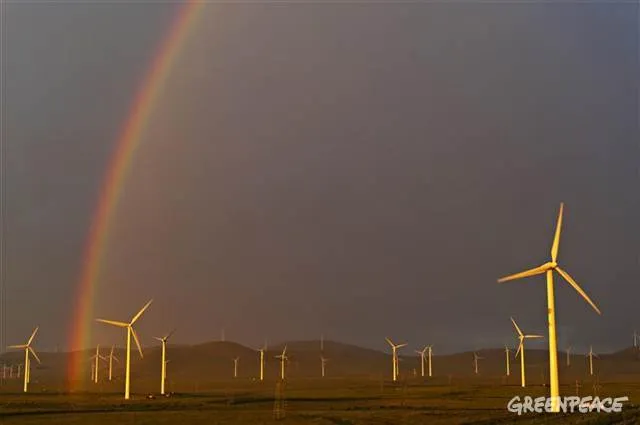
- Greenpeace image from Latest news: The future of energy is renewable