A collection of links to music, images and videos relating art and science. Today: Images of Mercury, LH72, Pacman Nebula. Music: Sky Invader Soundtrack. Video: Time-Lapse Coming back home.

Images of the decade
The Mariner probe at Mercury
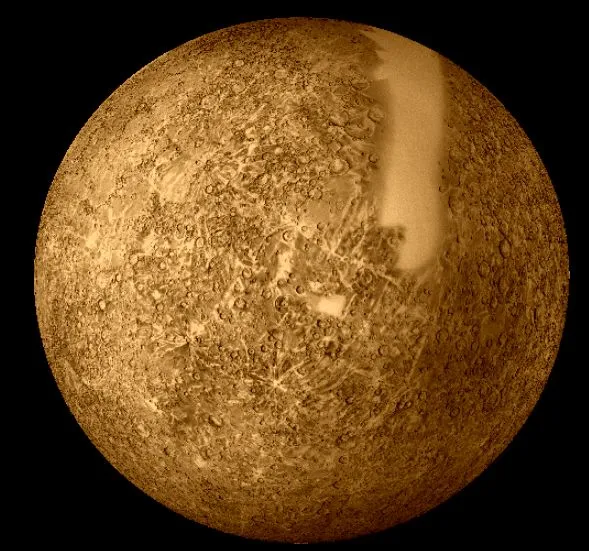
Mercury, the planet closest to the Sun, retains the most mysterious of the inner planets of the Solar System.
Hidden in the solar glare, it is a difficult target for observers settled on Earth.
The only probe that explored Mercury up close was Mariner 10 with the three flybys performed in 1974 and 1975, managing to obtain 45% of the surface.
Mariner 10 maneuvered skillfully to photograph part of the hemisphere lit by the Sun during each approach, then passed below the planet, and continued with the face to the Sun, while the probe gradually moved away.
Reprocessing the data from the Mariner 10 probe has made it possible to obtain this mosaic.
Like the Moon, Mercury's surface shows evidence of impact in the form of craters. The vertical area at the top, along with others in the center, represent regions for which there is no information available at the moment.
Credits: Mariner 10, Astrogeology Team, U.S. Geological Survey
It was NASA's Astronomy Picture of the Day (APOD) for November 24, 2001.
And on Observatorio.
Images of the week
Investigating a shell of gas and stars
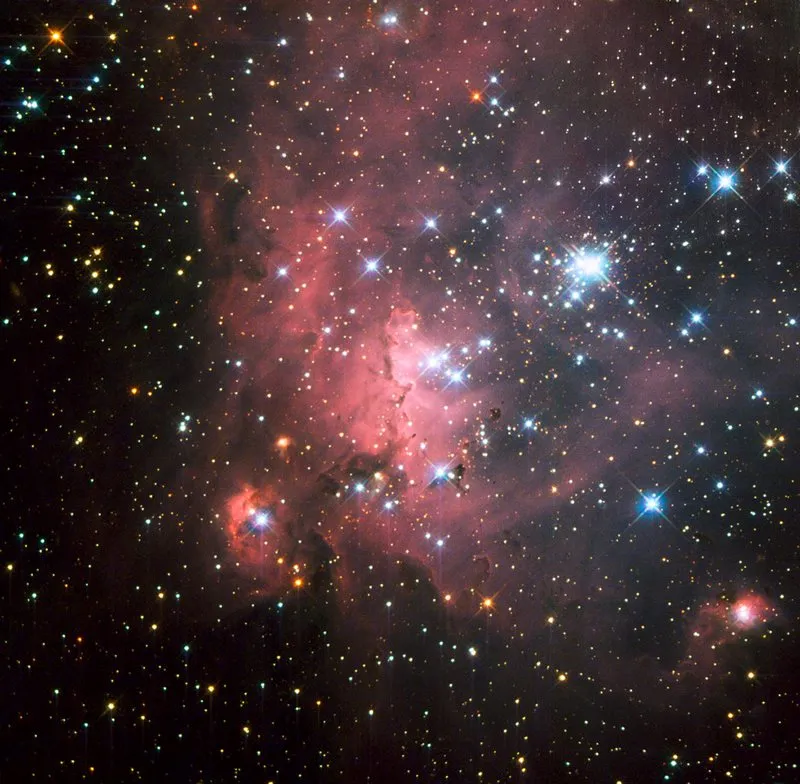
In one of the largest star-forming regions in the Large Magellanic Cloud, a small satellite galaxy of the Milky Way, lies a group of young, bright stars known as an OB association. One of these groupings, called LH 72, was captured in this dramatic Hubble image. It consists of young stars embedded in a beautiful, dense hydrogen nebula.
Much of the star formation in the LMC occurs in regions like this. These zones of interstellar gas were formed by powerful stellar winds and supernova explosions that swept away some of the material around the stars, creating these shells of gas and dust. Over time, the gas cools and fragments into small clouds that will later collapse to form new stars.
The largest of these regions, home to LH 72, is designated LMC 4. With a diameter of 6000 light-years, it is the largest in the Local Group of galaxies, of which the Large Magellanic Cloud and our galaxy are a part.
It was the Space Telescope Image of the Week.
Credit: NASA/ESA
A pacman in Cassiopeia
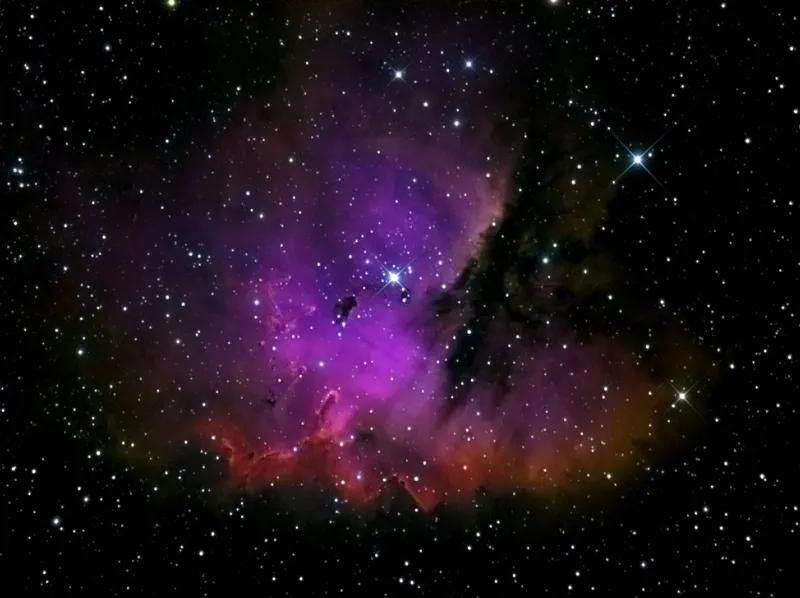
The nebula NGC 281 is known as the Pacman Nebula. It is difficult to see a pacman in some shots since the shape begins to be discernible in wider shots. See entry from El Sofista.
This region is known as an HII region and includes an open cluster, IC 1590, the star HD 5005, and several Bok globules. It lies about 9,500 light-years away from Earth.
It was the Amateur Astronomy Picture of the Day (AAPOD) for November 24, 2011. The image was taken by Joao Vieira from Torres Novas, Portugal.
Space Music
Sky Invader: OST
Phillipe Rey is a French professional musician, dedicated to composing soundtracks for films and video games.
We can find a list of his fabulous works on his website, on SoundCloud, and on Jamendo.
What follows is the music from the video game Sky Invader, which began development around 2009 but still seems under construction. (See comment in Spanish and video-trailer).
Phillipe has more "space" material that I will comment on in future editions of this section. The production of this Original Soundtrack walks the border between space music and epic music, possibly because the video game is a kind of "space-opera," a scenario worthy of heroic notes.
Animated Science
Time-Lapse: Returning home from the Space Station.
Video created from images taken from the ISS. Astronauts Ron Garan, Alexander Samokutyaev, and Andrey Borisenko, Expeditions 27 and 28, have been back home since September. The day this video was posted, November 21, part of Expedition 29 was returning. Garan, founder of Fragile Oasis, wanted to create this as a farewell.
On FragileOasis.org, astronaut Ron Garan tells us how this video was made (the brackets are my additions):
"About six weeks before my return to Earth from the ISS, I received an email from Katrina Willoughby, who is one of our photographers. She suggested I give time-lapse photography a try. I hadn't tried it because I overestimated how difficult it would be to capture good images and what I had seen hadn't seemed as impressive as the static images we had been taking with some of the new equipment on board.
A day or two after the email, I sent a Nikon D3S to the cupola (our glassed-in observatory on the ISS). I took some practice shots, playing with the camera until things seemed to be going well. Then I set the camera to take about 500 images at 3-second intervals. When I saw the results, I was so excited I couldn't sleep!
I quickly uploaded the images to the computer and put them together into a time-lapse. As I was doing it, the song "Back to Earth" by Peter Gabriel played in my head and I put the first part of the audio on the video (Peter's music was on my music playlist).
I posted the video on my blog (August 26 "Sneak Peek from space"). It is that sequence, Europe towards the Indian Ocean, that opens the video here (1:06) [after the introduction with Garan's words while the astronauts are seen saying goodbye with weightless hugs]."
And he continues:
"The next morning I gathered my crewmates and showed them the video while explaining how simple it was to put the images together. All of them experimented with this medium to capture the space experience, especially Mike Fossum, who has since elevated space time-lapse photography to an art form. All the sequences in this video were taken by Mike or by me.
Although the ISS travels at 17,500 miles per hour [7823 meters per second], orbiting Earth every 90 minutes, time-lapse photography apparently speeds up our movement considerably."
The flashes of light seen throughout the video are lightning captured by individual frames of the photograph. Yep, only a small percentage of the actual lightning is captured by the image. As the video speeds up, I think it captures exactly the paparazzi impression of lightning storms as we see them from space.
While I was still aboard the ISS, Peter Gabriel and I thought of some ideas for using this kind of imagery to help tell the story of our Fragile Oasis. The possibilities are truly exciting and I can't wait to see where this leads us. I hope to help people follow our missions not just as spectators, but as crewmates, inspired to help improve life on our planet.
He then gives some details about the camera setup and adds an image taken by Fossum of Garan preparing to take photographs from the cupola as they passed over Australia, giving new meaning to Peter Gabriel's song "Downside Up" whose instrumental version opens and closes this video.
To see that photo, you can go to Fragile Oasis or Flickr.
To access previous editions of this section, consult the Multimedia Selection Series.