Using ESO's VLT, astronomers say they have found the fastest rotating star to date. This massive and young star lies in the neighboring Large Magellanic Cloud, about 160,000 light-years away.

An international team of astronomers used the Very Large Telescope at the Paranal Observatory in Chile to survey the most massive and brightest stars in the Tarantula Nebula in the Large Magellanic Cloud. Among the many stars in that stellar nursery, the team detected one, called VFTS 102, which is rotating at over...2 million kilometers per hour, more than three hundred times faster than our Sun, and is at a point where it could be torn apart due to centrifugal forces. To date, VFTS 102 would be the fastest known. An airplane traveling at that speed would take one minute to circle the Earth at the Equator.
The researchers also found that the star, which is about 25 times more massive than the Sun and nearly one hundred thousand times brighter, moves through space (translation) at a significantly different speed than its neighbors.
"The remarkable rotation speed and the unusual motion compared to the surrounding stars led us to wonder if the star has had an unusual early life. We suspect." said Philip Dufton (Queen’s University Belfast), lead author of the paper presenting the results.
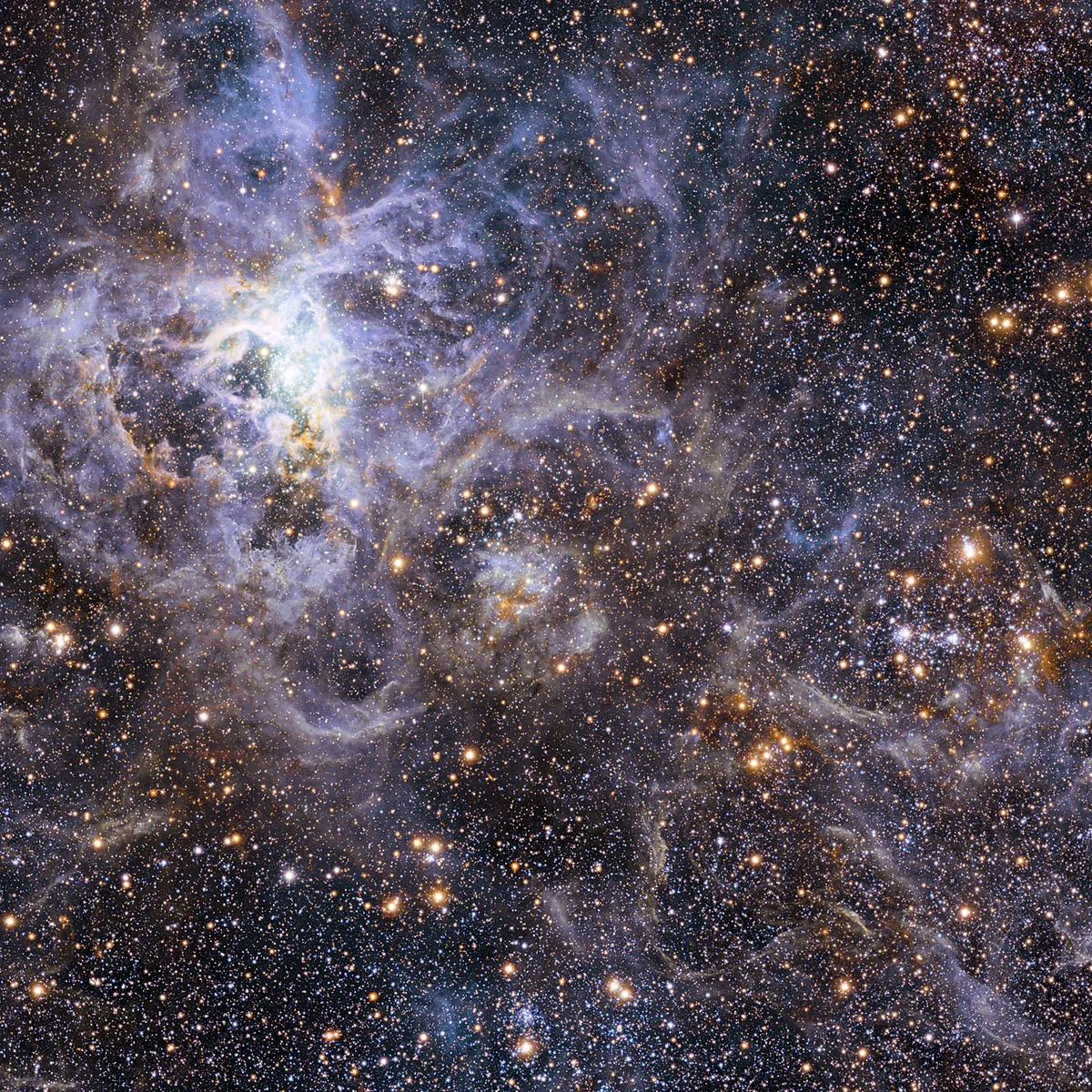
VFTS 102 translates at nearly 228 kilometers per second, which is lower than other similar stars in the region by about 40 kilometers per second. The velocities of about 180 stars (of type O) in the survey found that the average speed is 271 km/s.
This difference in speed could imply that VFTS 102 is a "runaway star", one that has been ejected from a binary system after its companion exploded as a supernova. This idea is supported by two clues: a pulsar and an associated supernova remnant in its vicinity.
The team has developed a possible backstory for this particular star. It could have started its life as a component of a binary star system. If the two stars were close, gas from the companion could have been transferred from one to the other and in the process the star would spin faster and faster. This would explain an unusual fact: why it rotates so fast. After a short life span of about ten million years, the massive companion would have exploded as a supernova, which could explain the characteristic gas cloud (known as a supernova remnant) found nearby. The explosion would also have led to an ejection of the star and explain the third anomaly: the difference between its speed and that of other stars in the region. Upon collapsing, the massive companion would have become a pulsar that is currently observed and that completes the solution to the puzzle.
Although astronomers cannot be sure that this happened exactly like this, Dufton concludes: "It's an irresistible story because it explains each of the unusual features we have seen. This star is certainly showing us unexpected sides of the short but dramatic lives of the most massive stars".
The star VFTS 102 gets its name from the survey in which it was discovered called the VLT-FLAMES Tarantula Survey, which in turn is known as such for being a survey using the VLT and the FLAMES instrument, which is a spectrograph.
Keys to motion
The news item refers to two movements that we can well compare with the most important ones performed by Earth, although with very different speeds. On the one hand, our world rotates, once every 24 hours approximately. At the same time, we translate around the Sun, moving through space and not just around the world's axis. This second movement takes a year to complete. It should be noted that the movements of objects, in this case Earth, occur due to gravitational interaction with other bodies like the Sun, but smaller objects also generate interactions that, although less notable, have their influence. Hence it is said that the planet performs two major movements, rotation and translation, although in truth Earth has other movements, like precession, which is harder to perceive as it takes 26,000 years.
Sources and related links
- VLT Finds Fastest Rotating Star
- The VLT-FLAMES Tarantula Survey: The Fastest Rotating O-type Star and Shortest Period LMC Pulsar—Remnants of a Supernova Disrupted Binary?
Dufton, P. L. et al.
The Astrophysical Journal Letters, Volume 743, Issue 1, article id. L22 (2011).
DOI: 10.1088/2041-8205/743/1/L22
2011ApJ...743L..22D - A hyper runaway star
About the images
- Image 1 and 2. Credit: ESO/M.-R. Cioni/VISTA Magellanic Cloud survey. Acknowledgment: Cambridge Astronomical Survey Unit