Images from the Hubble Space Telescope reveal 14 young runaway stars making their way through regions of dense interstellar gas, and creating bright structures and trails of glowing gas.
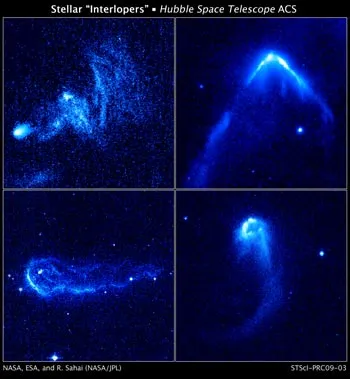
These bow shock shapes, or shock fronts, form when powerful stellar winds, streams of matter flowing from the stars, collide with the surrounding gas. The phenomenon is similar to a boat or motorboat making its way through the water of a lake.
Most stars produce powerful stellar winds, either when they are very young or very old. Only very massive stars, greater than 10 solar masses, have winds throughout their lives. But the objects observed by Hubble are not very massive, as they do not have bright clouds of ionized gas around them. They are medium-sized stars, a few times more massive than our Sun. They are not very old; the shapes of the nebulae around old stars are very different and "aged" stars are almost never found near dense interstellar clouds.
The shock waves indicate that the stars are traveling very fast (more than 180,000 kilometers per hour) relative to the gas, which is five times faster than typical young stars.
There are two possible explanations for these ejections. One is that a star in a binary system explodes in a supernova and ejects its companion. Another scenario is the collision between two binaries or a binary system and a third star. In these cases, some of the stars could have taken energy from the interaction and escaped from the grouping.
It is not the first time that "runaway" stars have been detected. Here we recently commented on a work in which an Argentine participated, about a hyper-velocity star (See A hyper runaway star. The IRAS satellite detected some similar objects in 1983. But the shock fronts were larger, suggesting that those stars were more massive.
"We believe the massive runaway stars observed previously were just the tip of the iceberg," says Raghvendra Sahai, of NASA's Jet Propulsion Laboratory, leader of the study.
These stars are difficult to detect. Those that have been found so far have usually been by chance, including these 14 found by Hubble, according to Sahai.
The team used the Advanced Camera for Surveys to examine 35 objects that appeared as bright infrared sources in the IRAS archive. They were looking for pre-planetary nebulae when they found these runaway stars.
Sources and related links
About the images
Credit: NASA, ESA, and R. Sahai (NASA's Jet Propulsion Laboratory)