A team of astrophysicists, including an Argentine, discovered the first hyper-velocity star ejected from the outer limit of the Milky Way's disk with signs of chemical enrichment from a nearby supernova.
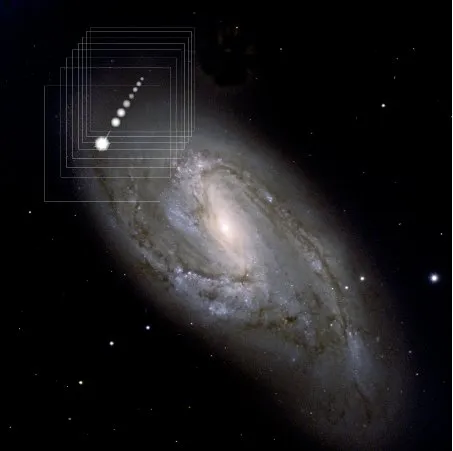
Using ESO's 2.2m telescope, the team detected a massive star (11 times more massive than the Sun) moving at 2.2 million kilometers per hour. The Milky Way's gravitational pull is not enough to keep the star bound to the galaxy. Thus, the star will escape into intergalactic space. Such objects were discovered in 2005 and systematic surveys identified another 16 of the so-called "hyper-velocity stars" (HVSs). The general consensus is that a supermassive black hole is required to accelerate stars to such extraordinary speed. Since the galactic center hosts a black hole, it is thought that these HVSs come from the center of the Milky Way. The star HD 271791, as the newly detected hyper-velocity star is called, is different.
In recent work measuring the star's motion, it was shown that it would not have originated in the galactic center. On the contrary, it would come from the outer limit of the galaxy where no hidden supermassive black hole is known. But there must then be another mechanism that can eject a star into intergalactic space.
According to a work in which Dr. Maria Fernanda Nieva participated, a Tucumán scientist of whom Argentines should be truly proud, from the Max Planck Institute for Astrophysics in Germany, the chemical composition shows small but significant deviations from the norm. The chemical signs point to a violent death: elements that formed when a massive star dies in a supernova explosion are overabundant in HD 271791.
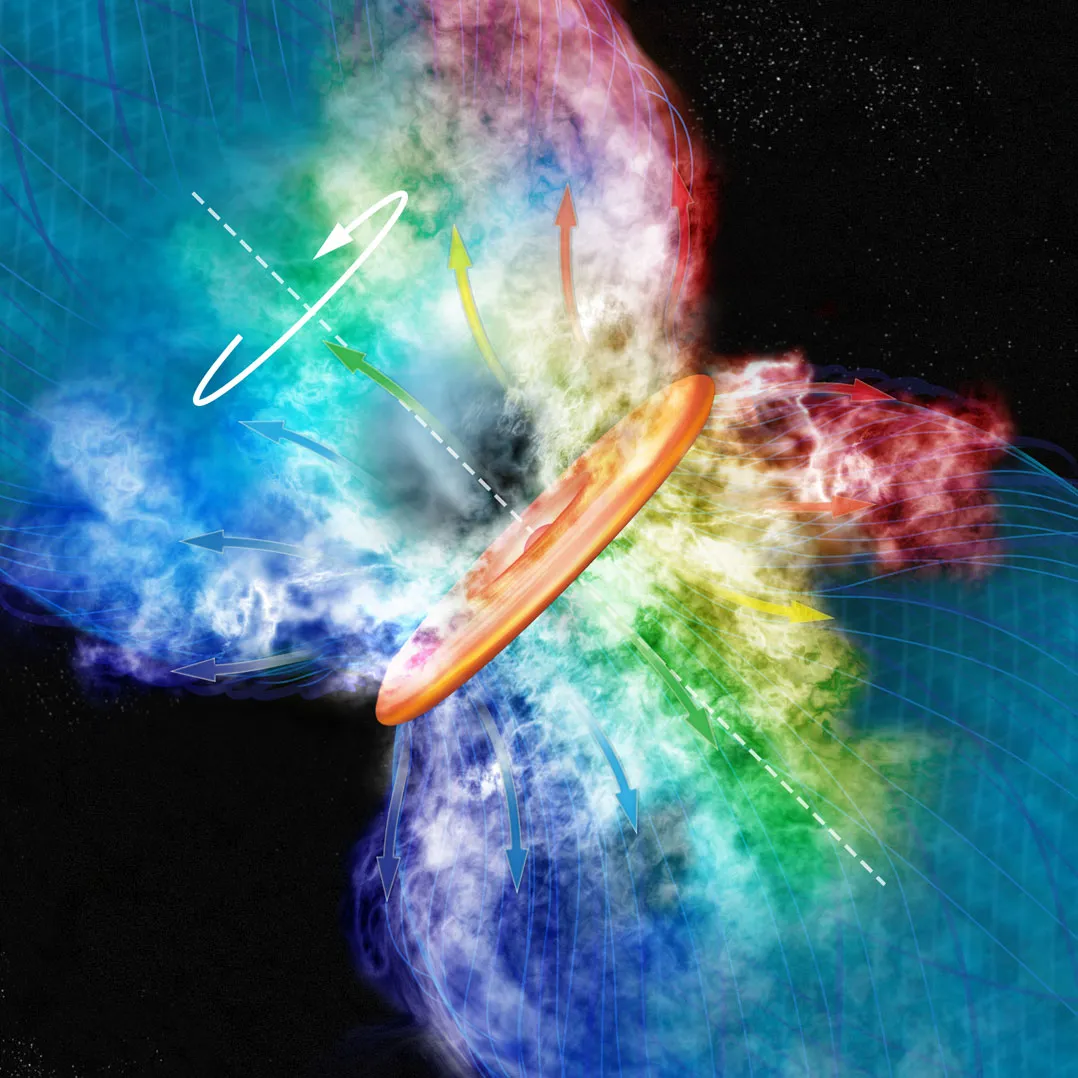
The authors investigated a scenario in which the star originally orbited another, even more massive star. A supernova then occurred that altered the binary system and the star in question was ejected. The supernova ejection would have "contaminated" HD 271791's atmosphere with elements.
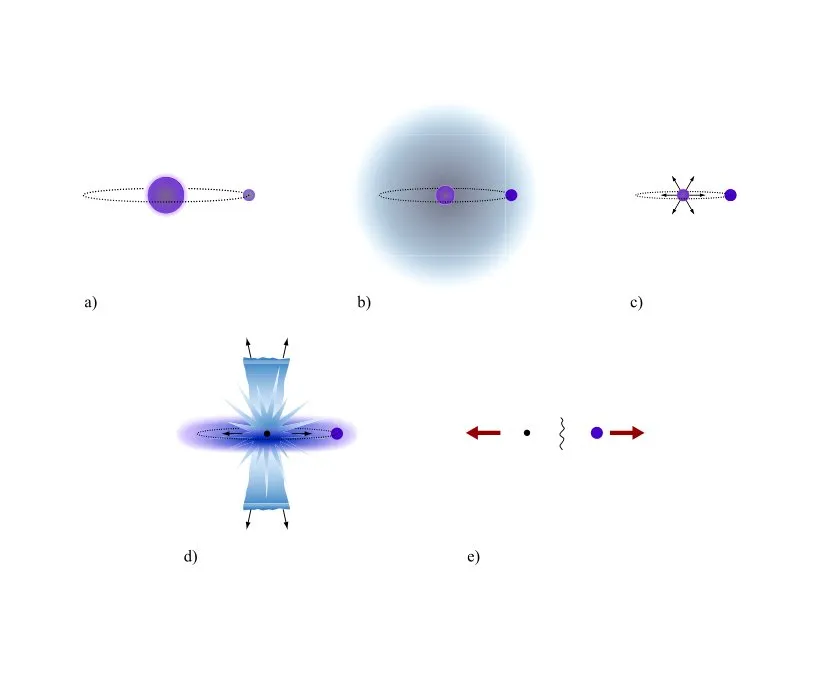
a) Initial system: M1 > 55 solar masses and M2 = 11 solar masses (HD 271791)
b)The rapid expansion of the first and its envelope
c) Short period binary, M1 = 20 solar masses (Wolf-Rayet star with powerful solar wind), together with M2
d)Supernova/hypernova explosion of M1, black hole formation
e)System disruption:HD 271791 is accelerated beyond the galaxy's escape velocity
Until now, such a scenario was dismissed for HVSs because the supernova precursor is usually a supergiant star and any companion should be at a great distance to orbit the star. Therefore, orbital velocities are quite modest. The most massive stars in the galaxy, however, end their lives as Wolf-Rayet stars instead of as supergiants. If the precursor is a Wolf-Rayet, there is room for a companion to move rapidly in a close orbit of about 1-day period. When the Wolf-Rayet exploded, its companion, HD 271791 would have been released at very high speed. Furthermore, the star used the Milky Way's rotation to finally reach escape velocity.
Thus, HD 271791 is a witness to the death of a very massive star (more than 55 times the mass of the Sun) that collapsed about 20 million years ago into a black hole. This would have been a truly spectacular event, as the collapse of a Wolf-Rayet star is not necessarily accompanied by an ordinary supernova explosion; they have been suggested as the origin of the most violent explosions in the Universe, a gamma-ray burst (GRB).
Sources and related links
- Hyper-velocity star challenges the Galactic Centre scenario
- HD 271791: An Extreme Supernova Runaway B Star Escaping from the Galaxy
Norbert Przybilla, M. Fernanda Nieva,Ulrich Heber, and Keith Butler
The Astrophysical Journal Letters, 684:L103–L106, September 10, 2008
About the images
Image of the Milky Way, courtesy ESO.
Credit for the figures:Mrs. Mayr-Ihbe (MPE/MPA)