A collection of links to music, images and videos relating art and science. Today: Images of Hubble's Cosmic Bonfire; The Belt of Venus; SH2-188; and The Moon, Venus and Mercury. Music by SoLaRis. Video: Rosa.

Images of the decade
Hubble's Cosmic Bonfire
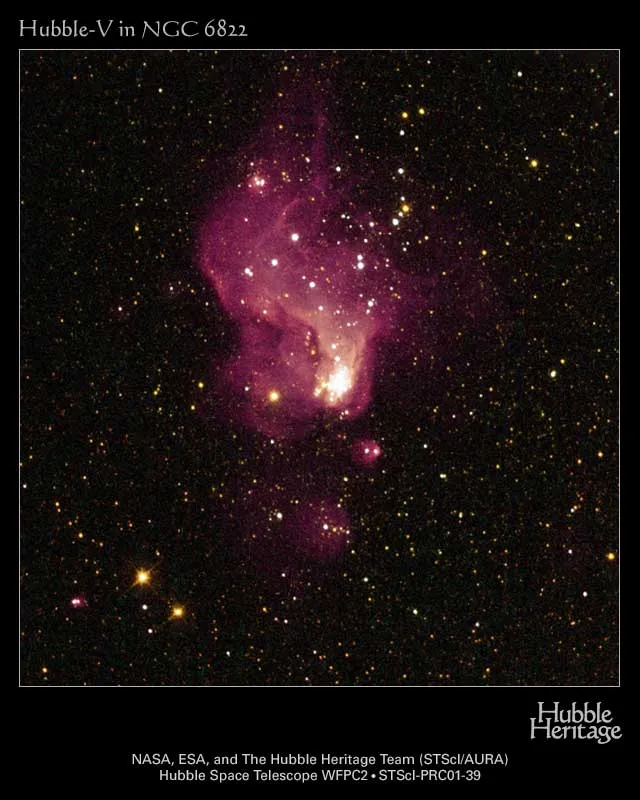
They look like the flames of a bonfire, but this nebula in a neighboring galaxy, NGC 6822 -Barnard's Galaxy, allows astronomers to better understand the fierce birth of stars. The nebula in question is known as Hubble V, at 1.6 million light-years in Sagittarius. It was found with the telescope for which it is nicknamed, in 2005.
The image was published on HubbleSite on December 6, 2001.
Credits: NASA, ESA, and The Hubble Heritage Team (STScI/AURA)//C. R. O'Dell (Vanderbilt University) and L. Bianchi (Johns Hopkins University and Osservatorio Astronomico, Torinese, Italy)
The Belt of Venus
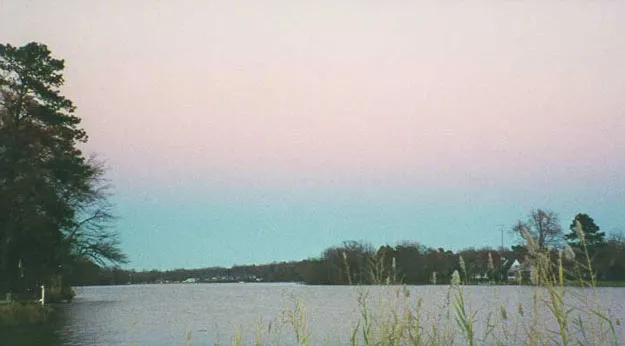
Although you have surely seen it, you probably haven't noticed it.
During a cloudy twilight, just before the Sun rises or sets, part of the atmosphere above the horizon appears a slightly pinkish color.
Visible in the photo above, this band of color between the dark sky and the blue sky can be seen in the direction opposite the Sun and is called the Belt of Venus.
Above it, the blue sky is normal with sunlight reflecting off the atmosphere.
In the Belt of Venus, however, the atmosphere reflects the light of the setting (or rising) Sun which appears redder.
The Belt of Venus can be seen from anywhere with a clear horizon.
It often appears in other photographs without the author knowing it.
It was NASA's Astronomy Picture of the Day (APOD) for December 9, 2001. And on Observatorio.
Credit: Doug Miller
Images of the week
Sh2-188
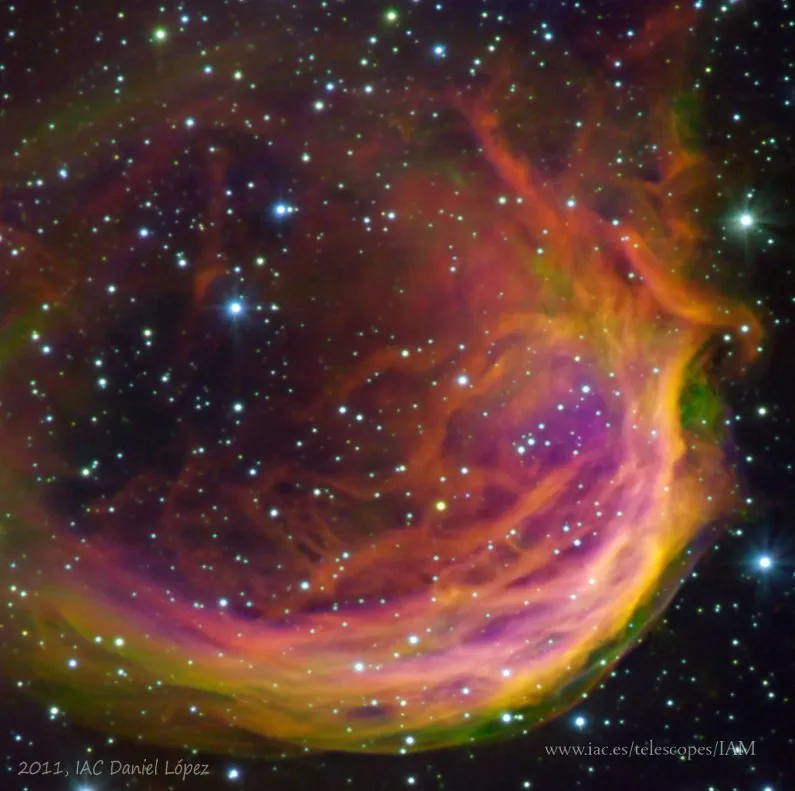
The object in question is listed as entry 188 in Stewart Sharpless's second catalog of nebulae from 1959 and which since 2008 has been digitized. It is a peculiar planetary nebula located in the constellation Cassiopeia and one of the best examples of interaction between a planetary nebula and the interstellar medium. Discovered in 1951, it was thought to be a supernova remnant, mainly due to its asymmetric shape. However, later studies discovered that it is actually a planetary nebula. Sh2-188 does not have a symmetrical outer shell enveloping it and expanding from the dying central star. The central star is about 850 light-years away and is moving at 125 kilometers per second, and this may be the reason for the lack of symmetry of the shell-like structure that envelops it. Since the central star is moving at high speed, most of the ejected material that forms the shell accumulates in the direction of motion, while in the back it is dragged and eventually dissipates.
The photograph was chosen as Astronomical Image of the Month by the IAC.
Observation site – Teide Observatory (Canary Islands – Spain; 16º 30' 35" W, 28º 18' 00" N).
Telescope – IAC80 Telescope (diameter 82cm).
Instrument– CCD E2V 42-40.
Focal Ratio – Cassegrain f/11.3.
Images taken and reduced by – Daniel López.
Text – Daniel López and Pablo Rodríguez-Gil.

Moon, Venus and Mercury at twilight
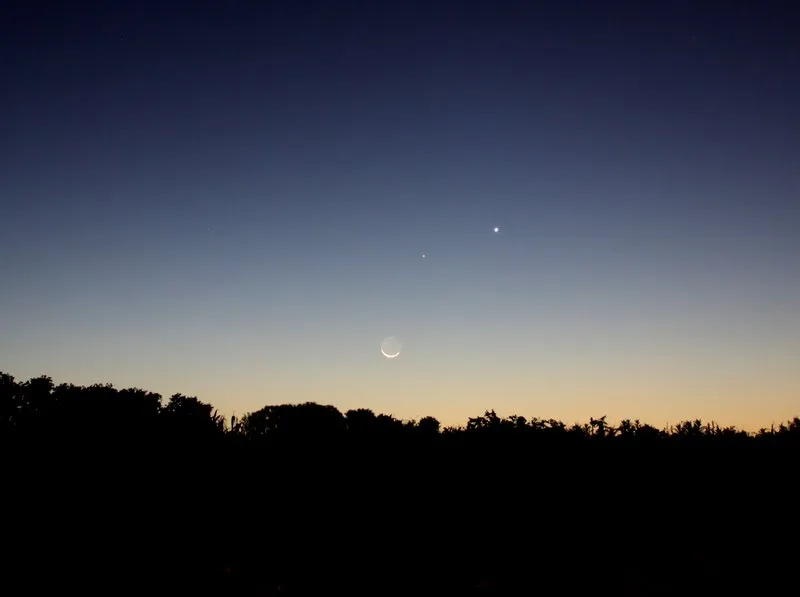
This beautiful twilight portrait, recorded by Diegote71 from Paso del Rey, Buenos Aires, contains a particular fact. The Moon was more than 357 thousand km from Earth, Venus more than 238 million (1.58 AU) and Mercury 194 million (1.29 AU), as noted by the author of the photograph taken on October 27, 2011.
If you look at the numbers again, you will notice that Mercury was closer to Earth than Venus, even though we normally say that, regarding their orbits around the Sun, the first planet is the one named after the god of commerce and eloquence, then the planet of love, and after that, the third rock we inhabit. "Venus and Mars are our immediate neighbors," we often say. But here Mercury is closer to Earth than Venus. This does not mean that the orbits cross, as happens with Pluto and Neptune. The following diagram illustrates the orbits of the inner planets for October 27 of this year.
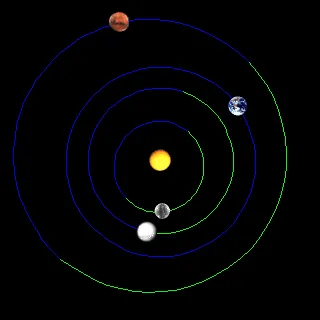
As can be seen, one thing is the distance between the planets, for example, the length separating Mercury from Earth, and another is the distance of each object to the Sun. In this case, Mercury is closer to both the Sun and Earth than Venus. Now, if someone told you this happens because the orbits are elliptical, would they be right? You can think about it or take a compass and a sheet of paper.
The image, obtained with Diegote71's Canon 450D, was chosen as the Amateur Astronomy Picture of the Day (AAPOD) for December 5, 2011.
The orbit chart belongs to Solar System Live, by John Walker.
Space Music
Today: SoLaRiS
We had mentioned this English artist before (SM 2001-38) whose stage name was partly inspired by the film of the same name, but also because it is an acronym for "Solo Artist", although his website says it is an anagram. With varied influences, from the progressive rock of his native country to Asian sounds, his works are instrumental with a recurring "space" atmosphere. Alternative, electronic, progressive, hallucinogenic. Solaris recently participated successfully in two Acid Planet contests ("Madmen & Dreamers" and "Ali Handal").
Solaris alias Asilros is included on Reverbnation, soundclick, Jamendo and other similar sites.

Here you can listen to 82 of his works which are also available for download on the mentioned sites.
Animated Science
Today: ROSA
In the near future, humanity has disappeared leaving behind a huge megalopolis devoid of natural life. From the destruction awakens ROSA, a robot part of the KERNEL project, the last attempt of the human race to restore the Earth's ecosystem by recovering already extinct plant species.
Wandering among the ruins of the lifeless city, Rosa will soon discover that she is not the only part of Kernel that has awakened.
http://www.youtube.com/watch?v=Jlrh4rFmdGw
ROSA is an independent short film created entirely by Jesús Orellana with no budget. From January 2010 to February 2011 he completed the 323 shots that make up the 9'50" minutes of the spectacular CG animated short film.
Jesús Orellana was born in Tarragona in 1981, has worked on many projects for the French publisher "Les Humanoides Associes". In 2009 he began creating his short film Rosa, and hopes to be able to make an animated film. He currently lives in Barcelona with his partner, the artist María Llovet.
Rosa (C) Orellana Pictures:
http://rosamovie.blogspot.com/
http://www.facebook.com/rosashortfilm https://www.facebook.com/orellanajesus http://orellana.deviantart.com/
http://twitter.com/#!/JesusOrellana_
To access previous editions of this section, consult the Multimedia Selection Series.