A collection of links to music, images and videos relating art and science. Today: Images of Neptune's Great Dark Spot, AE Aurigae, the Antares region, NGC 3621. Music: Autapkeia by Hecti González. Video: Space Alone.

Images of the decade
Neptune's Great Dark Spot
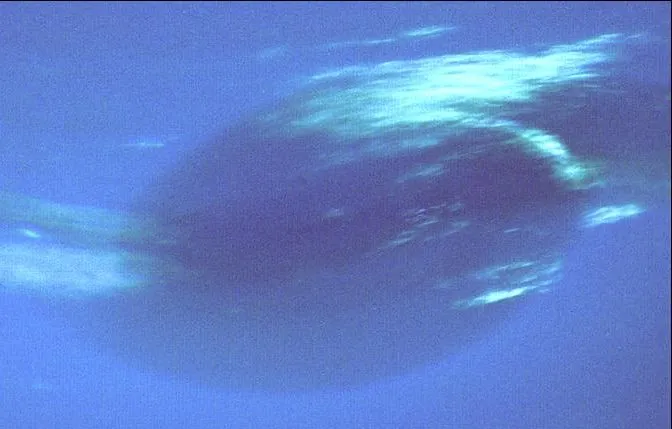
When NASA's Voyager 2 spacecraft flew over the distant planet Neptune in August 1989, astronomers were surprised.
Since Neptune receives only 3 percent of the sunlight that Jupiter receives, they expected to find a dark and dormant planet.
Instead, Voyager 2's images revealed evidence of a turbulent and dynamic world.
One of the most spectacular discoveries was the Great Dark Spot, shown here in the photo.
Surprisingly, it is comparable in size and relative position in the southern hemisphere in terms of latitude to Jupiter's Great Red Spot, so they could be similar rotating storm systems.
The wind near the spot travels at over 2400 km/h (1500 miles per hour), the strongest recorded on any planet.
Voyager data also reveal that the Great Dark Spot varied significantly in size during this short flyby.
When the Hubble Space Telescope saw the planet in 1994, the spot had disappeared — only to be replaced by another dark spot this time in the planet's northern hemisphere!
NASA has a page with several photos of Neptune where you can see the entire planet and the Great Spot in detail.
The previous image was NASA's Astronomy Picture of the Day (APOD) for December 1, 2001. And at Observatorio.
Credit: Voyager Project, JPL, NASA.
Is the star AE Aurigae on fire?
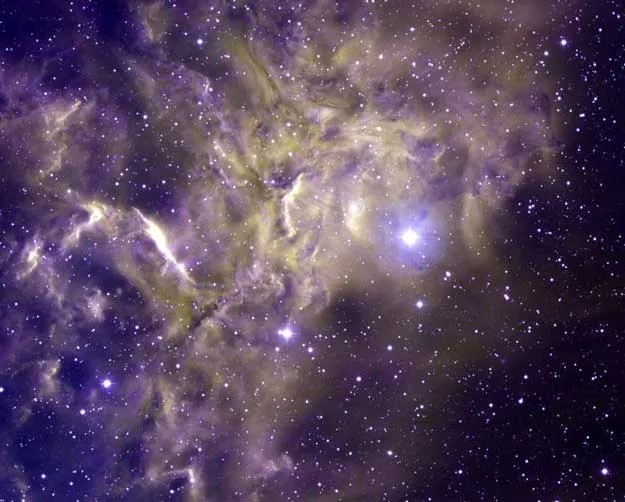
Although surrounded by what may look like smoke, the object known as "the flaming star" creates energy primarily from nuclear fusion, like other stars.
Fire, typically defined as a rapid molecular acquisition of oxygen, occurs only when there is enough oxygen present and is not important in environments such as the high-energy, low-oxygen ones of stars.
The material that appears as smoke is mostly interstellar hydrogen, but contains dark filaments like smoke of carbon-rich dust.
The AE Aurigae region was photographed by the KPNO 0.9-meter telescope and is shown above in false color.
The star AE Aurigae itself is very bright, blue, young and known as the runaway star since it appears to have been ejected from the Orion Nebula region about 2.7 million years ago.
Credit: T. A. Rector & B. A. Wolpa, NOAO, AURA, NSF
It was NASA's Astronomy Picture of the Day (APOD) for December 4, 2001. And at Observatorio.
Images of the week
The Antares region
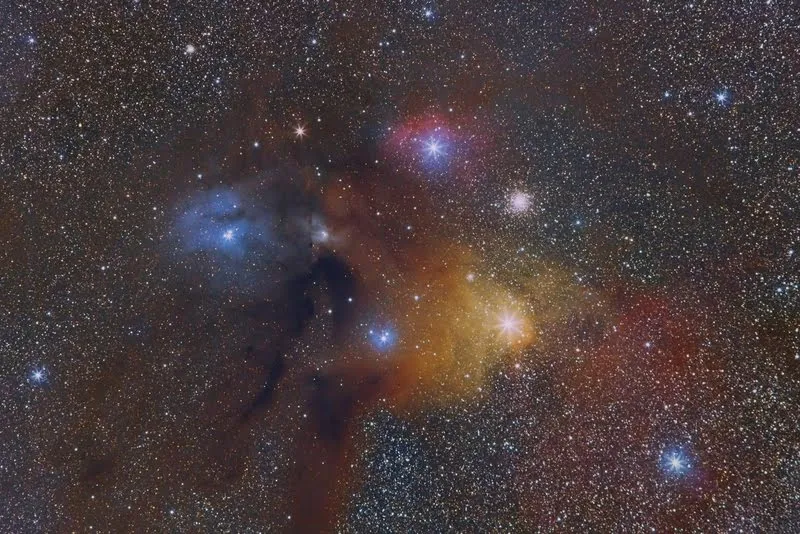
The beautiful nebular complex in Ophiuchus with the prominent Antares was photographed by Ignacio Diaz Bobillo from San Antonio de Areco, Buenos Aires.
It was the Amateur Astronomy Picture of the Day (AAPOD) for November 30, 2011.
NGC 3621, a galaxy full of surprises
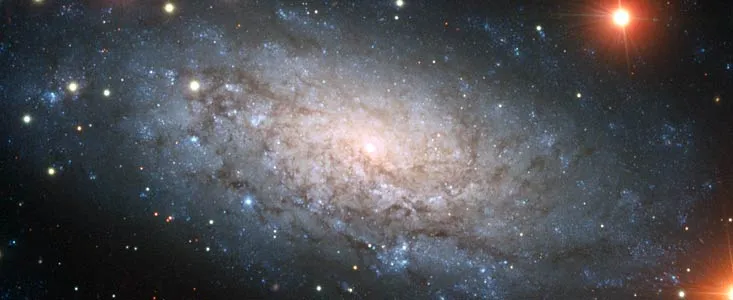
The ESO image, from the VLT, shows NGC 3621, a "pure disk" galaxy. Like other spirals it has a disk bathed in dark lanes of material and arms where young stars are forming clusters (the blue dots in the image). But unlike most, which have a central bulge, a large group of old stars packed in a compact, spheroidal region, this galaxy seems to lack a bulge. We can compare this image with that of NGC 6744 to notice the difference.
NGC 3621 is also interesting because it is thought to have a supermassive black hole at its center. What is striking is that most active galactic nuclei (AGN) exist in galaxies with significant bulges.
The central black hole would have an approximate mass of 20,000 suns. But it also seems there are two more black holes, with lower masses, near the nucleus.
The galaxy is located in the constellation Hydra about 22 million light-years away.
More at Pirulo Cósmico.
It was ESO's Picture of the Week.
Credit: ESO.
Space Music
Autapkeia: Hecti González
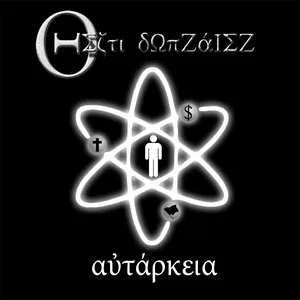
αὐτάρκεια: Autarky/autarchy. Greek word (derived from αὐτο-, "self," and ἀρκέω, "sufficiency"), meaning mental independence from all things. Not to be confused with autocracy (Greek: αὐτoκρατία/αὐταρχία "government by one person").
In Ancient Greece several philosophical currents saw in autarky an ideal of life. For the Cynic, Stoic, Epicurean and Cyrenaic schools, autarky is the condition of the wise person, who is self-sufficient to be happy, for they need nothing else for it but the exercise of virtue.
This is what Argentine artist Hecti González tells us in the video for this track.
His album Autapkeia is composed of eight tracks. What relation does this work have with astronomy?
Well, the first track Nataraja seems to allude to Natarash or Shiva, the king of dance or cosmic movement. The purpose of the dance is to free the human being from illusion, the place where this dance is performed is believed to be simultaneously the center of the universe and within the human heart.
Patas arriba is related to La escuela del mundo del revés, by Eduardo Galeano. "At the end of the millennium, the upside-down world is in plain sight: it is the world as it is, with the left on the right, the navel on the back and the head on the feet."
Somnium alludes to the novel written by Johannes Kepler, El Sueño, and on this topic Hecti also made a video.
The fourth track is the one that gives the album its name, Autapkeia.
It is followed by Newspeak in reference to the Newspeak of Orwell's 1984.
The sixth track is A personal Voyage, clearly referring to Carl Sagan's book Cosmos.
Then Satelles also explicitly alludes to astronomy by referring to natural satellites and we can see a video of it.
The last track is Dietrich trifft Steve.
I must say that the interpretations I made earlier of the other tracks are my own, but Hecti confirmed to me that they were appropriate. In communication with the artist, I asked what this last track alluded to, and he pointed out that it is an encounter (trifft) between "Dietrich Buxtehude, German composer and keyboardist of the 17th century and Steve Vai, electric guitarist from whom I borrowed a certain influence on this album. It is an attempt to bring their styles as close together as possible."
We can find Hecti González in several places like Jamendo and Soundcloud, but I recommend visiting his personal site, www.hectigonzalez.com.ar to get to know him better. His biography is at the same time very creative, a way of approaching the musician not so much to know his personal data, but through his ideas.
Hecti also tells me that he is producing a new work, so we will be attentive to tell about it here.
Animated science
Space alone
Everyone needs a friend, even in space, says Ilias Sounas in this multi-award-winning animated short.
Space Alone by Ilias Sounas (the original version)
http://www.youtube.com/watch?v=ASrRZ_XMR6s
To access previous editions of this section, consult the Multimedia Selection Series.