A collection of links to music, images and videos relating art and science. Today:
Images of The Iris Nebula; Sharpless 212; The Southern Pleiades; and NGC 6642. Music by Juan Galié. Video: The Moon and the other.

Images of the decade
NGC 7023: The Iris Nebula
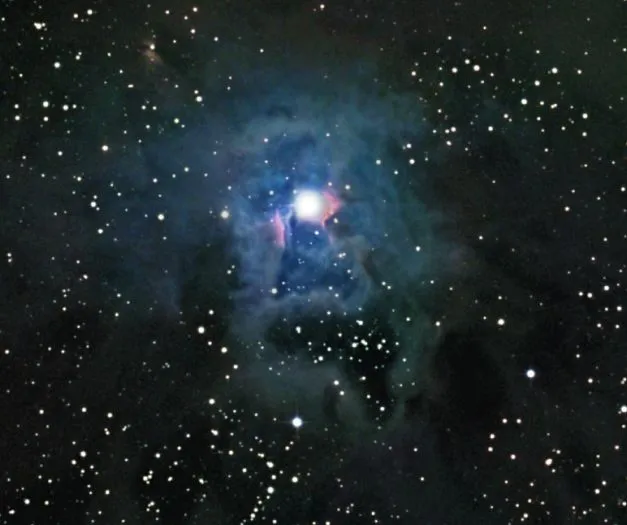
This cluster associated with nebulosity, in Cepheus, about 1,300 light-years away.
The nebular material is seen surrounding a young, hot and massive star (HD 200775) that is still in its formative years.
The photograph was NASA's Astronomy Picture of the Day (APOD) for December 14, 2001. And at Observatorio.
Credit: Brian Lula
Sharpless 212 in Hydrogen and Sulfur
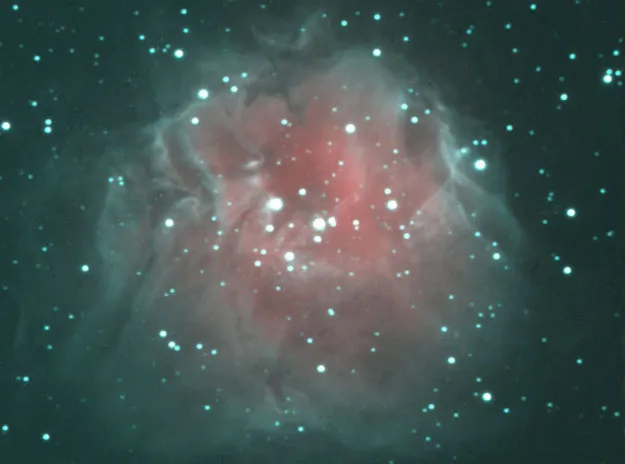
Sharpless 212 is an open cluster about 25,000 light-years away.
The energetic light from the massive stars at the center ionizes hydrogen, creating an HII region. When hydrogen atoms reacquire their electrons, they emit the highlighted red light. The cluster also contains small amounts of dust and heavy atoms like sulfur, whose emission is highlighted in blue.
Credits: Lise Deharveng (Universite de Provence) et al., CNRS, OHP
It was NASA's Astronomy Picture of the Day (APOD) for December 18, 2001. And at Observatorio.
Images of the week
The Southern Pleiades
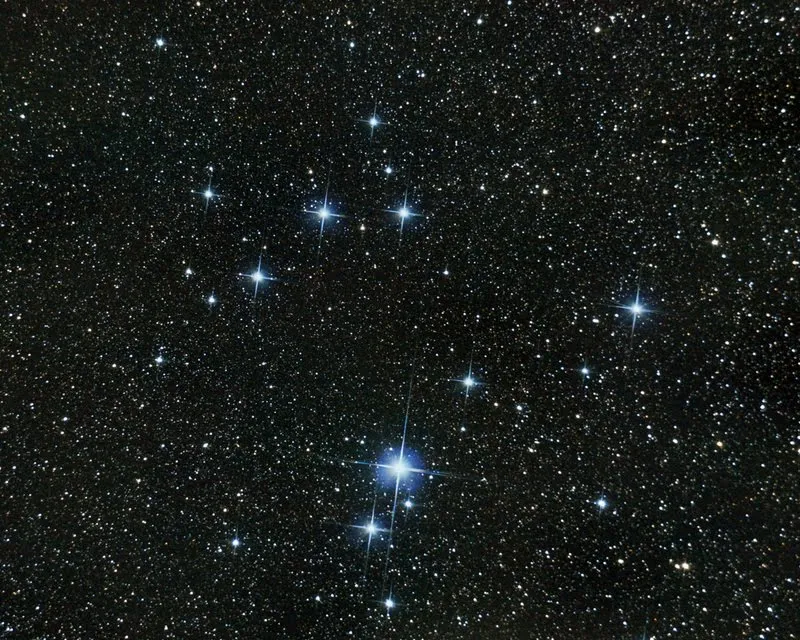
IC 2602 is an open cluster in Carina, about 479 light-years away. These Southern Pleiades, as they are known, can be seen with the naked eye from a dark sky. The brightest of these stars, Theta Carina, has an apparent magnitude of 2.74.
The image was taken from Villa Elisa, Entre Ríos, on March 27 of this year and was chosen as the Amateur Astronomy Picture of the Day (AAPOD) for December 17, 2001.
Credits: Diego Gentili with his Skywatcher 150/7500 EQ5 + Canon 450d.
NGC 6642
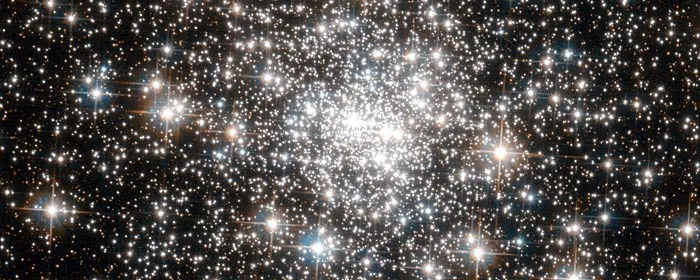
The compact nature of globular clusters is a double-edged sword. On the one hand, having so many stars of similar age in one package provides astronomers with clues about the chemical composition of our galaxy in its early history. But, at the same time, the high density of stars in the core of these globulars makes it difficult to determine individual stars.
The heart of NGC 6642, shown here by Hubble, is particularly dense and also occupies a central position in our galaxy, which implies that images often capture many stars that do not belong to the cluster. But with the Hubble Space Telescope's Advanced Camera for Surveys (ACS) it is possible to obtain this detailed image.
The cluster is located 25,000 light-years away, in Sagittarius.
It was the Hubble Space Telescope Picture of the Week.
Credit: NASA/ESA
Space Music
Destination 2005: JM Galié
Juan Galié, an Argentine artist, has several albums created. In this case, Destination 2005, recorded between 2003 and 2005, except for Revenge (1994) and Guide (1998), has 10 tracks of relaxing and warm sound that includes the track Falling Star.
Science in motion
The Moon and the other
This short film by filmmaker Romain Blanchet created for Canal J, in collaboration with Romain Delaunay, Rémy Hurlin and Martin Vermelen.
Is the Moon a natural satellite of Earth? Well, here, creative imagination proposes something very different.
Lune et l'autre from Romain Blanchet on Vimeo.
To access previous editions of this section, consult the Multimedia Selection Series.