A collection of links to music, images and videos that relate art and science. Today: Images of M31, Mars, NGC 3521 and Moon from Avellaneda. Music: SoLaRis. Video: Doodling in math class.

Images of the decade
The Southwest of Andromeda
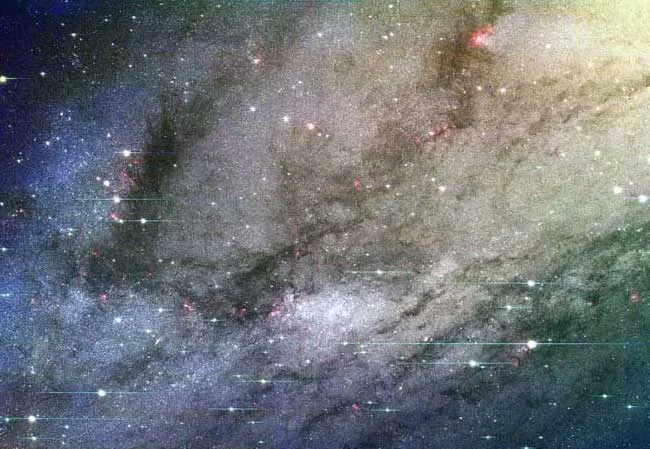
This composite image of the southwestern region of M31 from the Subaru Telescope shows many stars, nebulae and star clusters. An old population of stars near the center of Andromeda causes a yellowish hue visible at the top. There are young blue stars in the spirals at the bottom left. A red emission nebula, blue open clusters and dark lines that are cosmic dust. Andromeda is almost 2.5 million light-years away.
It was the Astronomy Picture of the Day (APOD) September 17, 2011. Also on Observatorio.
Credit: Satoshi Miyazaki (NAOJ) et al., Suprime-Cam, Subaru Telescope, NOAJ
Mars All Around

Just after landing on Mars in 1997, the main robotic station Mars Pathfinder took a first look. This panorama was taken even before the station's Sagan Memorial camera was raised to its two-meter-high position above the ground. The best way to view the image is by moving the horizontal scroll bar slowly to the right. This unique perspective shows in the foreground many of the Mars Pathfinder's instruments including a screen for sky illumination assessment, communication antennas, solar panels, and two ramps to the surface for the Sojourner rover. The Sojourner can be seen on the Martian surface after having descended via the right ramp. The Mars Pathfinder mission sent about 16,000 images and data that led to quite a few discoveries, including evidence of warmer and wetter conditions on Mars in the past. After nearly three spectacular months of surface exploration, the Mars Pathfinder cut communication, probably due to depleted batteries.
It was the Astronomy Picture of the Day (APOD) of September 18, 2001. And on Observatorio.
Credit: Mark T. Lemmon (Texas A&M), IMP Team, JPL, NASA
Images of the week
NGC 3521, the Bubble Galaxy
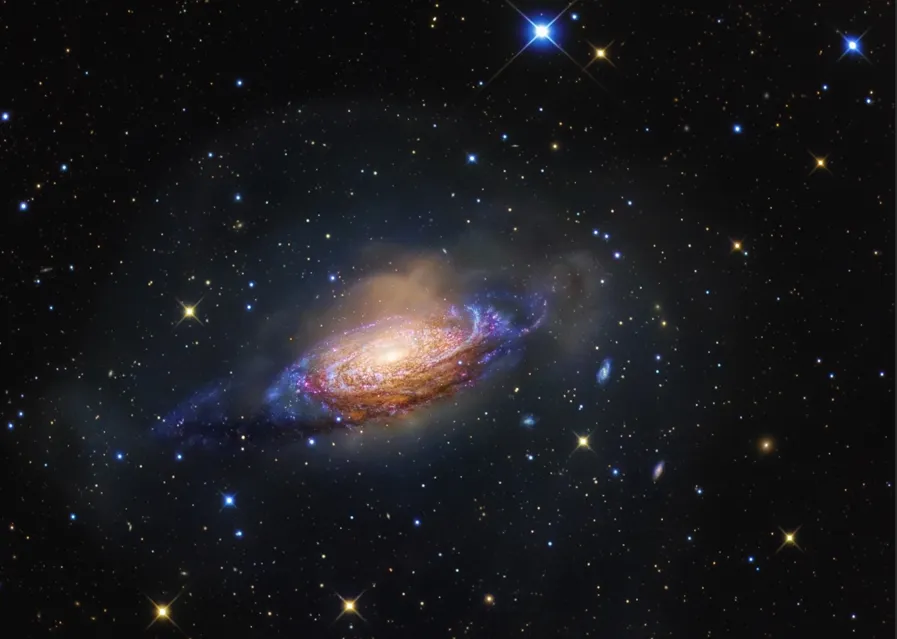
R. Jay GaBany, the well-known astrophotographer, recently published two new images.
NGC 3521, the Bubble Galaxy, is an image composition based on results from a productive collaboration between amateur and professional astronomers, led by Dr. David Martínez-Delgado of the Max Planck Institute. The project was dedicated to exploiting the scientific potential of modest-aperture telescopes.
The new view of NGC 3521 -a spiral galaxy located in the constellation of Leo, at a distance of 35 million light-years from the Milky Way- is an update and improvement of the original data reported in the study Stellar Tidal Streams in Spiral Galaxies of the Local Volume: A Pilot Survey with Modest Aperture Telescopes
Martínez-Delgado, David; Gabany, R. Jay et al.
2010AJ....140..962M
At a similar distance, but in Coma Berenices, lies the Umbrella Galaxy, NGC 4651, which was also part of the previous study. On the same site a new image made with the Subaru Telescope and the half-meter instrument of the Blackbird Observatory is shown.
The image shown here is only a sample. To admire it properly visit Cosmotography.com.
Credit: R. Jay GaBany.
MOON FROM AVELLANEDA
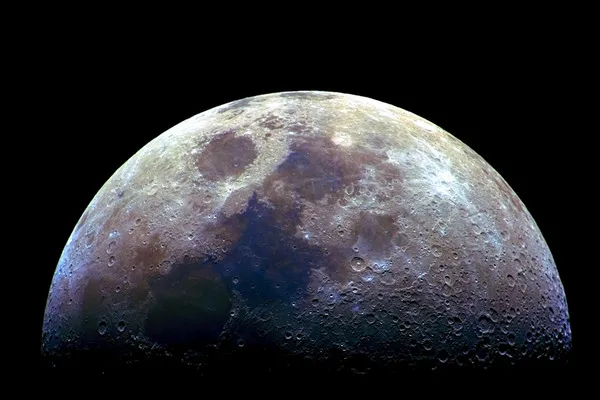
This beautiful colorful half Moon was photographed with a Canon 350D Rebel + barlow2x by Carlos Di Nallo from the town of Avellaneda, Buenos Aires, Argentina.
The image was the Amateur Astronomy Picture of the Day (AAPOD) September 17, 2011.
Congratulations to Carlos for such a beautiful record. Go ahead, sure you are on the right track!
Space Music
Today: SoLaRiS
SoLaRis is an English artist who often makes music with a "space sound", many times more towards the "mystical".
In this case, Sea Sand Stars & Space contains four tracks. The first gives its name to the album published in 2008.
Other works by SoLaRis can be listened to and downloaded on Jamendo, on Podomatic and on Tapegerm.
Science in motion
Today: Doodling in math class
Think of a pretty, sexy woman. Think? Do many names come to mind?
Ok, I think of Vi Hart. It's difficult, unfair, to classify people many times, but it could be said that Vi is a mathartist. And a very talented one.
Is math sexy? I think Vi makes it very attractive.
The advice in this video could be detrimental to math teachers. Surely in a boring class of whatever subject, you have started drawing "doodles".
Is there math in those doodles? Well there could be, as Vi shows in this video, which although it's in English, is understandable.
The idea is to put some method into creating doodles so as to make more and better shapes on the page while the teacher talks about those things that don't interest us because we'll never use them, right?
So while the math or computer teacher talks about iteration, we can ignore her and draw little similar shapes over and over...
http://www.youtube.com/watch?v=ik2CZqsAw28
As we will see in Vi Hart's video, by doodling we can play (like not leaving empty spaces, for example) and even make a nice necklace of doodle-ish iterations...
Ahh, there's also a video going around the web world to blow our minds! A Trip Around the World with the Space Station.
To access previous editions of this section, consult the Multimedia Selection Series.