A collection of links to music, images and videos that relate art and science. Today: Images of IC 2944; Butterfly Nebula; 50 years of La Silla; Comet Lovejoy. Music: Tangerine Space Original Remix. Video: My space, my time.

Images of the decade
Thackeray's Globules in IC 2944
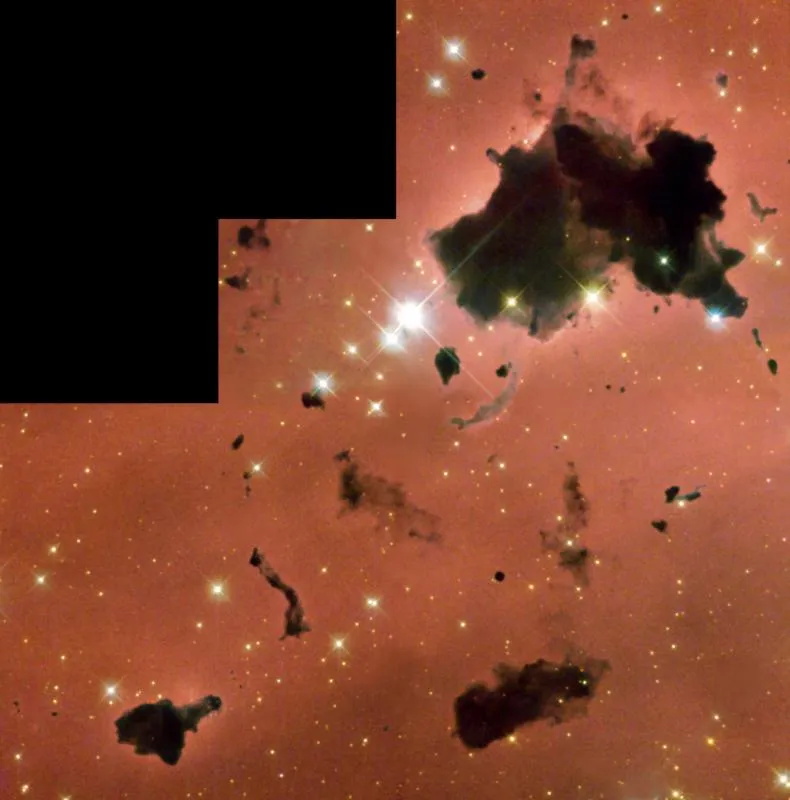
In this image from the Hubble Space Telescope, dark "patches" can be seen that appear to float serenely in space. Those dense and opaque clouds of dust, known as "globules," form their silhouette against the nearby bright stars in the star-forming region IC 2944. Astronomer A. D. Thackeray spied this area in the 1950s. Globules like these have been known since astronomer Bart Bok drew attention to these objects in 1947. But researchers still know little about their origin and nature, except that they are generally associated with star-forming areas or HII regions as they are called due to the presence of hydrogen. IC 2944 is a region of gas and dust illuminated and heated by several massive stars.
The image was released on January 3, 2002, a decade ago, on HubbleSite.
Credits: NASA and The Hubble Heritage Team (STScI/AURA) and Bo Reipurth (University of Hawaii).
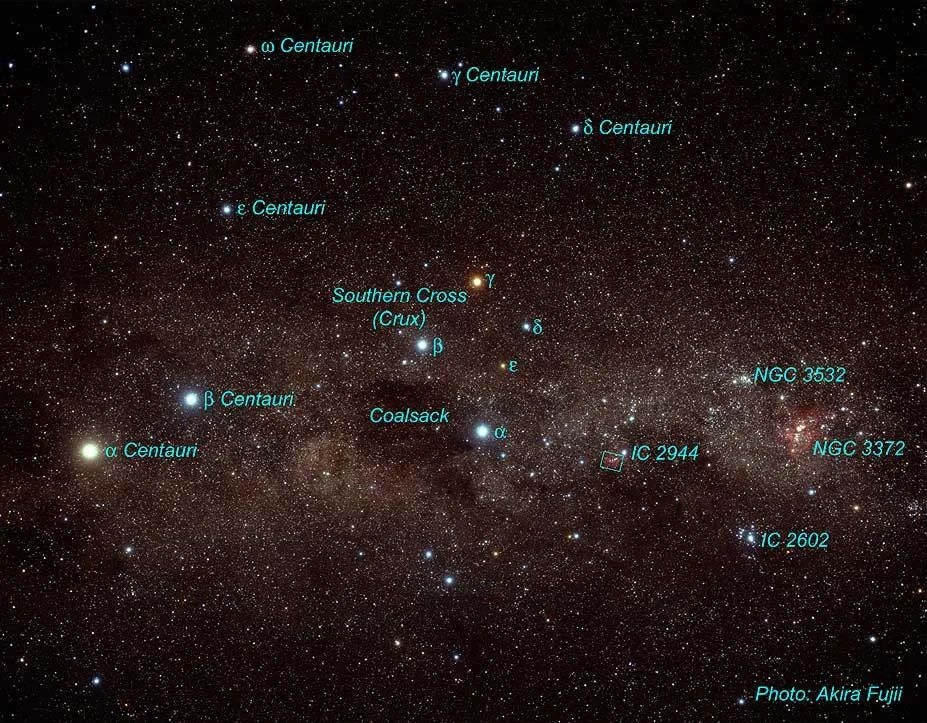
In this other image, a region of the sky is shown with labeled areas, including IC 2944, to know where to look for this area. The image is by Akira Fujii.
M2-9: Wings of the Butterfly Nebula
Are stars most beautiful once they die? In the case of low-mass stars like our Sun and M2-9 (above), stars transform from normal stars to white dwarfs by spewing out their gaseous envelopes.
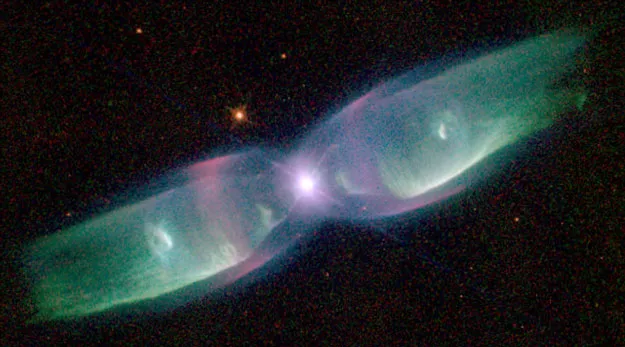
The expelled gas often forms a planetary nebula that gradually expands over thousands of years. M2-9, a planetary nebula in which some perceive the shape of a butterfly, is 2,100 light-years away.
At the center, two stars orbit within a gaseous disk 10 times the orbit of Pluto.
The expelled envelope from the dying star breaks away from the disk, creating a bipolar appearance.
Credits: B. Balick (U. Washington) et al., WFPC2, HST, NASA.
The image appeared on HubbleSite in December 1997, but was chosen as NASA's Astronomy Picture of the Day (APOD) for January 6, 2002. In Spanish on Observatorio.
Images of the week
50 years of ESO
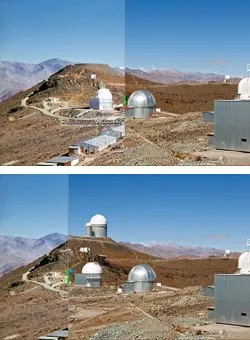
On January 3 of this year, the European Southern Observatory began a series of celebrations in the year of its 50th anniversary with a pair of images from La Silla Observatory that allow comparison of the changes produced there between the late 1960s and today.
It is possible to see an image from the early era and then compare it with the same site today.
But it is also possible to access a full-screen interactive.
More at: A Glimpse into the Past — Then and Now at La Silla Observatory
Comet C/2011 W3 Lovejoy
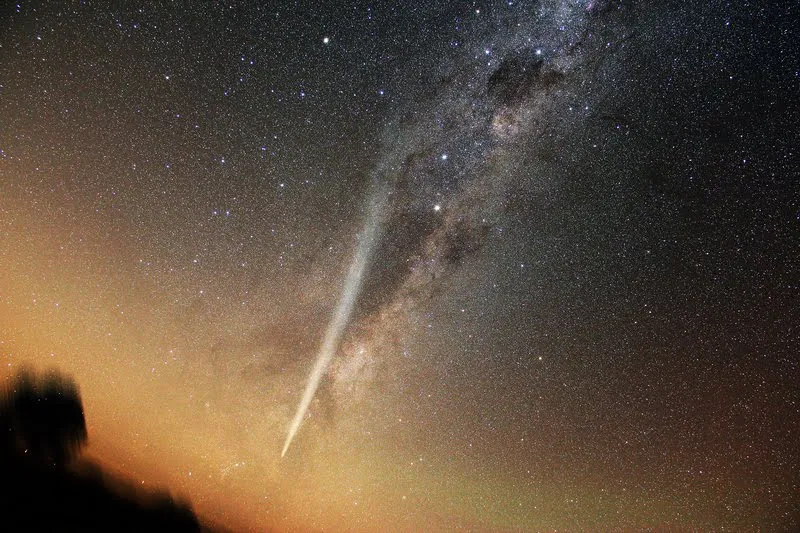
December 26, 2011 03:45 h
Canon 600D camera on EQ3
Canon 18-135 lens at 18mm f5
Exposure 900sec ISO800
Single shot, processed with Photoshop.
The photo is by Ariel Rodríguez from Del Carril, Buenos Aires, Argentina.
It was chosen as the Amateur Astronomy Picture of the Day (AAPOD) for January 5, 2012.
Space Music
Tangerine Space Original Remix (Deep Man/AndAWan collaboration)
This "remix" starts from the original Tangerine Space YearEnd2011 by the very collaborative Swede AndAWan with the Belgian musician called Deep man.
Tangerine Space Original Remix (Deep Man/AndAWan collaboration) by AndAWan
Animated Science
"My Space, My Time" explores the creative process of storytelling through visual illusions made possible by the interesting use of technology. It is a story of a red-haired girl who comes to life and walks through the imaginary world of her book, starting from canvas fabric, while the creators paint objects and worlds around her.
Created by Jeremy Chia, Wendy Tzu-Yin, Kai-sen Chan and Sandhya Prabhat, who study animation and digital arts at the Tisch School of the Arts in Singapore.
To access previous editions of this section, consult the Multimedia Selection Series.
The series attempts to show that the immensity of the universe can be perceived in different ways, by choosing some images from a decade ago—so they do not fall into oblivion—and from the current week that ends, as well as sounds, music and videos that are artistic forms of expression with content related to astronomy and related sciences.