A collection of links to music, images and videos that relate art and science. Today: Images of the galactic core in X-rays, a blue flash on the Sun, Andromeda and company from Spain, and dark matter by COMBO-17. Music by Héctor Alarcón (Helarkon) and a video about real science vs science fiction, from ESA.

Images of the decade
Galactic core in X-rays
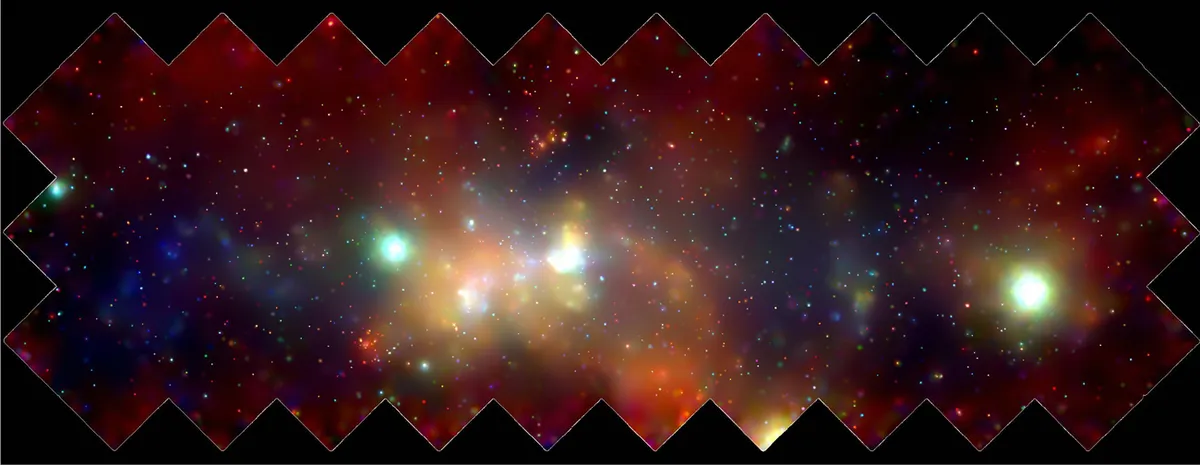
This 400 by 900 light-year mosaic of several images taken with the Chandra X-ray Observatory of the central region of the Milky Way reveals hundreds of white dwarfs, neutron stars and black holes bathed in a glowing fog of many millions of degrees. The supermassive black hole at the center of the Galaxy is located within the bright white portion at the center of the image. The colors indicate X-ray energy bands, with red for the lower energy ones, green for the middle band and blue for the most energetic rays.
As it is located only 26,000 light-years from Earth, the center of the Galaxy is an excellent laboratory for learning about galactic nuclei.
Credits: NASA/UMass/D.Wang et al.
The image was released on January 9, 2002. On the Chandra Observatory site additional material can be obtained.
Blue flash
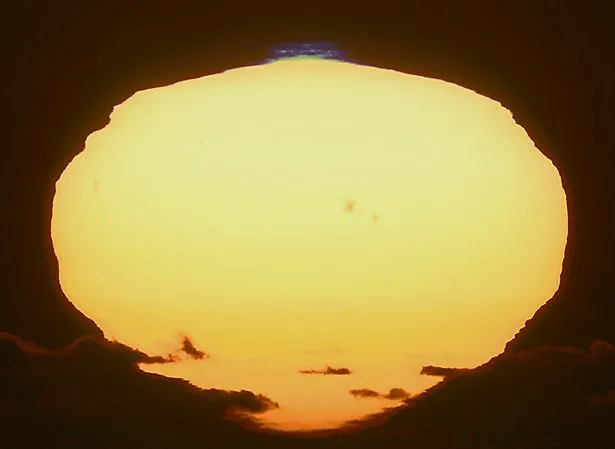
Hard to observe, the culminating moment of the green flash on the Sun at its setting or rising has already been documented as a phenomenon caused by the atmospheric refraction of sunlight.
Like a thin prism, the Earth's atmosphere breaks sunlight into colors, turning reddish colors into soft greens and blues by increasing the angles.
When the sky is clear, a green flash on the edge of the Sun can sometimes be seen for about a second or so, when the Sun is near the distant horizon.
The blue flash is harder to see, because the atmosphere must be extraordinarily clear to prevent the scattering and dimming of the Sun's blue light.
From a site near Roque de Los Muchachos (at an altitude of 2400 meters) in La Palma, in the Canary Islands, astrophotographer Mario Cogo took this fantastic image of a blue flash in October 2001.
A slight green zone can be seen just below the irregular blue flash.
Credits: Mario Cogo. On his site more images like this can be seen.
It was NASA's Astronomy Picture of the Day (APOD) for January 9, 2002. In Spanish at Observatorio.
Images of the week
Andromeda and company
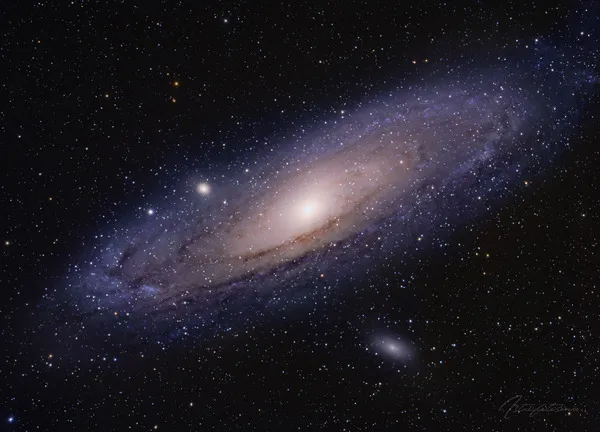
The Andromeda Galaxy, recorded by Messier as entry 31 of his catalog, is one of the most observed and beautiful to see in a dark sky.
In this image, the galaxies M32 and M110 can also be observed. The photo was taken by Jaime Diez and Iván García from Soria with their William Optics FLT-98 APO F/5 and a Canon 1000D in six hours of exposure. A brilliant work. And they have more to offer from their blog.
Credits: Jaime Diez (Jaimesoria) & Iván García (Pompas)
It was the Amateur Astronomy Picture of the Day (AAPOD) January 12, 2012.
Mapping dark matter
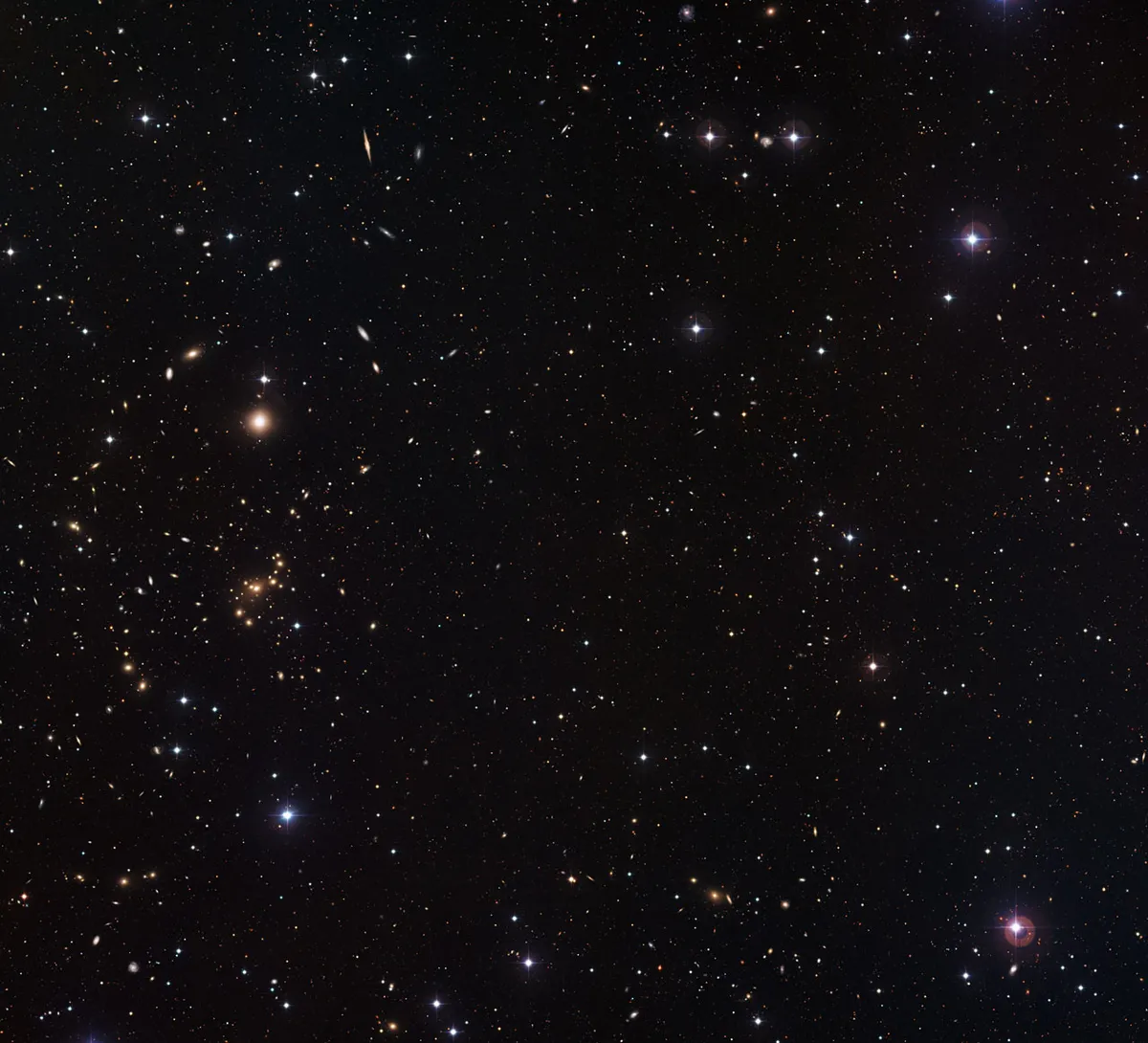
This image is part of the COMBO-17 study, an acronym meaning Classification of Objects by Multi-Band Observations in 17 filters. It is a project dedicated to recording small parts of the sky in detail. The area covered in this image is as small as the size of the full Moon, but hundreds of galaxies can be identified in this small area.
The image was taken with seven hours of exposure. The COMBO-17 survey is a powerful tool for studying the distribution of dark matter in galaxies. Some closer galaxies act as lenses that distort light coming from more distant galaxies located along the same line of sight. By measuring that distortion, an effect known as gravitational lensing, astronomers are able to understand how dark matter is distributed in the objects acting as lenses.
More at the Max Planck Institute on COMBO-17.
It was the ESO Picture of the Week.
Credit: ESO.
Space Music
Today: Helarkon
This time I present here the production of Héctor Alarcón, from Spain with his work Circumstellar Orbit which can be listened to and downloaded on SoundCloud and on Jamendo.
Circumstellar Orbit by Helarkon
Science in motion
Today: Science fiction - Science facts
'Science fiction - science fact' is part of a series of brief video lessons titled Space-in-Bytes, developed by ESA's Directorate of Human Spaceflight. Aimed at upper secondary school students and their teachers, the Space-in-Bytes series presents summarized scientific information as a starting point for further individual or classroom research.
The thin line that sometimes separates fiction literature and advances in space activities in real life is the background of this video lesson from ESA's Space-in-Bytes video.
More information at: Science fiction – science fact: new 'Space in-Bytes' video lesson. The following video can be accessed from the final link on the previous page where it is possible to choose in which language to view the subtitles and with a link to an evaluation form (in English).
http://www.youtube.com/watch?v=Q0xtHGCo7fk
To access previous editions of this section, consult the Multimedia Selection Series. The series attempts to show that the immensity of the universe can be perceived in different ways, by choosing some images from a decade ago -so they do not fall into oblivion- and from the current week that ends, as well as sounds, music and videos that are artistic forms of expression with content related to astronomy and related sciences.