A collection of links to music, images and videos relating art and science. Today: Images of Callisto; Saturn and Vesta in Taurus; Iris Nebula; and Thor's Helmet. Music: "Astronomia" remix. Video: Symbiosis between art and science.

Images of the decade
Callisto shows its face
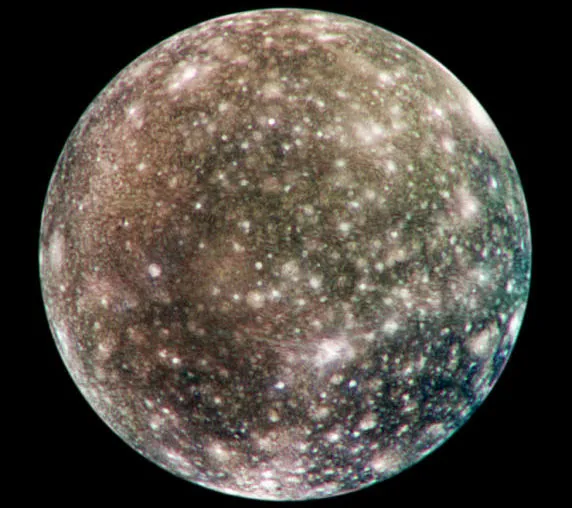
The surface of Callisto is an unmistakable symbol of its age.
Although it probably formed at the same time as Io, the difference between the surfaces of these two moons of Jupiter is quite evident and important.
Io's surface is young, shows few impact craters, and is "repaved" by the lava flows from its many large volcanoes.
Callisto has an old surface, which shows the highest density of craters in the Solar System, and neither volcanoes nor large mountains appear on its surface.
Callisto's surface is like a great ice field, full of holes and craters, after millions of years of collisions with interplanetary debris.
The image above was taken in May 2001 by the Galileo probe and was chosen as NASA's Astronomy Picture of the Day (APOD) for January 20, 2002. In Spanish at Observatorio.
Credits: Galileo Project, Voyager Project, JPL, NASA
Saturn and Vesta in Taurus
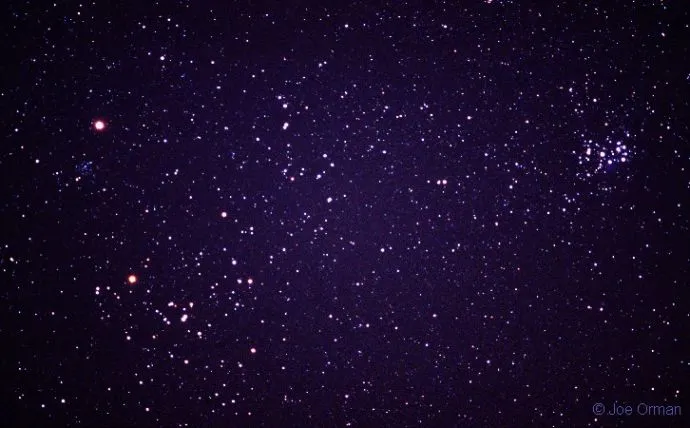
In November 2001, while observing the constellation Taurus, astrophotographer Joe Orman took his camera and pointed it at the beautiful clusters of the Hyades and Pleiades.
At a distance of 400 light-years for the Pleiades and 150 for the V-shaped cluster of the Hyades, these clusters are relatively neighbors of the Sun.
The bright, yellow Aldebaran, 60 light-years away, although it seems to point to the Hyades, is not a member of the cluster, though it is the brightest star in Taurus.
Above Aldebaran, an even brighter and yellower Saturn is located 1.2 light-hours from our planet.
Less massive, a small dot below Aldebaran is one of the main asteroids, Vesta, at only 13 light-minutes away.
Still crossing Taurus, Vesta was approaching its conjunction with Saturn on March 19.
Click on the image to see their positions.
The dates are not wrong. They are the positions of these objects in the sky for late 2001 and early 2002, a decade ago.

It was the Astronomy Picture of the Day (APOD) for January 18, 2002. And at Observatorio.
Credits:
Images of the week
Iris Nebula
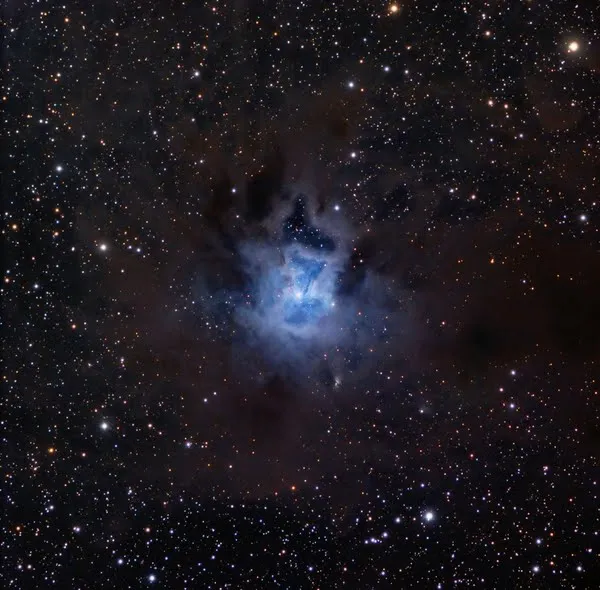
This beautiful shot of the Iris Nebula shows these clouds of interstellar dust and gas as if they were cosmic petals that bloomed 1,300 light-years away in the fertile stellar fields of Cepheus.
The reflection nebula is part of Lynds' Catalogue of Bright Nebulae (LBN) under entry 487 and the object is also known as NGC 7023, associated with a star cluster.
In the Iris, gas and dust surround a young, massive star in its formative years. The central filaments of cosmic dust glow with a reddish luminescence as some grains convert ultraviolet radiation into visible red light.
The photo was the Amateur Astronomy Picture of the Day (AAPOD) for January 18, 2012.
Credits: Olly Penrice from France with an Altair Astro 115mm.
Thor's Helmet (NGC 2359)
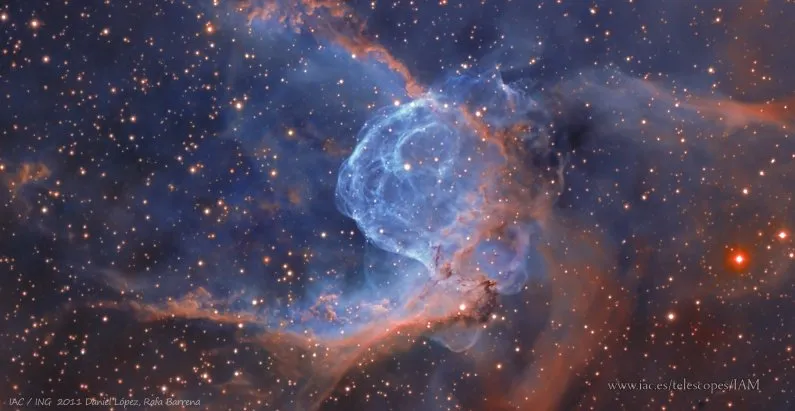
NGC 2359, better known as the Thor's Helmet Nebula, is really more than an interstellar bubble, inflated when the fast wind from the massive, bright star located near the center of the bubble moves through a surrounding molecular cloud. Known as a Wolf-Rayet star, the central star is an extremely hot giant that is supposedly in a pre-supernova stage within its stellar evolution. It is located about 15,000 light-years from Earth in the constellation Canis Major, measuring about 30 light-years.
Images taken and reduced by – Rafa Barrena and Daniel López.
Text – Daniel López and Pablo Rodríguez-Gil.
It is the Image of the Month from the IAC obtained with the 250 cm telescope from Roque de los Muchachos, in the Canary Islands, Spain. More at The Universe in Images.

Space Music
Today: Astronomy remix
Around these summer times here in the South, light music usually plays. An example of that muzak is the track "Astronomia" (like that, without an accent) by Anton Igumnov, alias Tony Igy.
And although I'm not very attracted to dance, it's true that the track is "catchy" (maybe "sticky").
The truth is that until now I hadn't included it in this section. So here I bring you two versions (out of the hundreds that already exist).
One example is the remix by Gerard Campos that mixes the sound of Igy's track with the Spanish voice from the movie Rocky (in its famous motivational speech from father to son) with "Regalito" by the Colombian Juanes. That's a mix!:
Astronomia rocky and regalito by Gerard Campos
Another remix is the one proposed by Claudio Cavalcante between "Astronomia" and "Talking to the Moon", a song by the now so popular Bruno Mars, the artistic-astronomical-candy name of musician Peter Gene Hernandez born in Hawaii with Filipino-Puerto Rican ancestry. Now yes. Everything mixed, everything mixed. Astronomy gives for everything!
Claudio - Talking To The Space (Astronomia Vs Talking To The Moon ) by claudio-cavalcante
Science in motion
Joaquín Fargas - Symbiosis between art, science and technology
Engineer-artist // artist-engineer, Joaquín Fargas integrates the artistic, scientific and technological fields in his production. From science, he disseminates concepts and theories in a playful, poetic way; from art he teaches to understand the properties of nature and to become aware of its care.
Here, a TEDxRíodelaPlata talk.
For more talks visit www.TEDxRiodelaPlata.org
To access previous editions of this section, consult the Multimedia Selection Series. The series attempts to show that the immensity of the universe can be perceived in different ways, by choosing some images from a decade ago -so they don't fall into oblivion- and from the current week that ends, as well as sounds, music and videos that are artistic forms of expression with content related to astronomy and related sciences.