A collection of links to music, images and videos relating art and science. Today: Images of the Centaurus cluster, the Coma Cluster, NGC 6752 and of M81-M82. Music: Electrelane-Blue Straggler. Video: The machine that makes stars.

Images of the decade
Centaurus cluster
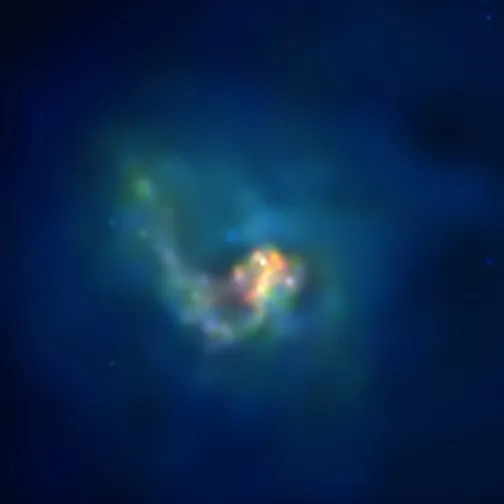
This Chandra image of the Centaurus galaxy cluster shows a plume-shaped feature 70,000 light-years in diameter and with a temperature of 10 million degrees Celsius. Hot, though several million degrees cooler than the surrounding gas, as can be seen in the image color-coded according to its temperature: red, yellow, green, blue indicate increasingly higher temperatures. The cluster is located 170 million light-years from home.
The Centaurus Cluster is also known as Abell 3526 due to its inclusion in the catalog of rich galaxies originally created by astronomer George Abell in 1958. That original registry contained 2712 clusters from the northern sky to which 1361 from the southern sky were later added.
This plume contains a mass comparable to one billion Suns. It could have formed as gas concentrated, condensed and cooled, along the path of the massive, and dominant galactic center, around which it is rotating. Other possibilities are that the plume is a collection of debris ejected from a galaxy that fell into the cluster or that it is gas pushed out of the cluster's center by explosive activity in the central galaxy. A problem with these ideas is that the plume has the same concentration of heavy elements like oxygen and iron as the surrounding hot gas. Questions that remain to be answered.
And it couldn't be any other way, considering that the largest galaxy in the cluster is NGC 4696, a cosmic "big question mark". (see NGC 4696 by Chandra).
Credit: NASA/IoA/J.Sanders & A.Fabian.
The image was published on January 29, 2002 on the Chandra X-ray Observatory website.
The Coma cluster: as many galaxies as to lose your mind
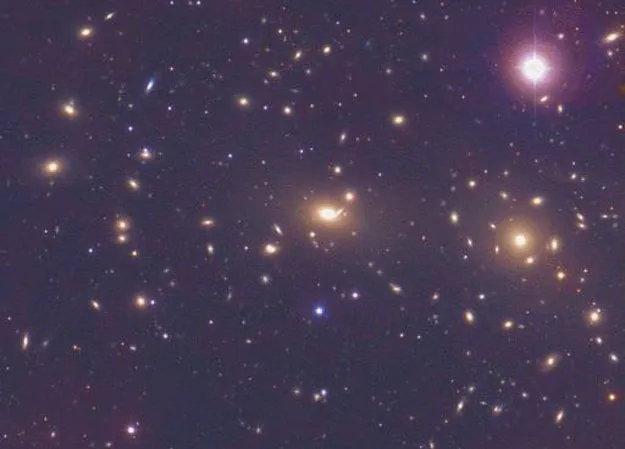
Most of the objects in this photo are galaxies.
The Coma Galaxy Cluster (Abell 1656) is one of the densest known, with hundreds of galaxies.
Each of these galaxies houses billions of stars – in the same way that our Galaxy, the Milky Way, does.
Although it is close compared to most other clusters, light from the Coma Cluster takes hundreds of millions of years to reach us. It lies more than 300 million light-years away.
In fact, the Coma Cluster is so large that light takes millions of years just to cross from one side to the other!
Most galaxies in Coma and other clusters are elliptical, while most galaxies outside clusters are spirals.
Note: there is a star cluster, of stars, also called the Coma Cluster and another cluster of scattered galaxies known as Coma I. The Coma galaxy cluster is part of the Coma Supercluster (SCl 117).
And why is it called Coma? Because it is in the constellation Coma Berenices. Where does that name for a constellation come from? It means "Berenice's Hair" and refers to the wife of an Egyptian king who offered her beautiful hair to Aphrodite so that her husband would return alive from the war. Then, it is said, the hair was stolen from the temple and it was thought that it was no longer there because it was among the stars.
Credits: O. Lopez-Cruz (INAOEP) et al., AURA,NOAO, NSF.
It was the Astronomy Picture of the Day (APOD) of February 3, 2002. In Spanish at Observatorio.
Images of the week
Young stars in an old cluster
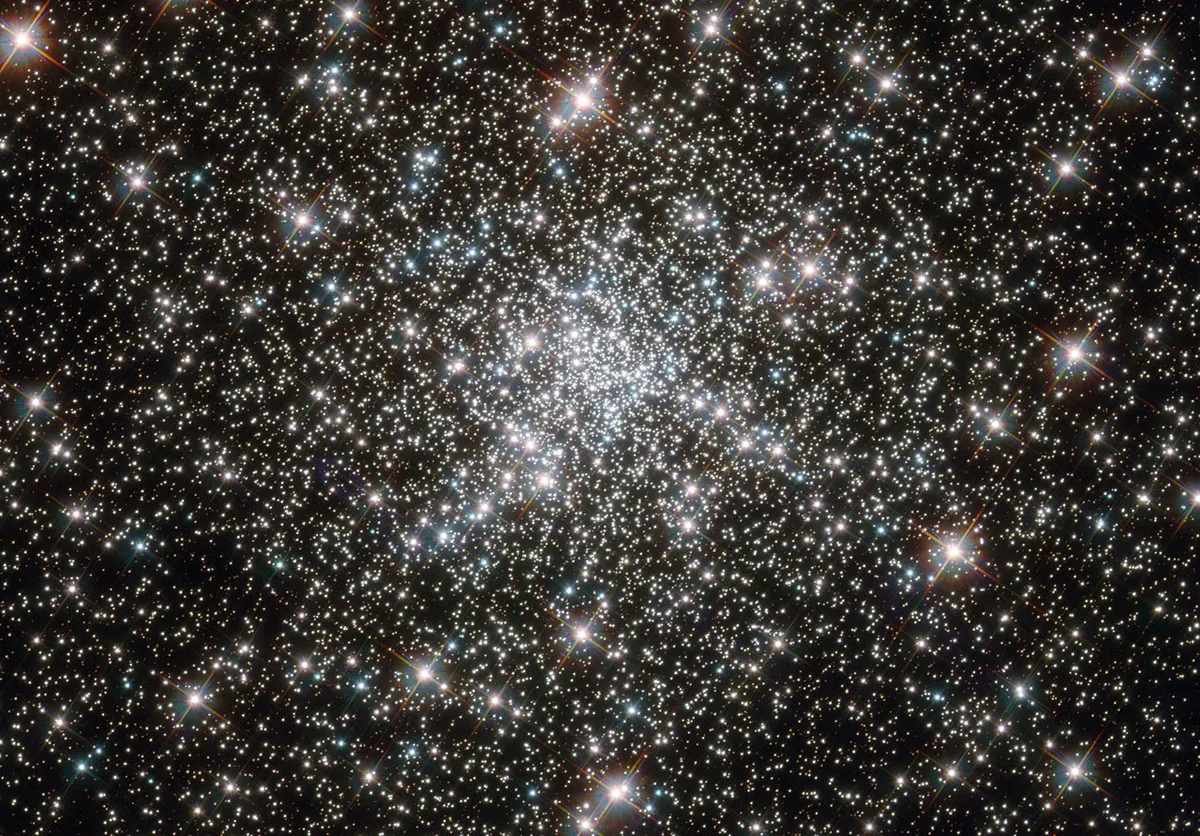
NGC 6752 is a treasure trove of jewels (although The Jewel Box is the common name for another object, the open cluster Kappa Crucis or NGC 4755). This is a globular cluster about 10 billion years old. One of the oldest known collections of stars and it has been shining since long before the Solar System existed (it is twice as old).
The cluster contains a large number of "blue stragglers", some visible in the image. These stars show characteristics of younger stars than their neighbors, despite models suggesting that most stars in a globular cluster should have formed at approximately the same time. Since they appear younger than the others, their aging seems "straggled".
Studies suggest that up to 38% of the stars in this region are binary systems. Collisions between stars in this turbulent zone could generate the blue stragglers (known as BSS or as Blue straggler stars).
The cluster is located 13,000 light-years away.
It was the Hubble Space Telescope Image of the Week.
Credit: NASA/ESA Hubble.
M81 and M82 from Benamahoma
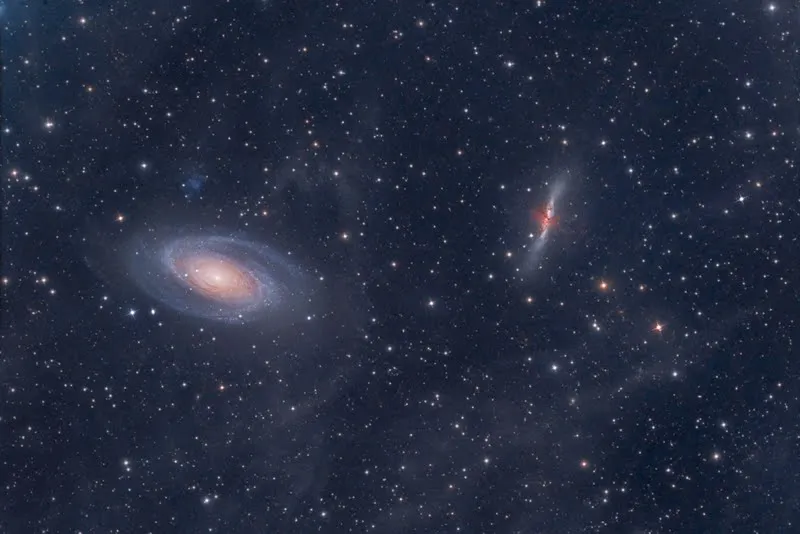
From Cádiz, Jesús Vargas and Maritxu Poyal, from Astrogades, give us this fabulous view of Bode's Galaxy (M81) and the Cigar Galaxy (M82). The first is a spiral and the second an irregular with high star formation. Both about 12 million light-years away in Ursa Major.
The image title includes the term "IFN background". It refers to what Steve Mandel coined as Integrated Flux Nebulae. It alludes to high galactic latitude nebulae that are illuminated not by a single star, as is the case with most nebulae in the plane of the Galaxy, but by the energy of the integrated flux of all the stars in the Milky Way.
It was the Amateur Astronomy Picture of the Day (AAPOD) on February 4, 2012.
Credits: Jesús Vargas (Astrogades) & Maritxu Poyal ( Maritxu). Astrogades.
Space Music
Blue Straggler Electrelane
Electrelane is an English band composed only of women. It was formed in 1998 by Verity Susman and Emma Gaze.
The debut album was Rock it to the Moon, almost entirely instrumental, whose fifth track is "Blue Straggler", which may have been a title taken from the astronomical objects I mentioned earlier, the blue straggler stars.
On the Electrelane website you can listen to the albums and see two videos, including the one titled like this track. Here is a version by GravitysSon on SoundCloud.
Animated science
The Machine That Makes Stars
It is a 3D animated feature film aimed at children with an artistic proposal that makes it attractive to adult audiences as well. The story and its characters are set in an imaginary universe, but the relationships that are established and their desires are profoundly human.
Every night he goes out to his balcony hoping that the stars have disappeared from the sky. According to his grandfather, there is a machine that generates the stars every night and, if one day it fails and the stars disappear, a member of his family will be in charge of repairing it.
Thus, Pilo will live a huge adventure traveling to repair the machine to return the stars to the Sinfín. The journey will change him forever, facing the family destiny, turning him into a man and a hero.
This Argentine production will premiere on Thursday, 2/16 in Buenos Aires cinemas. Don't miss seeing it. To learn more:
http://www.lamaquinaquehaceestrellas.com/index.html
To access previous editions of this section, consult the Multimedia Selection Series. The series attempts to show that the immensity of the universe can be perceived in different ways, by choosing some images from a decade ago -so they don't fall into oblivion- and from the current week that ends, as well as sounds, music and videos that are artistic forms of expression with content related to astronomy and related sciences.