The installation of two robotic cameras has begun in San Juan, which will allow for the automatic detection of brightness changes in various astronomical objects.
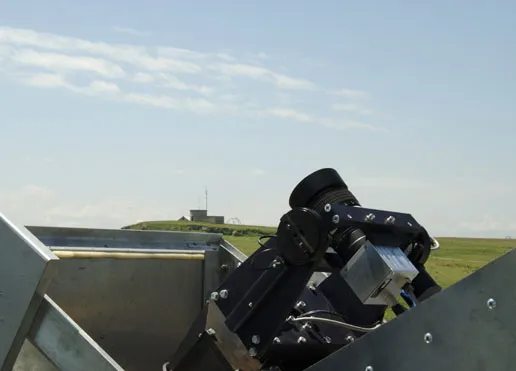
Thanks to a series of agreements between the Institute of Earth and Space Astronomical Sciences (ICATE) under CONICET-UNSJ, the Carlos Cesco Station under the "Félix Aguilar" Observatory (OAFA) and the Sternberg Institute of Moscow University (Russia), the installation of two cameras to carry out robotic sky observations has begun.
For the installation, Russian researchers arrived in the country, such as Vladimir Lipunov, Aleksandre Belinski and Evgeny Gorbovskoy. The first leads the Mobile Astronomical System of the Telescope-Robots (MASTER) project [1] in his country, composed of stations equipped with a telescope and cameras with which they have already obtained good results.
It is estimated that the installation of this equipment will be completed on February 12 next, from when they will be operated by members of ICATE.
According to statements to the newspaper El Zonda by Dr. Hugo Levato: "Every 20 minutes the cameras will take images of the entire southern hemisphere sky. These will be compared with each other, looking for any object that varies in brightness. And these objects will be studied individually."
The MASTER VWF cameras from the Russian initiative have two lenses: 35.7mm (Nikon 50f/1.4), field of 1040 square degrees (CCD 24x36), and 60.7mm Zeiss-Nikon 85/1.4, 432 square degrees. The limiting magnitude for a 1 min. exposure is 11 for f50 and 13 for f85. [2]
Data on the variability of astronomical objects will thus be obtained for subsequent analysis. But the agreement with Russia also promotes the exchange of human resources with that country and the interaction of astronomy students with professionals from other parts of the world.
According to the same newspaper, currently, the Astronomy degree at UNSJ has 150 students; and since this degree program started, in 1995, there are 30 graduated astronomers; furthermore, the doctorate in astronomy has been offered since 2009.
Update
When I learned about this news yesterday, I thought of consulting Dr. Levato, which I did via email. As that usually takes time, I went ahead and wrote the post with the information available on the web.
But now, after Dr. Levato's response, I can confirm what I suspected: the camera configuration is similar to that of the MASTER project (see [2]).
On the other hand, since MASTER has telescopes, I asked if there would also be some here. To which Dr. Hugo Levato indicated to me that "at this moment only two cameras are being installed and then the next step is to install the Master-ICATE II which consists of the two parallel telescopes in the same dome."
"The data is uploaded automatically to the WEB and is the property of the Russian and Argentine researchers working on the topic, at least for now," the Argentine astronomer pointed out to me in response to my question about the availability of the data obtained with these instruments.
He also pointed out to me that the cameras were made in Russia. They are being installed here and will be operated with local personnel.
Finally, he informed me that on February 3, "a mini workshop was held where the Russian visitors presented the virtues of the equipment and authorities of the Provincial Government and the National University of San Juan highlighted the importance of the cooperation with the Russian Federation that has been developing for many years from UNSJ."
The Mini Workshop, which was attended by advanced students of the astronomy degree at our university, astronomers and technical personnel from both ICATE and OAFA, was sponsored by the Casa de Rusia in Buenos Aires and several representatives of it accompanied the delegation of scientists, as reported in the press release sent to the media.
Sources and related links
- El Zonda: The southern hemisphere sky will be patrolled from San Juan
- [1] MASTER: Mobile Astronomical System of theTElescope-Robots
- [2] Lipunov et al., 2010, Master Robotic Net, Advances in Astronomy, vol. 2010, pp. 1-7
2010AdAst2010E..30L
DOI: 10.1155/2010/349171 - A Scientific Delegation From Moscow State University Visited Dr. Sergio Uñac
- With Russian investments, Leoncito will premiere a state-of-the-art telescope
About the images
- Very Wide Field Camera near Kislovodsk: MASTER WFC-Kislovodsk. Credits: Mobile Astronomical System of theTElescope-Robots/Prof. Vladimir Lipunov. http://observ.pereplet.ru/resurs_e.shtml