An Argentine astronomer participated in the unprecedented work.
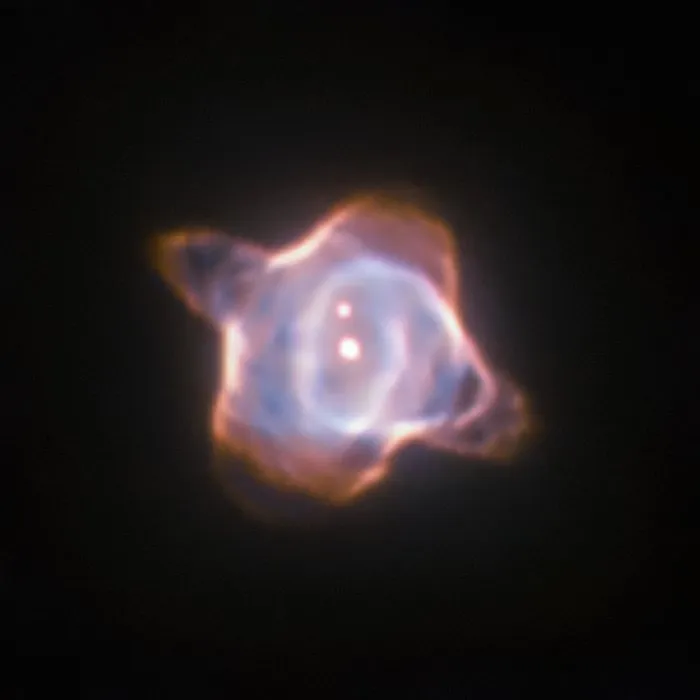
An international team of astronomers -which includes an Argentine astronomer- studied stellar evolution in real time using Hubble. Over a period of 30 years the dramatic increases in the temperature of the star SAO 244567 were observed. Now the star is cooling down again, in a rebirth of a previous stage of stellar evolution. This is the first time this "rebirth" phenomenon has been observed during both the heating and cooling periods.
Although the Universe is constantly changing, most processes are too slow to be observed on human timescales. But now, an international team of astronomers has observed an exception to this rule.
"SAO 244567 is one of the rare examples of a star that allows us to witness stellar evolution in real time", explained Nicole Reindl from the University of Leicester, lead author of the study. "In just twenty years the star has doubled its temperature and it was possible to observe the ionization of its previously ejected envelope, now known as the Stingray Nebula".
The star lies 2,700 light-years from Earth, at the center of the nebula, and its evolution has been observed over the last 45 years. Between 1971 and 2002 the star's surface temperature soared to 40 thousand degrees Celsius. Now, new observations made with the COS spectrograph on Hubble revealed to scientists that the star has begun to cool and expand.
This is unusual[1], though not entirely unknown, and the rapid heating could easily be explained if one assumes SAO 244567 had an initial mass of 3 to 4 times the mass of the Sun. However, the data show that the star must have had an original mass similar to our Sun. Such low-mass stars evolve on much longer timescales, so the rapid heating has been a mystery for decades.
In 2014 Reindl and her team proposed a theory that resolved the issue of both the temperature increase and the low stellar mass. They suggested the heating was due to what is called a helium flash event: a brief ignition of helium outside the stellar core [2].
This theory has clear implications for the future of the star: if it indeed happened that way, this would force the central star to begin expanding and cooling again, returning to its previous evolutionary phase. This is exactly what the new observations confirm and it's well worth a big Eureka!
As Reindl explained: "The release of nuclear energy by the flash forces the already very compact star to expand back to giant dimensions, the rebirth scenario".
It's just one example of such a star, but it's the first time it has been observed in both stages of this "transformation".
Stellar evolution models run into problems explaining this behavior. "We need to refine the calculations to explain some details in the behavior of SAO 244567. That would help us not only to better understand the star itself, but would provide a better understanding of the evolution of the central stars of planetary nebulae".
The work was published in MNRAS and besides the aforementioned lead author, the paper was also signed by Marcelo Miller Bertolami (UNLP-CONICET, Argentina), whom we congratulate from here for his excellent professional work which is not recent, but has been going on for many years studying this type of phenomenon together with other distinguished scientists from the same institution.
PS: One could hope for some "rebirth" of scientific dissemination and outreach at UNLP, which has not given it coverage on the University's website nor on the site of the Faculty of Astronomy and the IALP. Listen up!
Sources and related links
[1] Another star thought to have undergone a similar experience (helium flash) is FG Sagittae. However, other objects go through "rebirth" scenarios like the Sakurai's Object.
[2] Helium flash events, also known as late thermal pulses, occur at the end of the evolution of 25% of low and intermediate mass stars. After leaving the main sequence, these stars enter the red giant phase, in which they expand dramatically. Several changes occur in the chemical and physical composition of the stars during this phase, until they run out of helium in the core which is then composed of carbon and oxygen. Helium fusion continues in a thin shell around the core, but then it ends. This allows hydrogen fusion to begin above the helium shell. By fusing hydrogen, helium is formed which, when accumulated sufficiently, fuses again, generating the late pulse that ultimately causes the star to expand, cool and temporarily increase in brightness.
Breaking news from the HST: The central star of the Stingray Nebula is now returning towards the AGB
Nicole Reindl et al
MNRAS (2016)
DOI: 10.1093/mnrasl/slw175
Astronomers observe star reborn in a flash https://www.spacetelescope.org/news/heic1618/
About the images
The image of the Stingray Nebula, a planetary nebula 2,700 light-years from Earth, was taken with Hubble's WFPC2 in 1998. At the center of the nebula, the star SAO 244567.
Credit: ESA/Hubble & NASA