A collection of links to music, images and videos that relate art and science. Today: Images of Jupiter, M27, Antlia Dwarf Galaxy. Sounds: Chacarera Júpiter. Video: El chavo.

Images of the decade
Hot auroras on Jupiter
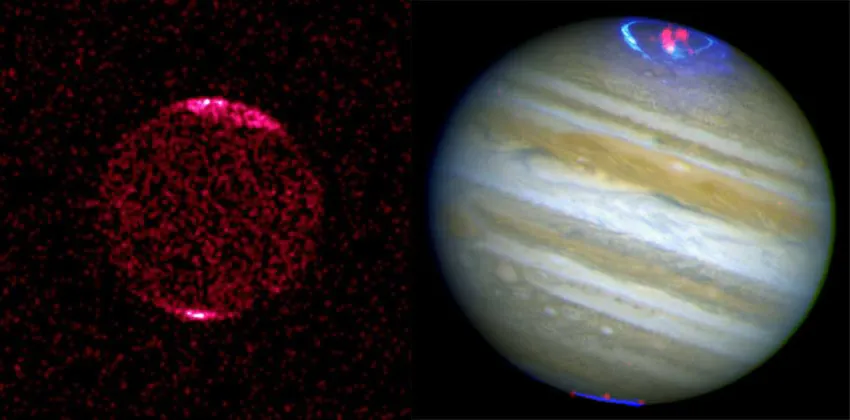
These images of Jupiter show concentrations of X-rays in the auroras near the planet's magnetic poles. The Chandra Observatory observes the giant's entire 10-hour rotation and thus detected that the X-rays from the north configure a "hot spot" that pulses with a period of 45 minutes.
It is thought that the X-rays are produced by energetic ions of oxygen and sulfur trapped in the magnetic field.
The image on the left was produced after 10 hours of observation on December 18, 2000 (when the planet of the Great Red Spot was 650 million kilometers from Earth) and was released on February 27, 2002 (along with a publication in Nature -G.R. Gladstone et al. Nature 415, 1000).
The research had its value because although X-rays had already been detected on Jupiter, this was the first time they were located so close to the poles, which went against theoretical models.
The image on the right is a composite of X-ray, UV and optical from Chandra and Hubble.
Credits X-ray: NASA/CXC/SWRI/G.R.Gladstone et al.; UV: NASA/HST/J.Clarke et al., Optical: NASA/HST/R.Beebe et al.)
M27 is not a comet
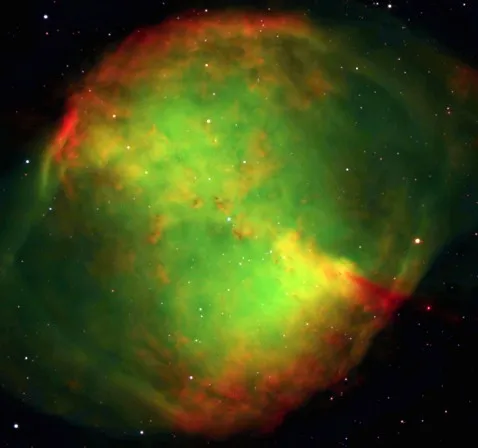
While searching for comets in the 18th century skies, Charles Messier recorded this object as number 27 on his list. It is what is known as a planetary nebula, although it has nothing in common with planets, except that in more modest telescopes than today's, these nebulae were seen with a circular shape, so they looked like planets. However M27, also known as the Dumbbell Nebula, is the result of the expulsion of the outer layers of a Sun-like star as it nears the end of its stellar life. The visible glow is generated by atoms excited by the star's intense ultraviolet radiation. This object is 1200 light-years away in Vulpecula.
This splendid color image of M27 was achieved during the testing of one of the telescopes of the European Southern Observatory (ESO).
Credit: FORS Team, 8.2-meter VLT, ESO.
It was NASA's Astronomy Picture of the Day (APOD) on March 2, 2002. And in Observatorio.
Images of the week
The Antlia Dwarf Galaxy sprinkles the sky with stars
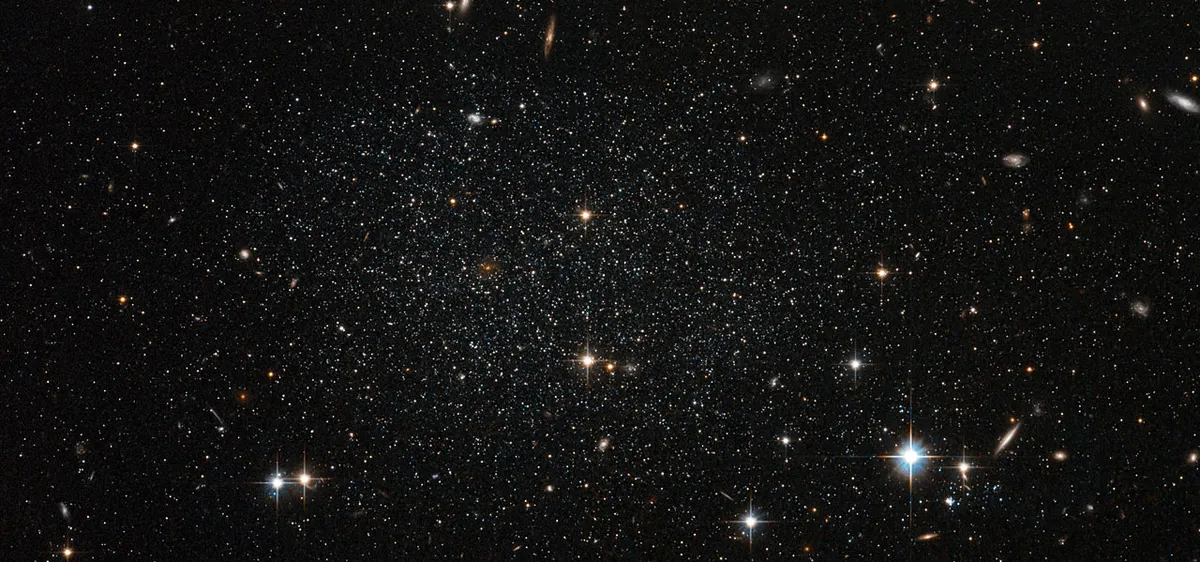
This myriad of faint stars that make up the Antlia Dwarf Galaxy are more than 4 million light-years from Earth, but this Hubble image offers such clarity that they could be mistaken for closer stars, in our Milky Way. This faint and scattered small galaxy was only discovered in 1997. Despite its size, the object is of great appeal as it possesses stars in different stages of evolution. It is not entirely clear whether the object is part of the so-called Local Group of neighboring galaxies.
As I pointed out, the subject is extensive. So much so that it forms part of the thesis proposals for bachelor's and doctoral degrees at the Universidad de La Plata. There, some members of the Research Group in Globular Clusters and Dwarf Galaxies have studied this sector of the sky.
Credit: NASA/ESA Hubble.
It was the Image of the Week of the Space Telescope.
Walking under the stars
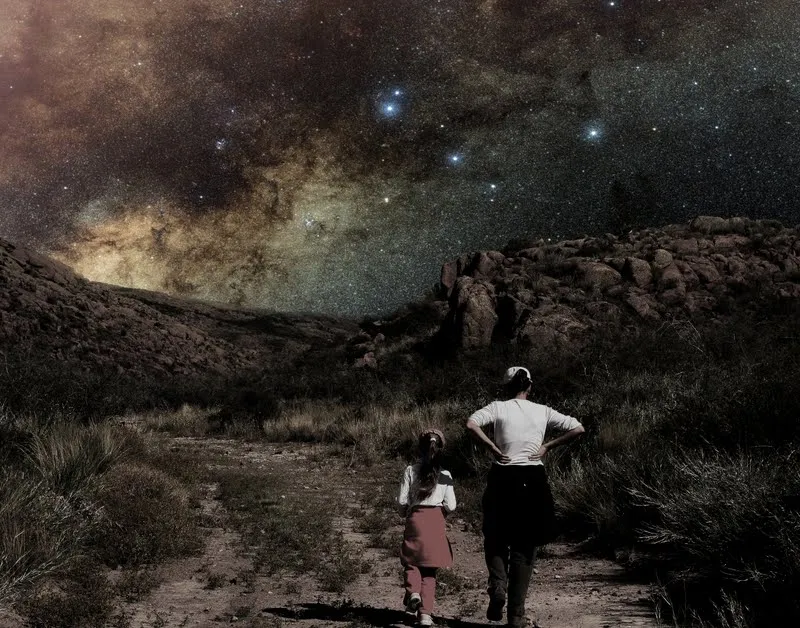
Has the reader ever walked under a night sky like the one in the photo? The woman and the girl in the image haven't either.
It is a composition made by Carlos Di Nallo. According to what he explains on his blog, the photomontage was "made with a shot of a landscape in Parque Nacional Liheul Calel with a photo of a wide field taken in Areco. As a result it has given a strange landscape, perhaps because of how desolate the Pampean desert is crossed by the immensity of the sky and us there, walking, bearing witness that we belong to this union".
Credit: Carlos Di Nallo.
It was the Amateur Astronomy Picture of the Day (AAPOD) on February 27, 2012.
Space Music
Jupiter is Argentine
Many musical pieces allude to the gas giant and not necessarily for astronomical reasons. Here I present Chacarera Jupiter by Nico Posse from his album Desnudos and which also appears on Otros desnudos. There is a version with the trio completed by Rodo Palmieri and Sebastián Borromeo on Soundcloud.
Posse, author with Mono Morello of the Ópera Martín Fierro, composed and played with several artists, among them Fabiana Cantilo. With Faby and Fernando Noy he composed Júpiter which appears on the album ¿De qué se ríen? by Cantilo. The video of the track is on Vimeo and on YouTube (the latter shows the lyrics).
Why is it that things associated with space (and with the future and with vampires) invite dressing in latex, I don't know...
Animated Science
El Chavo in astronomy class
As we already know, the great Mexican actor Roberto Gómez Bolaños was hospitalized while the recording in homage to his career was being made. The program “América celebra a Chespirito” will be broadcast on 11/3 and the actor is already well, according to reports from the press. The comedian was moved by the tribute offered by his peers, although perhaps saddened by the absence of La Chilindrina and Kiko who reportedly did not attend the aforementioned program.
Maybe because I felt nostalgic, maybe because I'm nostalgic, I remember fondly the neighborhood of El Chavo and the other characters like Doctor Chapatín and Chapulín Colorado.
I also remember other TV series from when I was a kid, like Odisea Burbujas (the one with Abejorro and Ecoloco).
http://youtu.be/gyPmuOXWZdU
Also, the Sun 3D
This week a new NASA SDO video was released (Solar Dynamics Observatory) of images of the Sun for viewing with 3D glasses.
To access previous editions of this section, consult the Multimedia Selection Series. The series attempts to show that the immensity of the universe can be perceived in different ways, by choosing some images from a decade ago -so they don't fall into oblivion- and from the current week that ends, as well as sounds, music and videos that are artistic forms of expression and with content related to astronomy and related sciences.