A collection of links to music, images and videos relating art and science. Today: Images of N44C; Planets over Stonehenge; A Satellite with a Compass; The Moon as a Mirror. Music: Pablo Masiá. Video: The Transit of Venus.

Images of the decade
Gaseous filaments flutter in a stellar breeze
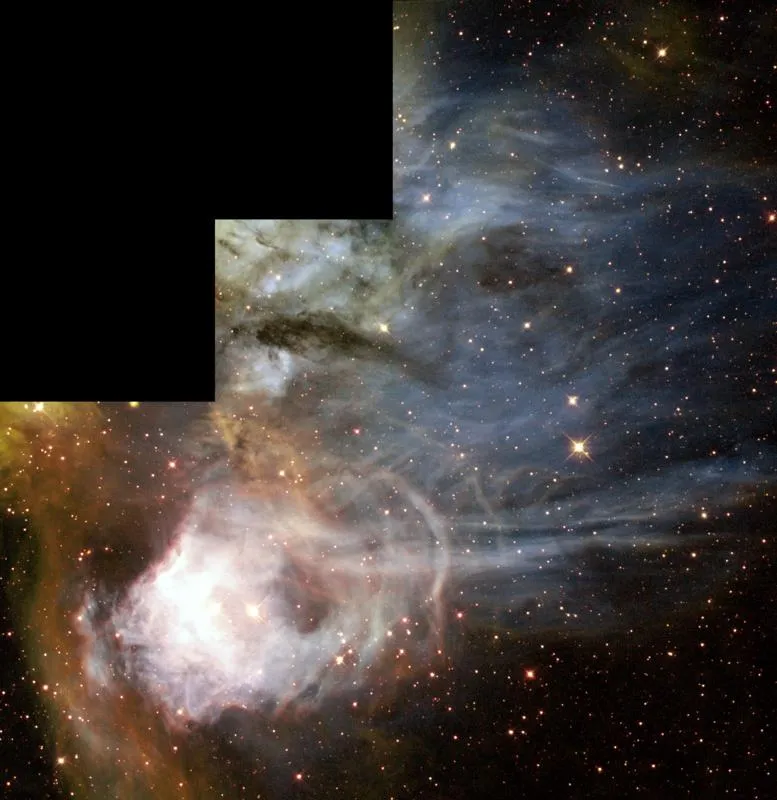
Resembling the hair in the famous painting of the birth of Venus by Botticelli, soft glowing filaments flow from a complex of young stars.
The image portrays the N44C nebula, taken by Hubble. This region of glowing hydrogen surrounds an association of young stars in the Large Magellanic Cloud. The star that predominantly illuminates the nebula is incredibly hot. The most massive stars, between 10 and 50 times the mass of our Sun, have maximum temperatures between 30,000 and 50,000 degrees Kelvin (in degrees Celsius it's almost the same). But the star that illuminates N44C appears to be much hotter, with a temperature of 75,000 K!
The gaseous filaments of the nebula (which look like the hair in the painting) surround a Wolf-Rayet star, another type of star characterized by a very vigorous wind of charged particles. The collision of these particles with the surrounding gas generates that glow in the gaseous filaments.
The nebula is part of the N44C Complex, which includes hot and massive stars, nebulae, and a "superbubble" generated by multiple supernovae. It lies in the constellation Dorado, 160,000 light-years from Earth.
The data were taken in November 1996 with Hubble's WFPC2 by Donald Garnett and collaborators. Later, the image was composed by the Hubble Heritage team and published on HubbleSite on May 9, 2002.
NASA and The Hubble Heritage Team (STScI/AURA)/D. Garnett (University of Arizona)
Planets over Stonehenge
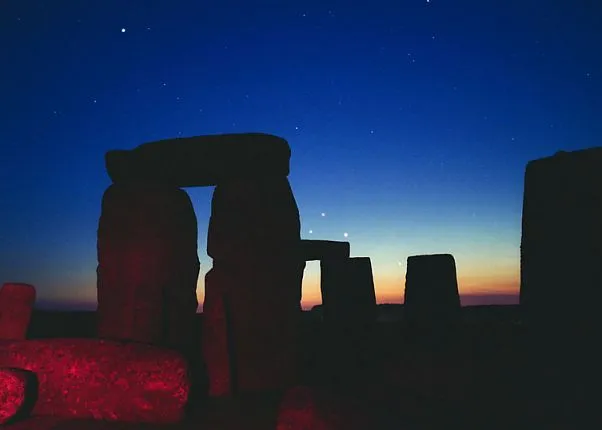
The stones of the Bronze Age megalithic monument in England are about 4,000 years old, but this image is more recent. It was a fabulous alignment of planets: Jupiter, the brightest, is at the top left. Below and to the right, a triangle formed by Saturn on the left, Mars at the top and Venus on the right is clearly seen.
Struggling against the glow of the recently set Sun, Mercury is perceived near the horizon. If we draw a line down from Mars, passing through Venus, we reach Mercury, in this image.
The photograph does not date from 2000 BC like the stones, but was obtained on the afternoon of May 4, 2002 AD by astrophotographer Philip Perkins, on whose page we can see an annotated version. Before going there, dear reader, and considering that the other bright points in that sky are not planets, but stars, can you identify any? Jupiter was around Gemini and the planetary triangle through Taurus.
It was NASA's Astronomy Picture of the Day (APOD) for May 9, 2002. Also on Observatorio.
Credit and Copyright: Philip Perkins.
Images of the week
A satellite with a compass
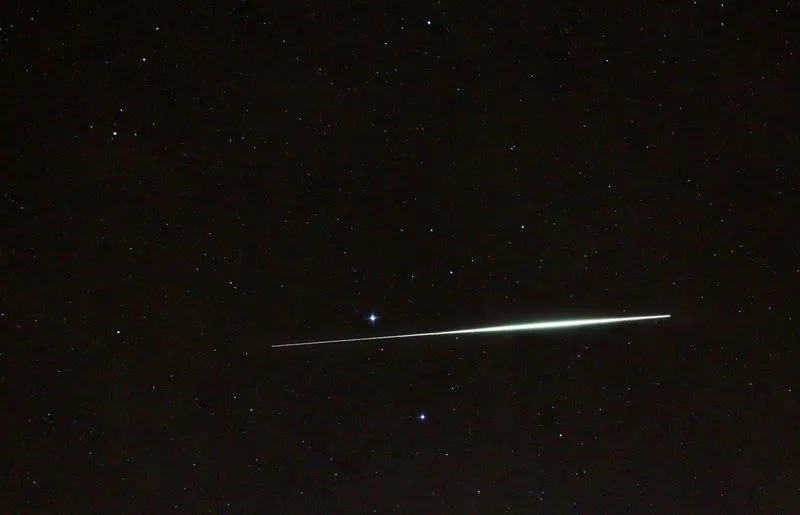
Although some might suspect that what is portrayed in this image is not of this world, the truth is that it is very human. It is the glow produced by the antennas of satellite 50 of the Iridium constellation. No, it's not that Iridium is a constellation of stars, it is a set of satellites. Number 50 was responsible for this glow (commonly called a "flare") which in this case had a magnitude of 7. The constellation of stars, on the other hand, in that area of the sky was Pyxis, the compass. The bright star near the flare is gamma pyxis.
The astrophotographer who made the shot, the Argentine Luis Argerich, says that he used calsky to predict when the flare would occur.
Then he used Stellarium to locate the position and took several exposures to center the camera with a 135mm lens on the spot where the glow would be seen.
It was the Amateur Astronomy Picture of the Day (AAPOD) for May 9, 2012.
Credit: Luis Argerich (http://www.luisargerich.com/)
The photo was taken, according to AAPOD, on January 28, 2012, from Buenos Aires, and, although not indicated, it is possible to say that it was at 21:50 h (via CalSky).
Using the Moon as a mirror
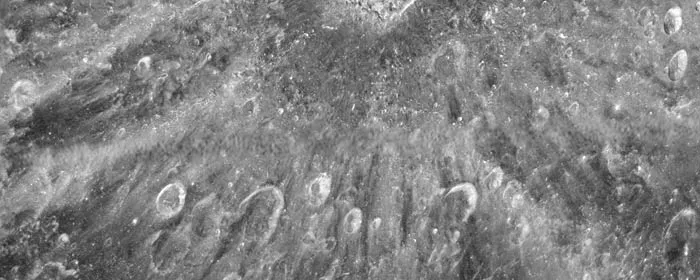
This speckled landscape showing crater Tycho is one of the most characteristic of our Moon. But astronomers did not point Hubble in that direction to study the crater itself. The image was taken in preparation for the transit of Venus in front of the Sun on the upcoming June 5/6. (See below in Video).
Since Hubble cannot look directly at the Sun (nor should the reader), astronomers planned to point the telescope at the Moon and use it as a mirror to capture reflected sunlight. During the transit, a small fraction of the Sun's light will have passed through Venus's atmosphere and thus astronomers hope to find traces that allow them to know more about the inner planet.
These observations will mimic a technique already used for the atmospheres of giant exoplanets that pass in front of their stars. In this case, astronomers already know the chemical composition of Venus's atmosphere, but they can use the event to test whether that technique can detect the fragile traces of the atmosphere of an Earth-like planet orbiting another star.
The image shows an area 700 kilometers in diameter and reveals lunar details as small as 170 meters in diameter. The impact, top of the photo, was caused by an asteroid 100 million years ago. Tycho is about 80 km wide and is surrounded by a ring of material rising nearly 5 km above the crater floor.
The image was obtained on January 11, 2012 and was the Space Telescope Image of the Week.
Credit: NASA/ESA Hubble.
Space Music
Today: Pablo Masiá: After the Supernova
On Jamendo, Pablo introduces himself as a self-taught artist from Pallejà (Barcelona), Spain.
From his vast production, of which I have only listened to a few albums, I highlight the work titled After the Supernova, which contains tracks with titles related to astronomical themes and whose sound evokes cosmic landscapes. It includes Dawn in the Fields of Venus, another reference to the planet, which has served as a leitmotif for this weekly installment.
I especially liked tracks number 6 and 12.
I will surely comment on other works by Pablo in the future because what I heard I loved. Among other things, the Futura Project, of which the artist was a part, is noteworthy.
Animated science
Today: The transit of Venus
As I pointed out above, regarding Hubble's photo of the week, the transit of the planet Venus across the Sun can be observed on June 5/6 in many places on the Planet.
The event is not only beautiful in itself, but can also translate into new scientific knowledge, for example to recalculate the Earth-Sun distance or, as indicated above, to test techniques applied to exoplanet atmospheres.
The NASA Eclipse site has diagrams and tables with specific information.
To my reader friends in the Latin American Southern Hemisphere, I recommend bookmarking another NASA page, SunEarthDay, from which the event will be broadcast thanks to the Mauna Kea Observatory in Hawaii.
For the inhabitants of Latin America in the Southern Hemisphere, the transit will not be visible.
In several countries in Africa, Portugal and part of Spain, it will also not be observable. In contrast, the lucky inhabitants of parts of Australia, Japan or Hawaii will be able to see the entire transit.
In Latin America it will be visible in Peru, Colombia, Venezuela, Ecuador, Central America and Mexico. As a reference, in Quito it can be observed from 22:05 (UTC) on June 5, while in Spain it will be seen in some northwestern regions around 04:35 (UTC) on the 6th of this month.
The image Ut supra was part of the preparations for Hubble's observations of the Moon during the transit, which must be planned carefully since the next time a transit of Venus across the Sun will occur is in 2117! A fact that is highly eloquent for observers located in places where the event is visible. It's a once-in-a-lifetime thing...
To access previous editions of this section, consult the Multimedia Selection Series. The series attempts to show that the immensity of the universe can be perceived in different ways. I choose some images from a decade ago -so they don't fall into oblivion- and from the current week that ends, as well as sounds/music and videos that are artistic forms of expression with content related to astronomy and related sciences.