A collection of links to music, images and videos relating art and science. Today: Images of Andromeda; Tethys; NGC 6164; and NGC 891. Music: Andrómeda, by Pablo Masiá. Video: La soledad de la Luna.

Images of the decade
Island Universe of Andromeda
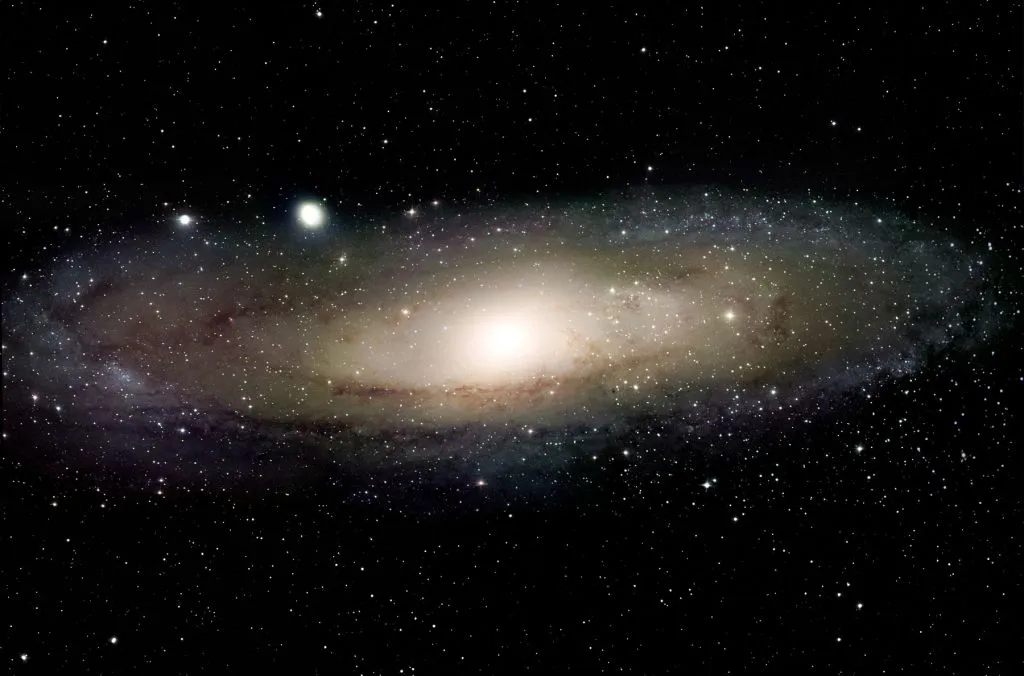
The most distant object visible to the naked eye is M31, the Andromeda Galaxy, about 2 million light-years away. Even without a telescope, this immense spiral galaxy appears as a diffuse nebula in the constellation Andromeda.
In this image, however, we can observe the yellow and bright nucleus and dark areas, the spiral arms and globular clusters.
In the image, M32 is also perceived and near that other galaxy the presence of the bright HD3914 is notable. See on Sky-Map.
Currently, there is no doubt about the existence of other galaxies like M31, but not a century ago, the idea of "island universes" was questioned. The famous Great Debate Shapley-Curtis of 1920 was resolved, in part, thanks to observations of the Andromeda Galaxy.
Credit & Copyright: Robert Gendler.
It was NASA's Astronomy Picture of the Day (APOD) for May 18, 2002. Also on Observatorio.
Saturn's moon: Tethys
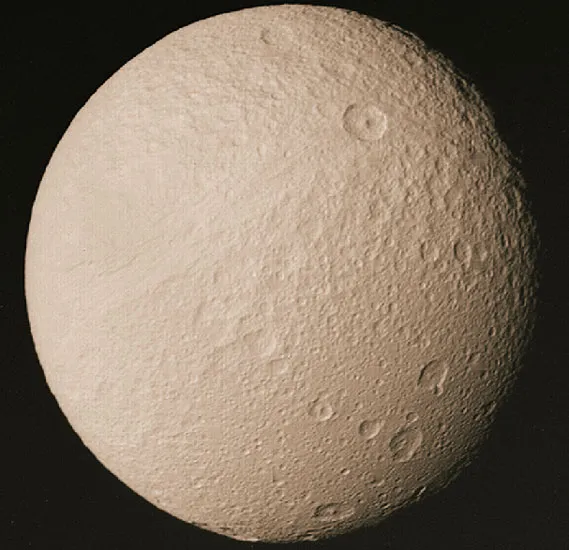
Tethys is one of the largest and closest moons of Saturn.
It was visited by the Voyager 1 probe in November 1980 and by Voyager 2 in August 1981. Later, the Cassini probe flew by the moon in 2005 and 2007.
Tethys is composed almost entirely of water ice.
To date, 62 moons have been found at Saturn, 53 of which have names. Tethys is a small moon 1066 km in diameter that orbits almost 300,000 kms from the ringed planet. It is similar to its sisters Dione and Rhea, although it does not have as many craters as those natural satellites.
Two of the main surface features are the crater Odysseus or Ulysses, whose diameter is two-fifths that of Tethys. Such an impact could have shattered a solid body, suggesting that the satellite's internal composition was partially molten.
Another feature is the Ithaca Chasma valley, the supposed homeland of Ulysses (Ithaca). It is 100 kms wide, 3 to 5 km deep and extends for 2,000 kms.
Giovanni Cassini discovered Tethys in 1684.
Credits: Voyager Project, NASA; Copyright: (digital w/colortable): Calvin J. Hamilton.
It was NASA's Astronomy Picture of the Day (APOD) for May 19, 2002. Also on Observatorio.
Images of the week
NGC 6164 Planetary Nebula
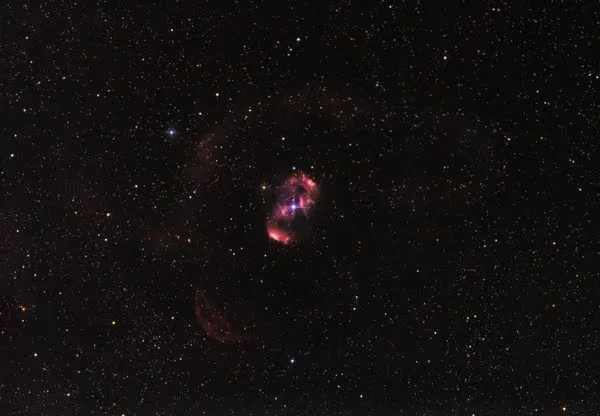
With a 254mm aperture Newtonian reflector and 1200 focal length (F/D=5) and a modified Canon EOS 350D + filters and a lot of patience, the Argentine amateur astrophotographer Omar Mangini, from Buenos Aires, captured this beautiful planetary nebula NGC 6164. The emission nebula was created by an O-type star (HD 148937) with 40 times the mass of the Sun. It lies 4,200 light-years away in the constellation Norma. We can see an image taken at Gemini South of this nebula.
Credit: Omar Mangini.
It was the Amateur Astronomy Picture of the Day (AAPOD) for May 17, 2012.

A beauty, edge-on
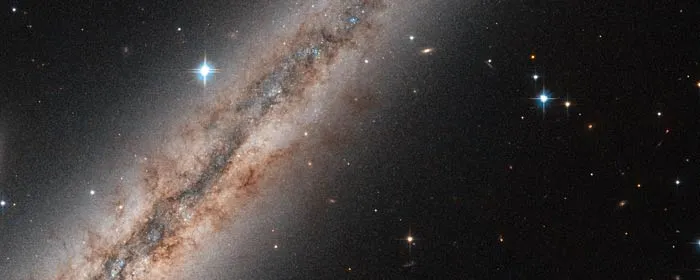
Visible in the constellation Andromeda, NGC 891 is located 30 million light-years from Earth. Hubble pointed towards this spiral galaxy and took this photo of the northern half of the object. The central bulge is out of the image, in the lower left region.
The galaxy extends 100,000 light-years and from Earth we see it edge-on, which reveals its plane of dust and gas. Detailed observations revealed the existence of filaments of dust and gas escaping from the plane of the galaxy. Astronomers think those filaments are the result of material ejection due to supernovae or intense star formation. A version of this image entered the Hubble Hidden Treasures Contest by participant Nick Rose.
Credits: NASA/ESA Hubble.
It was the Space Telescope Image of the Week.
Space Music
Today: Andrómeda by Pablo Masiá
Last week I published music by this Spanish artist in this same section and promised more, as he is a prolific musician.
The first four tracks (Pársecs I-IV) of this work titled Andrómeda, are a single theme, as the author indicates on Jamendo.
The eighth track of the album refers to Saturn and both the name of the work and two of its tracks refer to M31.
Animated Science
Today: La Soledad de la Luna (2011)
When the city lights steal your memories, there is always a way to recover them.
Direction: Javier Marco (Spain)
Production: Javier Marco
Script: Belén Sánchez-Arévalo
Actors: Drakko, Victoria Ortiz de Zárate
More at http://cortometrajes.org/
To access previous editions of this section, consult the Multimedia Selection Series. The series attempts to show that the immensity of the universe can be perceived in different ways. I choose some images from a decade ago -so they don't fall into oblivion- and from the current week that ends, as well as sounds/music and videos that are artistic forms of expression with content related to astronomy and related sciences.