A collection of links to music, images and videos relating art and science. Today: Images of Tadpole Galaxy, Cone Nebula, the "mice" and M17. The moons of Earth. The eye of the storm. M83: a remarkable explosion from an old black hole. Music: Mir by Doc. Video: The story of a kiss between the Sun and the Moon.

Images of the decade
Impressive views of the universe
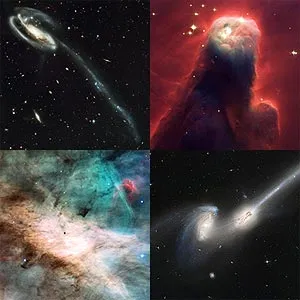
In March 2002, through spacewalks, the world's most famous space telescope, Hubble, had a servicing mission (STS-109) through which the Advanced Camera for Surveys (ACS) was added, along with a new power unit, solar panels and a cooling unit.
With the new camera, in April of that year, four impressive views of the cosmos were presented that took the breath away from astronomers and the rest of the world.
To demonstrate the capabilities of the ACS, light from UGC 10214, the Tadpole Galaxy, a barred spiral that suffered disturbances lying 400 million light-years from Earth, was captured. Another photograph portrayed "the mice" of NGC 4676, at 300 million light-years: two colliding galaxies.
The same was done with the Cone Nebula (NGC 2264), closer to home, at 2,500 light-years. And finally M17 or the Omega Nebula. The area in that photograph is about 3,500 times larger than the solar system. This nebula lies 5,500 light-years from Earth.
The images were published on HubbleSite on April 30, 2002.
On the site you can get the images that make up this collage separately.
Credits: NASA, H. Ford (JHU), G. Illingworth (UCSC/LO), M.Clampin (STScI), G. Hartig (STScI), the ACS Science Team, and ESA.
The Moons of Earth
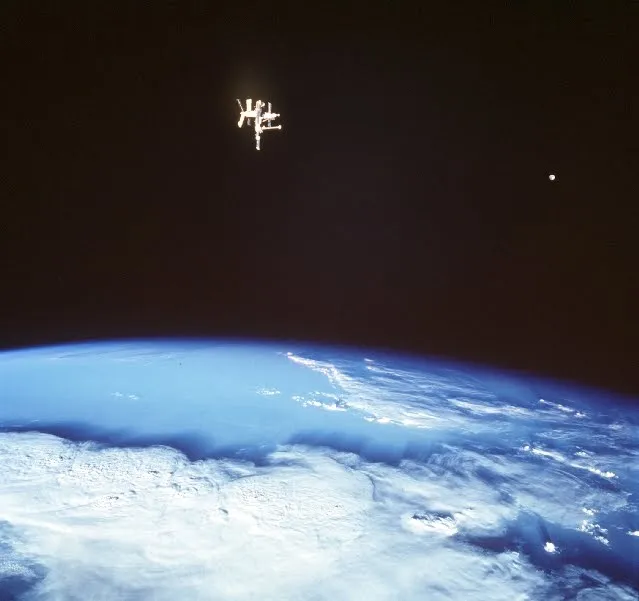
This image was taken by the crew of STS-91, aboard the space shuttle Discovery.
What is seen is a part of the planet's atmosphere, with stormy clouds, the Moon and the Russian space station Mir, which a few years later would have a final descent.
It was NASA's Astronomy Picture of the Day (APOD) for May 4, 2002. Also on Observatorio.
Credits: STS-91, NASA
Images of the week
The eye of the storm
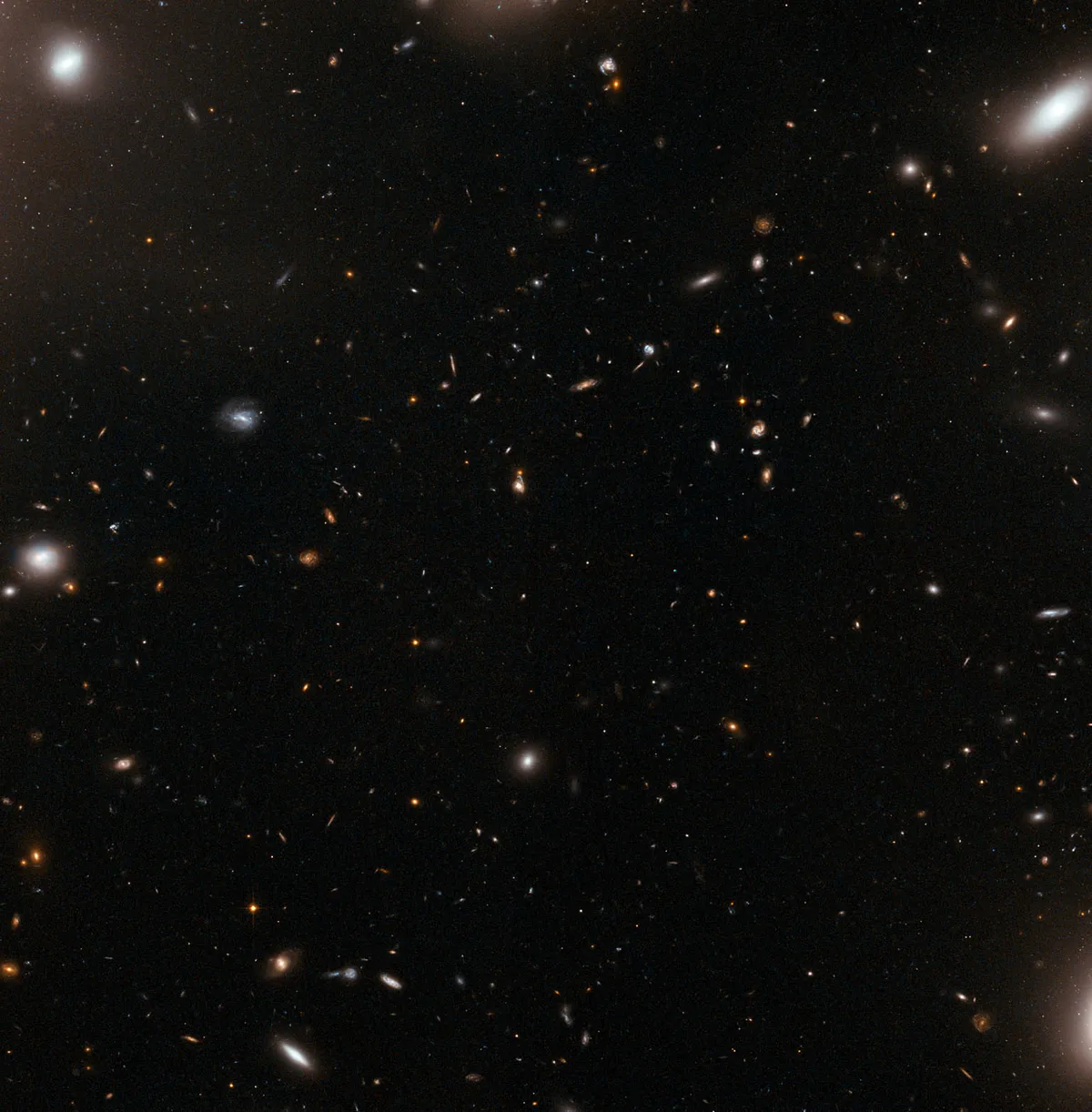
This Hubble image might look like a tranquil region of the sky. But the first impression is deceptive. If we approached the center of the galaxy cluster it would be like being in the eye of the storm.
Galaxy clusters are large groups of dozens to hundreds of galaxies, related by gravity. The enormous gravitational forces can produce distortions in the galaxies (as we saw in the Hubble photos from 2002). This particular cluster, called Abell 1185, is chaotic. Galaxies of various shapes and sizes approach each other dangerously. Some have already been very distorted, spilling trails of matter into the void and creating "shapes" in space. Although it's not noticeable in this photograph, there's a guitar around there.
Abell 1185 is located 400 million light-years away and extends a million light-years.
It was the Space Telescope Image of the Week.
Credit: NASA/ESA.
M83: a remarkable explosion from an old black hole
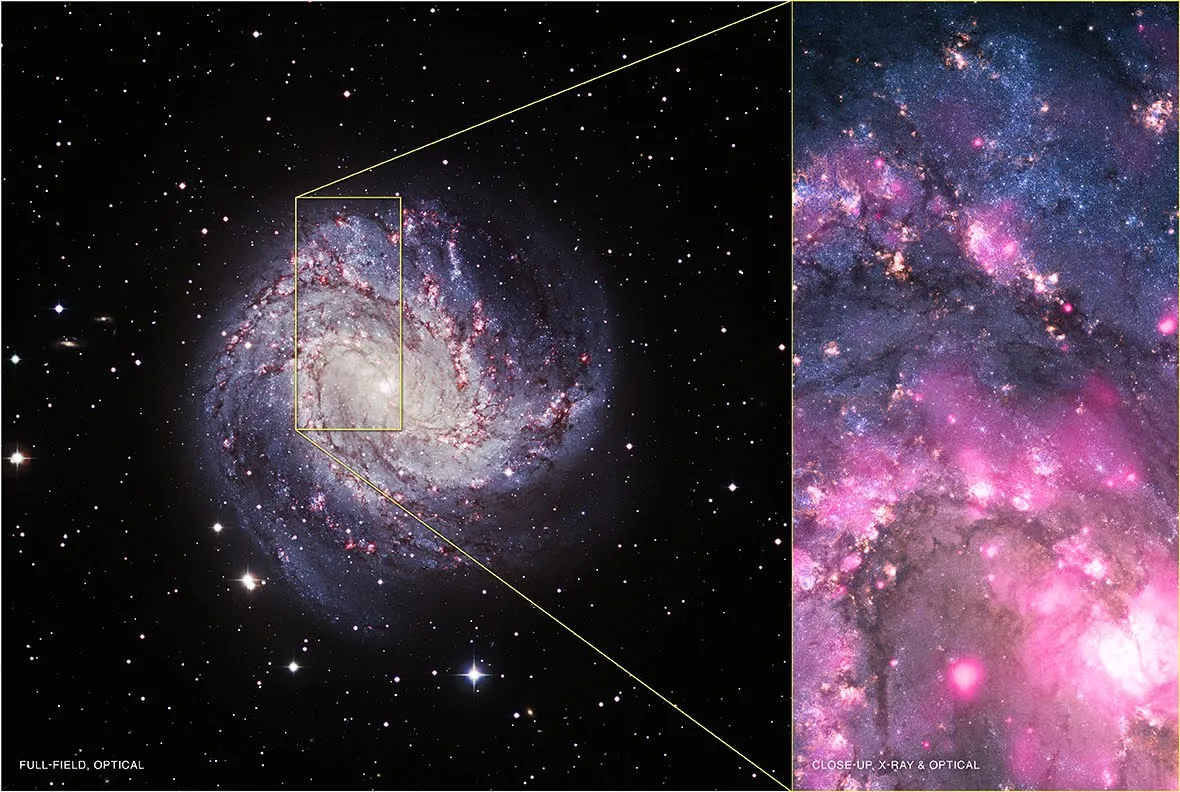
The Chandra X-ray Observatory found an extraordinary outburst from a black hole in the spiral galaxy M83, 15 million light-years from home. Using Chandra, astronomers found an ultraluminous X-ray source (ULX), objects that generate more of that energy than "normal" binary systems in which a star orbits a neutron star or a black hole.
On the left we see an optical image of M83 taken by ESO's VLT in Chile. On the right we see a composite showing Chandra's X-rays in pink and Hubble's optical data in blue and yellow. The ULX source is located at the bottom of the right image as a bright pink dot.
In Chandra's observations, over several years, the ULX in M83 increased its brightness in X-rays at least 3,000 times! This sudden brightening is one of the largest changes in those wavelengths ever seen in an object of this class.
Optical images reveal a bright blue source at that same position during the outburst, but that source is not observed before. This implies that a red giant with a mass less than 4 times that of the Sun was wandering near a black hole.
The star would be over 500 million years old and according to theoretical models, the black hole should have a similar age. Astronomers think the bright emission seen during the outburst was caused by a disk surrounding the black hole that shone dramatically as it gained more material from the star.
The image was published on Chandra on April 30, 2012.
For the more interested, there are details of the research on Chandra's blog.
Credits: Optical: ESO/VLT; Close-up - X-ray: NASA/CXC/Curtin University/R.Soria et al., Optical: NASA/STScI/Middlebury College/F.Winkler et al.
Space Music
Today: Mir by Doc & Lena Selyanina
Doc is an ambient/electronic music artist from Finland. Here is a track about Mir. We can get to know Doc's music on the netlabel Musictrade, on Jamendo and on SoundCloud.
Animated Science
Today: Kiss, a love story
A short animation about the consequences of a kiss. A love story between the Sun and the Moon in an eclipse.
The short film has a website at http://www.kiss.racecar.no/
"The Sun is the past, the Earth is the present and the Moon is the future"
Paul Auster
Director: Joseph Hodgson & Franck Aubry
Animation & Art Direction: Joseph Hodgson & Franck Aubry
Production: Racecar - racecar.no
Sound design: Erlend Elvesveen & Sven Erik Nordset
Mix: Erlend Elvesveen
Music: 'Stille' by Bendik
Kiss - A Love Story from RACECAR on Vimeo.
To access previous editions of this section, consult the Multimedia Selection Series. The series attempts to show that the immensity of the universe can be perceived in different ways. I choose some images from a decade ago -so they don't fall into oblivion- and from the current week that ends, as well as sounds/music and videos that are artistic forms of expression with content related to astronomy and related sciences.