The application of the Fray Jorge Park in the Coquimbo Region, Chile, as the fourth Starlight Reserve in the world has begun.
The National Tourism Service (Sernatur) of Chile (Coquimbo Region), in close collaboration with CONAF, the regional government and with the technical support of the Department of Physics of the University of La Serena and the Office for the Protection of the Quality of the Sky of Northern Chile, presents, in an unprecedented initiative in Chile and Latin America: the start of the process that will allow the Coquimbo Region to become one of the first tourist destinations with a Starlight Reserve, certified areas that add specific protection, such as the defense of the night sky and access to starlight.
The National Director of the National Tourism Service, Daniel Pardo, highlighted the relevance of this initiative: "We want to position astronomical tourism as an alternative, not only for national and international tourists interested in experiencing this type of special interest tourism throughout the year, but also for amateur visitors to the discipline who will find here a great place for observation."
These Starlight reserves are areas that, regardless of the guarantees they may enjoy due to their location and nature, add specific protection in the defense of the quality of the night sky and access to starlight, their main function being to value and protect the associated resources, whether cultural, scientific, astronomical, natural and landscape.
There are other initiatives that have already obtained this Reserve certification and others that are declared "Tourist destinations." Many other cities have already adopted the Starlight Declaration.
The Director of Sernatur Coquimbo Region, Adriana Peñafiel, stated: "This is a great boost to make ourselves known as a pioneering region in sky certification at the Latin American level and which only has three points on the planet; Lake Tekapo in New Zealand; Monfragüe National Park and the North Coast of Fuerteventura, both in Spain, which gives us a great advantage to position ourselves with astronomical tourism, with the largest number of observatories in the world."
This Starlight Tourism Certification system was created with the aim of promoting, worldwide, the improvement of the quality of tourist experiences by guaranteeing the ability to properly enjoy stargazing and the protection of night skies, bringing together scientific, cultural, natural and landscape values of the area.
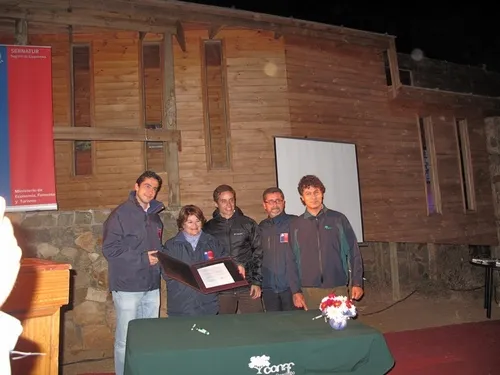
To prepare the implementation of the Certification of Fray Jorge as a Starlight point in the world, work is being done jointly with the advice of the Department of Physics of ULS, the Office for the protection of the quality of the sky of Northern Chile and Astronomers from scientific observatories such as El Tololo. Measurements will be carried out throughout 2012 to obtain the certificate in December 2012, being a major step towards obtaining recognition of the Coquimbo Region's sky as a World Heritage Site.
In total, the Coquimbo Region is unique in the world for the number of observatories it concentrates in its territory (16 in total)
5 Scientific: Tololo, Gemini, SOAR, Campana and La Silla
3 Municipal: Mamalluca (Vicuña), Collowara (Andacollo) and Cruz del Sur (Combarbalá)
8 Private tourist: Mayu (Quebrada de Talca), Pangue (Vicuña), Cancana (Cochiguaz), Hacienda Los Andes (Rio Hurtado), Observatory La Serena (Hinojal), IntiRuna (Vicuña), Valle del Sol (Ovalle) GHC Hospedaje (Chillepin, Choapa)
Why Fray Jorge
The Fray Jorge Forest National Park is a national park located in the Limarí Province of the Coquimbo Region, near the city of Ovalle. It was created in 1941, in order to preserve one of Chile's most exclusive ecosystems. In 1977 it was declared a Biosphere Reserve by UNESCO.
It is for these reasons that the park already has a base and a list of parameters that it meets due to its status as a biosphere reserve, facilitating its preference as a Starlight Reserve and generating more background to become in the next step a World Heritage Site.
Regarding its microclimate, the places proposed for observation are located in the core of the park, in a lower area free from the humidity produced in the sectors near the Talinay mountain range.
Sources and related links
- Coquimbo promotes the quality of its skies
- Starlight
- Starlight Declaration (In defense of the night sky and the right to observe the stars)
- A journey to stars, valleys and mountains
About the images
- Starlight logo. Credit: Starlight.
- Photograph: Sernatur.