Allow me, reader, a slight reflection on topics as distinct as basic sciences, currency restrictions and freedom.
I always think, when reading others and when sitting down to write, that relating diverse topics is a double-edged sword, sometimes a cul-de-sac, generally, a hodgepodge.
But, at the same time, it awakens neurons, at least in the one who writes, even if the result is a salad. It also allows giving some order to ideas. Here I go.
For some time I have wanted to address a problem that could be titled "Justification of astronomy". I explain what I mean: doing astronomy (I specifically refer to professional research) implies two things, apparently, contradictory. On the one hand, it is about knowing more about topics that will not generate (prima facie) any practical benefit for society. And on the other, they require an economic expenditure. Is this contradictory? No. But it can become so when considering that this money comes from the State's coffers. And that, simultaneously, there are many other needs, more basic or fundamental, unsatisfied.
How to justify, from the State, that distribution of funds? How to sustain basic research, particularly in astronomy, considering that it requires money, which could well be used for other, more urgent purposes, to study brown dwarfs or pulsars?
It's a whole topic. And one I like. Unfortunately, when asking these questions to many scientists, the answers given are weak. It is pointed out that without science there would be no progress. That the most fruitful States are those where more research is done. Does that answer the question? I think not. Yes, it is possible that this is so, it would not be right to ignore that reality, but how to explain that if we invest in the study of globular clusters or Bok globules, that will result in a social benefit?
I will not develop here a whole set of ideas I have on the matter that would answer the question. Know that I am preparing specific material on the subject. But it is at least possible to begin to answer the interrogation, if we pose the same thing, in another way. And that other way will lead me directly to concepts of politics and, ultimately, of freedom, which is where I want to get.
SCIENTIFIC POLICY
If, as I indicated above, astronomy does not generate (in the first instance) a benefit for society, then, what would happen if that research activity were left only in the hands of private activity?
It must be known that astronomy, as well as other basic sciences, can indeed produce "social" benefits through education and the transfer of knowledge and technology. Those are subtopics that I have dealt with here on some occasions and that should be part of the question, but they are not the core and here I will let it pass.
The question I just asked is linked to private activity and its motivation: economic utility. Studying black holes or supernova remnants does not result in economic benefits. If research were exclusively a private activity, then, there would be no research, there would be no way to justify it because private activity only admits a tangible benefit of an economic type.
That is why it is the State that must carry out that research. But that, at the same time, implies an interference by the State.
There are those who embrace the idea of freedom, considering that the State should not meddle, that it should "let us do". It is the "Laissez faire" of the free market.
It would be fabulous if we had enormous freedom to do what "we fancy", I tell myself, scratching my mustache. But, it happens, that I speak in the third person plural: an undefined, heterogeneous, contradictory "us". We are not all white sheep in this flock. There are those who possess enormous amounts of land, while others have nothing.
Look: recently I heard an agricultural leader point out that he "only has 50 hectares", while there are others, larger, who own 60/70 thousand ha. Of course, between 50 and 70,000 there is an enormous difference. But I live in an apartment of 30 m2. A hectare is a plot of 100x100, that is, 10 thousand square meters. And 50 ha is half a million square meters! And that guy complains that "he is doing badly".
Let society manage itself with minimal state intervention and the result will not be "freedom", because those who have the most will always impose themselves on those with fewer resources. They will impose THEIR rules on us, those that only favor them.
Is that freedom?
That kind of freedom would end science as we know it, which rests on a motivation of knowledge, without considering extra benefits, although they may occur.
By the way, at this point, although I will not delve into it on this occasion, distinctions such as those made by Varsavsky in reference to "luxury science" versus the need to solve social problems through science should be noted. (1)
But what has been said so far, with astronomy as an example, tries to account for something we already know: there is no freedom without rules. And those norms should not be imposed by the one who has the most to the detriment of the one who has the least, nor will we tolerate that our actions are justified solely on the basis of an exclusively economic benefit. And that is why the State must intervene and guarantee rights.
THE FREEDOM OF YESTERDAY, THAT OF TODAY, THAT OF TOMORROW
They say that when an idea is repeated a lot, even the most brilliant ones, they cease to be so. But the speech of Benjamin Constant, from 1819, remains a classic.
Ancient peoples were smaller, more susceptible to the friction of war, while their citizens had greater intervention in public affairs, directly. Later, commerce replaced armed conflicts and citizens had, we have, less participation in the affairs of the State, through representative democracies. I quote Constant:
They will tell us: "What is, in essence, the purpose of your efforts, the motive of your labors, the object of your hopes? Is it not happiness? Well, that happiness, let us act and we will give it to you.” No, gentlemen, let us not let them act. However touching that tender interest may be, we beg the authority to remain within its limits. Let it limit itself to being just, we will take care of being happy. (2)
And it is that, at the same time that we recognize the participation of the State in our lives, through our representatives -by considering that this is the best way to administer public affairs- it is possible that we let ourselves be, and they run over us.
FREEDOM AND DOLLAR
Currently, in Argentina, there is a feeling that freedom is at stake because a minority is restricted from the possibility of buying dollars. The restrictions, to tell the truth, apply to a majority, but it is a small fraction of society that "needs" to acquire that foreign currency.
Those who proclaim a lack of freedom are none other than those who propose themselves as Libertarians. That freedom they proclaim is profoundly deceptive. Their statements sound nice, but a small analysis of the consequences is enough to realize what they imply. They propose, then, that the State stop being welfare-oriented, so that task is left in private hands. It's the tale of Corporate Social Responsibility, behind which there is nothing but cheap marketing whose only concern is to sell more to increase revenue and profits (yes, there are exceptions, which are just that).
Those who promote this "libertarian" system are the ones it benefits most. It is those who have the most who care that the State does not regulate, so they will be the ones who impose themselves because they are the ones with the greatest resources.
But, as I indicated above, through the quote from Constant, being against these ideas, expressed as such, does not imply that we let our freedoms rest on political representation, without more. There we must demand accountability.
It should not be tolerated that such interference is for the benefit of the friends of power. Thus, while it is possible to understand State intervention in the monetary market, this is no obstacle to demanding balance and justice in State actions. And we should not tolerate double discourse. Where has the principle of reciprocity gone?
ANCIENT AND MODERN CYNICISM
We live today in a provocative world (See RAE: Provocar). It feels as if, in the most massive and popular media, no communication is worthwhile if it does not appeal to impact, to provocation.
In the same way, many political statements are provocative. They appeal to emotions, to patriotic feelings, grand statements that hide nothing but contrary actions by those who utter them.
It is no longer the cynicism of Diogenes of Sinope, which by the way was a stripped-down attitude, detached from the material. It is modern cynicism: "it can perhaps be summarized in shamelessly defending what is considered morally and socially inconvenient or indefensible, and even in manifesting, without the slightest blush, a shameless contradiction between what is said and what is done, has its origin, surely, in the way the cynics themselves were seen (one can discuss whether correctly or not) by their fellow citizens", as indicated by Alfonso Fernández Tresguerres. (3)
BELIEVING AND THINKING
I recently wrote here about Expectation and Reality. This discourse goes in the same direction. Not letting ourselves be carried away by statements. Demand reasons, think, before believing. Otherwise we would be easily manipulated both to argue that the State must intervene in our lives, and to argue the contrary. And although I classify myself as a relativist, because ideas have different values according to the frame of reference with which they are compared, that does not mean that everything is worth the same or that nothing is worth anything. I don't usually think in absolute terms (this, it must be said, brings with it certain contradictions, particularly in the ethical realm), but that should not lead us to think that then everything has the same value. One plus one is two. In other parts of the Multiverse (if such a frame of reference exists) there could be different physical laws, other dimensions that could lead us to think that there one plus one is different from two. Ergo, such a statement could not be considered absolutely true. But let's not confuse reality and possibility. Today, here and now, one apple plus another is two apples. And whoever says otherwise must prove it. It matters little if the apples move me, if they are from my own orchard and not from someone else's, what matters is the justification.
I return to Constant's discourse: "Moreover, gentlemen, is it so certain that happiness, whatever it may be, is the only end of the human species? In that case, our career would be very narrow, and our destiny very undistinguished, there is none of us who, if he wished to descend, restrict his moral faculties, reduce his desires, renounce activity, glory, generous and profound emotions, could brutalize himself and be happy. No, gentlemen, I bear witness to this excellent part of our nature, this noble restlessness that pursues and torments us, this ardor to extend our lights and develop our faculties: it is not only happiness, it is to perfection that our destiny calls us; and liberty is the most powerful, the most energetic means of perfection that heaven has given us." (4)
We all want to be happy. Ignorance ensures happiness for those with narrow views. For the rest of us, it will be hard to achieve it. We will doubt because the world, reality is deceptive and our ideas, subjective. But it is then that we manifest our human capacities. Those that allow us to distinguish when a piece of meat is presented to us to make us salivate.
Sources and related links
- (1): Science, politics and scientism and other texts. Oscar Varsavsky, with preliminary study by Pablo Kreimer. Capital Intelectual, Buenos Aires, 2010.
- (2): Discurso sobre la libertad de los antiguos comparada con la de los modernos, Benjamin Constant. From Revista de Estudios Públicos N° 59, winter 1995, Oscar Godoy (compiler), Pontificia Universidad Católica de Chile.
http://www7.uc.cl/historia/vinculos/2006/vatter_revoluciones.pdf - (3): On ancient and modern cynicism, by Alfonso Fernández Tresguerres. http://www.worcel.com/archivos/6/cinicos.html (02-06-2012)
- (4): Constant, op cit.
About the images
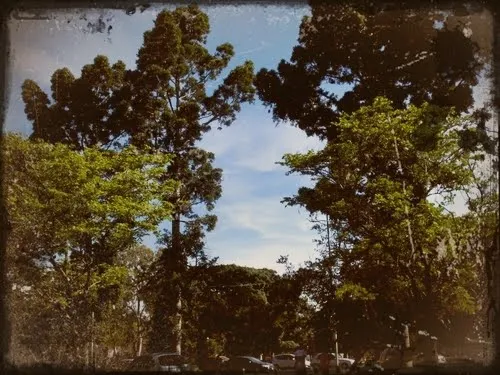
- The initial image, which looks like an old photo, was obtained by me in the Palermo woods on November 20, 2010. The photo records trees, bordering the Planetario de la Ciudad, whose tops seemed to me to form an upward Arrow shape.