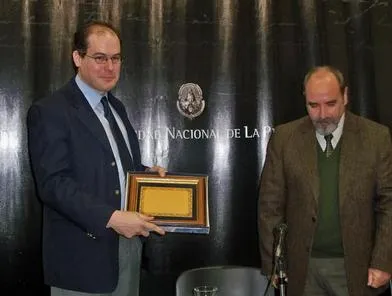
Dr. Santiago Grigera was awarded by the European Physical Society for his work on magnetic monopoles in spin ice.
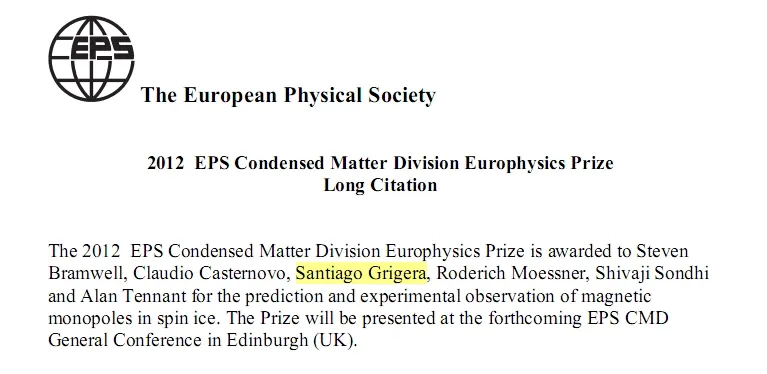
On May 29, the European Physical Society (EPS) announced that the 2012 prize of the Condensed Matter Division was awarded to researchers Steven Bramwell, Claudio Castelnovo, Santiago Grigera, Roderich Moessner, Shivaji Sondhi and Alan Tennant for the prediction and experimental observation of monopoles in spin ice. The award will be presented at the next Conference of that division in Edinburgh between September 3 and 7.
What are known as spin ices are a class of magnetic systems with large residual entropy at low temperatures. This material is not found in nature, but is synthesized in the laboratory from compounds such as titanium, oxygen and dysprosium.
In 2009, Grigera was part of a group that published in Science a paper on magnetic monopoles in dysprosium titanate spin ices.
What is a magnetic monopole?
We all know that a magnet has a positive pole and a negative pole. And that if we break the magnet into two pieces, each of them will again have two poles. And we all also know about the relationship between electricity and magnetism. But we also know of the existence of electrons and protons, that is, negative and positive charges, respectively, which are found in nature in separate form. Couldn't the same also happen with magnetism?
As early as 1931, Dirac pointed out that magnetic monopoles must exist as particles with a single magnetic pole associated with what were called "Dirac strings". During the first instants of the Big Bang, these monopoles would have been created according to certain Grand Unification Theories (GUT). But these monopoles have not been found. The hypothesis of Cosmic Inflation proposed by Alan Guth in the 1980s seemed to solve many problems, among them, the mystery of magnetic monopoles, almost homeopathically, like a diluting Deus ex machina. If this were the case, although many of these exotic objects were created at the beginning, since space-time would have expanded exponentially, there would be very few around us.
In 1982, Blas Cabrera (Stanford) - grandson of the great Spanish physicist of the same name and son of Nicolás Cabrera, a physicist at the University of Virginia - indicated that they had detected an event in their search for magnetic monopoles. The detection was not repeated.
Spin ice
Spin ices are "frustrated" magnetic systems. A system is said to be frustrated when it does not have the ability to minimize the energy of all its interactions. A material that behaves like spin ice is dysprosium titanate (Dy2Ti2O7) at a temperature below 1K. These monopoles are not like those proposed by Dirac, but they allow progress in the study of the phenomenon.
For several years now, many physicists have started working along this path.
The experiments are based on the neutron diffraction technique, through which it was determined that this material forms strings similar to Dirac strings through which magnetic flux is transported.
In CienciaNet they explain how the distribution of the magnetic field inside the material is reconstructed.
I also recommend reading the explanations given by the Department of Physics and Chemistry of the IES "Leonardo Da Vinci" on its website.
In the press release, the EPS stated that "among the most exotic and unexpected developments of recent decades is the discovery that the collective excitations of some systems with strong interactions have quantum numbers that are fractions of those belonging to the indivisible individual components. Until now, this type of phenomenon was restricted to one and two dimensions with examples in classical and quantum systems. (...) Now, for the first time, fractionalization has been found in a three-dimensional classical system leading to the unexpected appearance of free magnetic monopoles".
Who is Santiago Grigera?
In this space, I wrote here (Young scientist from La Plata awarded) in 2010 about this repatriated physicist from La Plata.
In the article from the newspaper El Día, there are more details about his upbringing and education. Currently, Dr. Santiago Grigera is a researcher at the Institute of Liquids and Biological Systems Physics (Iflysib) - Conicet and a professor at the Faculty of Exact Sciences of the UNLP.
He has done much work on what is known as "quantum criticality" in strontium ruthenate (Sr3Ru2O7).
What is this discovery useful for?
I quote the words of Grigera himself to the newspaper El Día: "As always, first comes the discovery, then, with time, its application". And he gave an example: "When silicon semiconductors were discovered, many wondered what they would be useful for. Twenty years later the first transistor was created. And today we could not live without semiconductors". A phrase we should stick with a magnet to our cold utilitarianism.
Videos of Santiago Grigera's talk at AFA La Plata
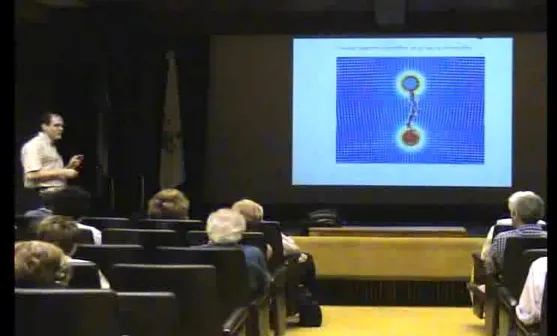
From the website of the Argentine Physical Association La Plata Branch it is possible to access the videos of the outreach talks "The Physics that changes our lives". Santiago Grigera, as part of that series, gave the lecture "One, none and one hundred thousand in Physics" a couple of years ago: The idea of that talk is to tell a bit about some of the surprises and challenges encountered when studying condensed matter from the perspective of physics.
Note written for the XXXII Carnival of Physics, in this edition hosted by Ciencia. To join and read the entries visit Gravedad Cero.
Sources and related links
- EPS CMD Prize 2012 awarded
- Diagonales: The European Physical Society distinguished a researcher from La Plata
- El Día: Major international prize for a physicist from La Plata
- The magnetic monopole, or the applause of a single hand, by Matías Alinovi in Página/12 (JANUARY 9, 2010).
- What is a magnetic monopole in a spin ice, by la Mula Francis (francisthemulenews) 04-18-2010
About the images
- Image of an excerpt from the EPS Press Release
- Image of a segment of Grigera's talks on YouTube