A collection of links to music, images and videos that relate art and science. Today: Images of The Retina Nebula; The Other Lord of the Rings; The Southern Cross; The missing satellite galaxies problem. Music by CosmoMoose. Video: Encounter, a SF short film made with USD 50 and a lot of talent.

Images of the decade
A nebula that looks at us
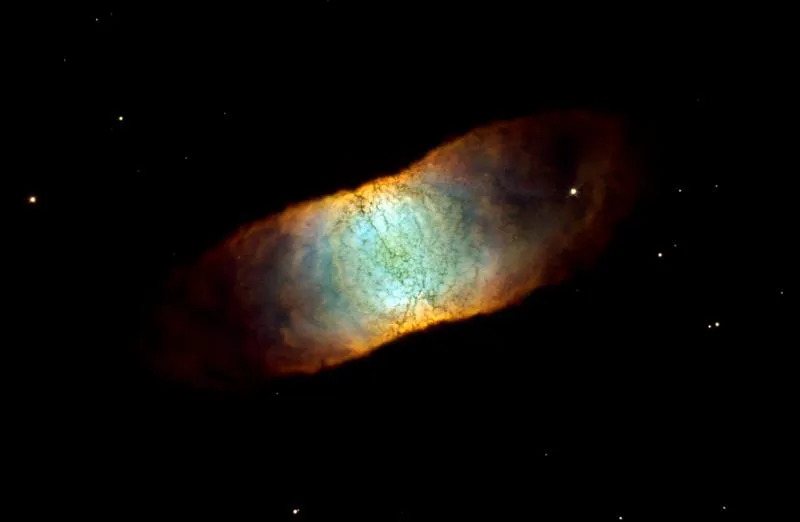
Astronomers used the Hubble Space Telescope to reveal a rainbow of colors in a dying star, IC 4406. Like many other planetary nebulae, it exhibits a high degree of symmetry. The right and left halves are almost mirror images of each other. Due to its shape and the dust lanes created at the boundaries between the cooler and hotter gas, seen from our particular point of view, the nebula looks like a human eye. That is why it is known as the Retina Nebula. It is located in Lupus, the Wolf, 1900 light-years away from Earth.
One of the most interesting features of IC 4406 is the irregular network of dust lanes that cross the center of the nebula. These lanes are about 160 astronomical units wide (1 AU is equal to the Earth-Sun distance). The image is a composite of data taken by Bob O'Dell (Vanderbilt University) with the WFPC 2 camera and collaborators and by the Hubble Heritage team.
Credits: NASA and The Hubble Heritage Team (STScI/AURA)//C.R. O'Dell (Vanderbilt University)
The image was presented on HubbleSite on June 13, 2002.
The other lord of the rings
Allow me to recount that a while ago, I rated Jupiter as "The lord of the rings," to the astonishment of a reader who thought I had made a huge mistake. Certainly we usually call Saturn by that nickname, but although Jupiter's rings are much fainter, it is the great planet of our Solar System.
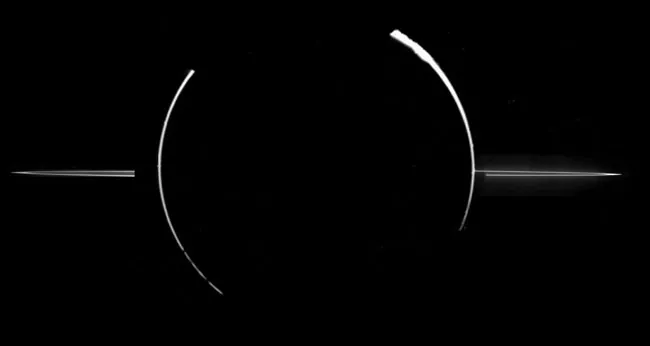
That is why this simple monochrome image may not be visually striking, but it is. The rings of the planet with the Great Red Spot were discovered in 1979 by the passage of Voyager 1. The rings are thought to be remnants of material created by meteorite impacts on nearby moons.
What we see in the image is a solar eclipse by Jupiter, seen by the Galileo spacecraft.
Credits: M. Belton (NOAO), J. Burns (Cornell) et al., Galileo Project, JPL, NASA
It was NASA's Astronomy Picture of the Day (APOD) for June 16, 2002. Also on Observatorio.
Images of the week
Cross, Fly, Coal Sack, and the rhea
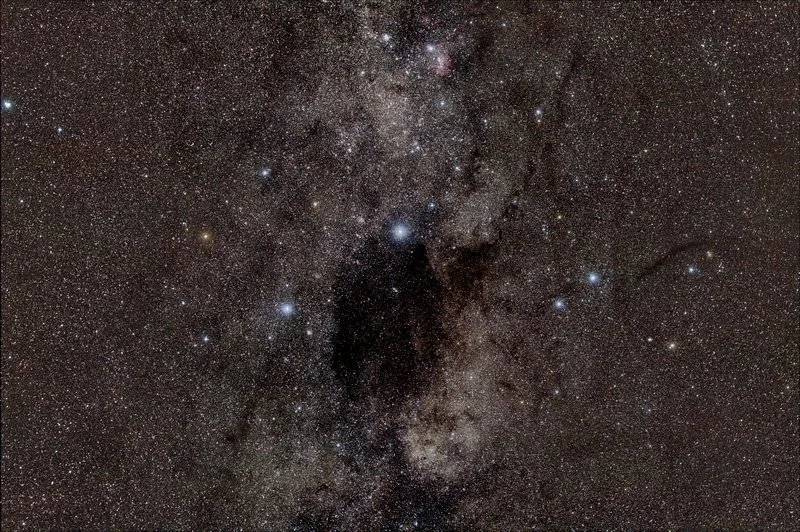
This beautiful photographic portrait of the famous Southern Cross also shows the constellation of the Fly with the Coal Sack nebula.
The area was seen as the signs of a rhea by pre-Columbian cultures, native to South America. It is particularly interesting to observe in a dark night sky, when the constellation is high, how the dark Nebula seems like the head of the Suri and its body extends lengthwise along the Milky Way.
For those who wish to know about the native myths associated with this area I recommend consulting:
Crux at Observatorio San José
The page of Doctor Mariela Corti (FCAGLP UNLP) (Right frame/Extension)
The photograph was taken by Diego Gentili from Mina Clavero, Córdoba, Argentina and was the Amateur Astronomy Picture of the Day (AAPOD) for June 15, 2012.
The missing satellite galaxies problem
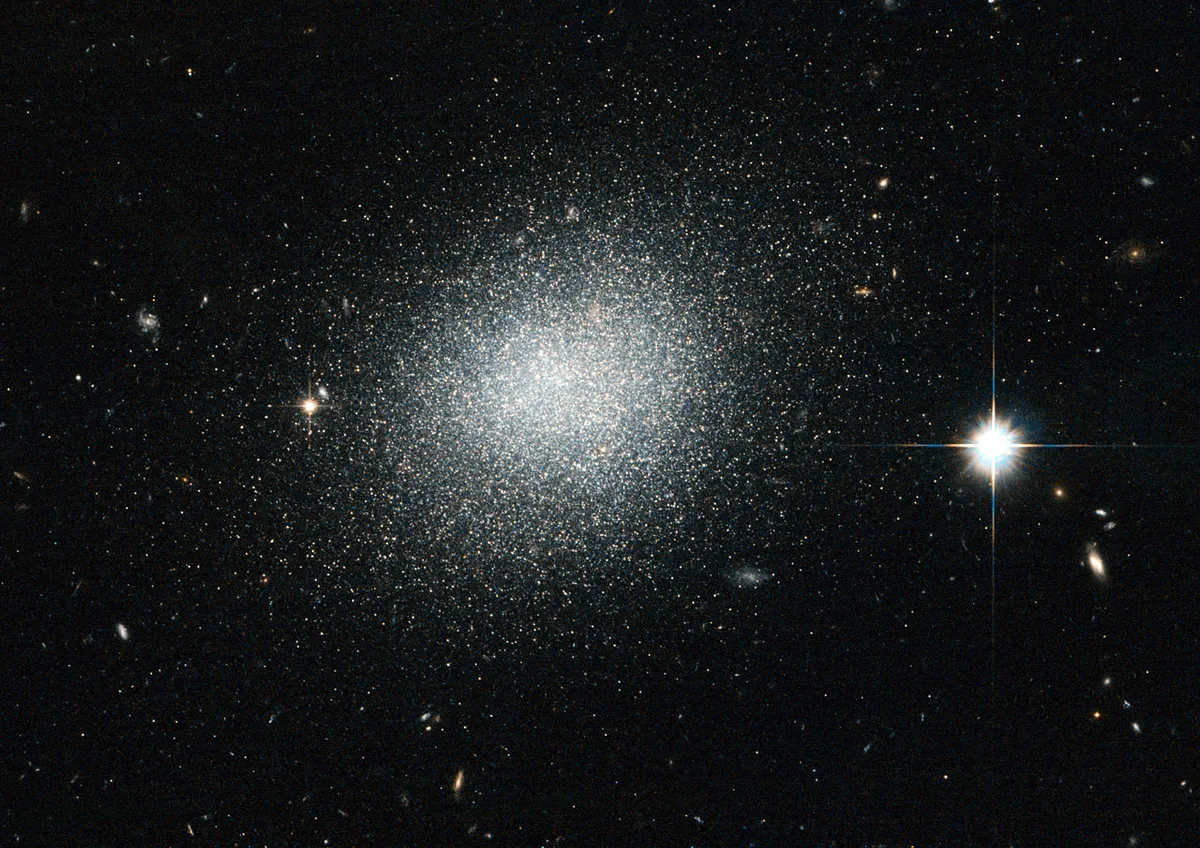
With the Hubble Space Telescope, astronomers captured this view of the dwarf galaxy UGC 5497. It is a compact dwarf galaxy where new clusters of blue stars are emerging, coloring its appearance.
The object is considered part of the M81 group of galaxies, 12 million light-years away in Ursa Major. It was discovered in 2007.
According to the LCDM model of galaxy formation (cold dark matter + dark energy) there should be many more dwarf satellite galaxies associated with large galaxies like M81 and the Milky Way than are known.
Another question that arises from the image is: how much difference is there between this object, classified as an Ultra Compact Dwarf Galaxy, and Globular Clusters? Some are asking.
It was the Hubble Space Telescope Image of the Week.
Credit: NASA / ESA Hubble
Space Music
Today: The mission of Galileo
CosmoMoose is the artistic name of Chris Medway (Great Britain). Here is a track in tribute to the discoveries of Galileo Galilei.
Animated Science
Today: Encounter
The beautiful thing about this brief science fiction tale is that it was made with just USD 50 and with just 4 people, among whom its director stands out, who was at the same time everything else (screenwriter, director of photography, etc.), except that he does not appear on camera (although a relative does).
It is the final project of Philip Grishayev from the Polish Japanese Institute of Information Technology (PJIIT). The work can also be seen on Vimeo.
To access previous editions of this section, consult the Multimedia Selection Series. The series attempts to show that the immensity of the universe can be perceived in different ways. I choose some images from a decade ago -so they don't fall into oblivion- and from the current week that ends, as well as sounds/music and videos that are artistic forms of expression with content related to astronomy and related sciences.