A collection of links to music, images and videos relating art and science. Today: Images of NGC 4697, 4649 and 1553; NGC 4013; Messier 99; NGC 7822. Music: Tribute to Ray Bradbury. Video: The 2012 Transit of Venus.

Images of the decade
Distant black holes in X-rays
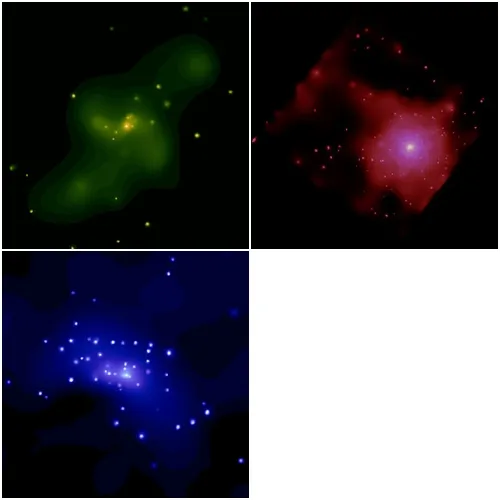
Using the Chandra X-ray Observatory, astronomers observed three elliptical galaxies cataloged in NGC as 4697, 4649 and 1553.
"The black holes and neutron stars we see in these elliptical galaxies are reminders of their very active past," said Craig Sarazin of the University of Virginia, leader of the team of astronomers who made the observations.
The Chandra press release was accompanied by three images of the elliptical galaxies taken in X-rays. The white dots in each are due to black holes and neutron stars in binary systems.
NGC 4697 is located in Virgo at a distance of 40 million light-years. NGC 1553 is found in the constellation Dorado, 70 million light-years away. And NGC 4649, also in Virgo, is 60 million light-years away.
The three images were presented on the Chandra site on June 4, 2002.
Credits: NGC 4649: NASA/CXC/UVa/S.Randall et al. NGC 1553: NASA/CXC/UVa/E.Blanton et al. NGC 4697:NASA/CXC/UVa/C.Sarazin et al.
A golden ring in the heart of a galaxy
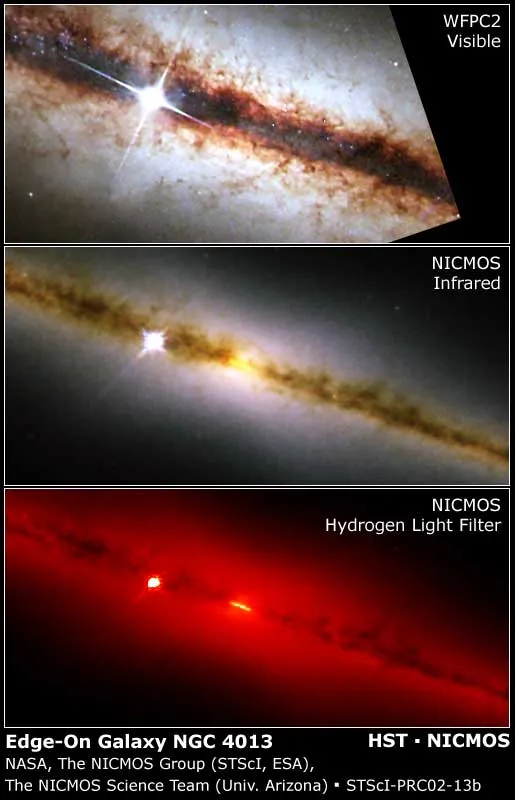
Using the Near Infrared Camera and Multi-Object Spectrometer (NICMOS) aboard Hubble, astronomers found a bright band-like structure, which could be a ring of new stars (the yellow band in the middle photo), seen edge-on.
In visible light (the top photo) the ring is not perceived because it is shrouded in dust. But the NICMOS instrument can observe at other wavelengths, such as near-infrared, and penetrate the dust. The ring-shaped structure surrounds the nucleus of this galaxy NGC 4013 and has a diameter of 720 light-years, a typical size for star-forming rings found in disk galaxies.
The bottom image was taken with a filter sensitive to hydrogen. The very bright star seen is a neighbor of the Milky Way and does not belong to NGC 4013, a galaxy that resides in Ursa Major, 55 million light-years from Earth.
The images were published on June 5, 2002, following the Hubble servicing mission that installed a refrigerator on the observatory which allowed the NICMOS instrument to be revived after three years of inactivity. The instrument had been installed on Hubble in 1997 in a container with solid nitrogen that evaporated after two years, in 1999, at twice the expected rate. From then until 2002 the instrument could not be used until servicing mission 3B in March 2002.
Credits: NASA, the NICMOS Group (STScI, ESA), and the NICMOS Science Team (University of Arizona)
Images of the week
A bright spark in a nearby spiral galaxy
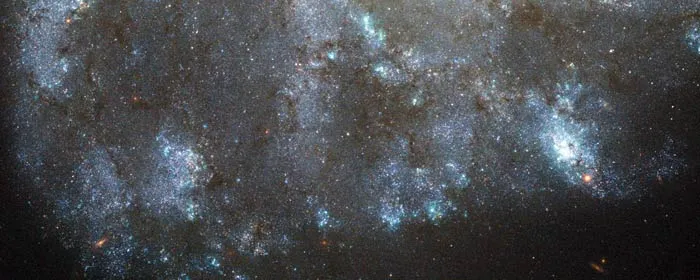
This image, taken with Hubble, shows a detailed view of the spiral arms on one side of the galaxy Messier 99, 50 million light-years from Earth.
In recent years astronomers have studied different phenomena there. Among them, the nature of the brightest stars visible in this image. Cataloged as PTF 10fqs and visible as a yellow-orange star at the top left in the photo, it was first seen by the Palomar Transient Factory (PTF) which scans the skies for sudden changes in brightness. What is unusual here is that PTF 10fqs is brighter than a nova, but less than a supernova.
(Like that joke by S. Harris!)
The Hubble image was taken in June 2010. A version of this image entered the Hubble's Hidden Treasures contest by contestant Matej Novak.

Credits: ESA/NASA Hubble.
It was the Space Telescope Image of the Week.
NGC 7822 in Cepheus
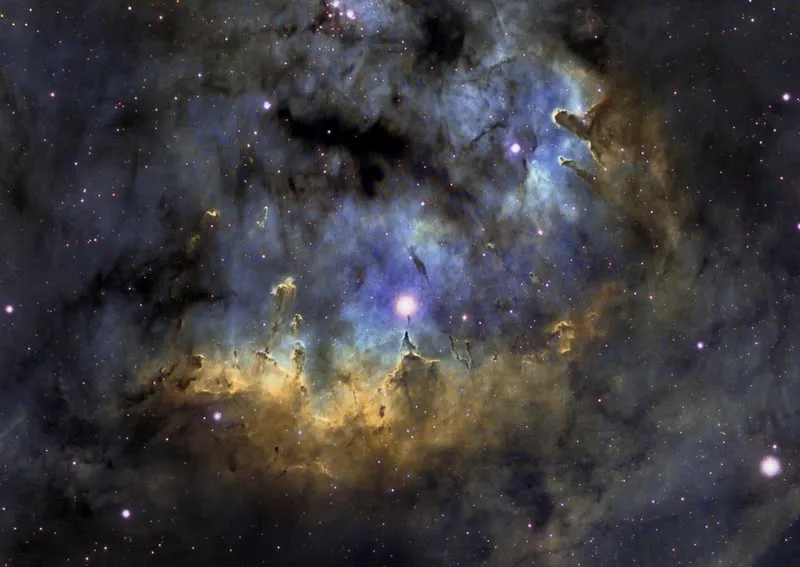
Using a Takahashi TOA 130 apo, Manuel Fernández achieved this fantastic nebular landscape corresponding to a star-forming region about 3 thousand light-years away in the direction of the constellation Cepheus.
The image was taken in November 2011 from León, Spain.
It was the Amateur Astronomical Picture of the Day (AAPOD) on June 8, 2012. Earlier, on November 16, 2011 it was chosen as the APOD photo!
Space Music
Today: Tribute to Ray Bradbury
I intended to put music related to the transit of Venus here. But the physical disappearance of Bradbury made me change my mind. To achieve both things I indicate some topics related to the astronomical phenomenon, but today's song will be a remembrance of the great science fiction author.
Ray Bradbury
The great thing about great science fiction authors is that they are not tied to the genre. Genres are forms of classification and, therefore, of pigeonholing. They are also a "formula" loaded with stereotypes. These conventions help the viewer/reader identify topics, to know what it's about. They also generate expectations, but at the same time they are a reductionist view based on themes and their setting. Fortunately, great storytellers manage to use genres to raise issues beyond the anecdotal. Bradbury's work responds to the characteristics of the science fiction genre, but at the same time it is an excuse to raise a social, cultural critique.
One of my first contacts with his work was...by radio. Yes, the radio host Hugo Guerrero Marthineitz, unfortunately deceased two years ago, whom we knew in Argentina as "the talkative Peruvian," used to read the stories from "The Martian Chronicles" on the radio.
That prompted me to later read Fahrenheit 451 and The Illustrated Man. The three works mentioned were brought to the big screen. Also "A Sound of Thunder".
Among the stories I remember with the greatest impact is "And the Moon Be Still as Bright," from The Martian Chronicles. The one that asked (and answered): "What is the purpose of living?"
In memory of Ray, a track created by Translunar (Darrell Farnsworth) in tribute to the great writer.
Links to music about the Transit of Venus
- There is an opera with this title. It is a work in three acts with music by Victor Davies and libretto by Maureen Hunter.
- William Zeitler, in his Music of the Spheres, speaks of the Sphere of Love and the Sphere of Will, in reference to Venus and the Sun respectively.
And he has performed the first theme with his glass harmonica.
John Philip Sousa, the "March King", was an American composer and conductor who wrote a march for the Transit of Venus.
Animated science
Transit of Venus 2012
From these latitudes we could not observe the transit, but thanks to the internet and the GLORIA project, we were able to observe it virtually.
Here is a video of the first and second contact, from Japan, but there are more videos on the GLORIA site.
http://youtu.be/OIp1_V1FLQg
I also recommend watching the high-definition video achieved by NASA.
And also the material from NASA on the special site for the 2012 Transit of Venus.
To access previous editions of this section, consult the Multimedia Selection Series. The series attempts to show that the immensity of the universe can be perceived in different ways. I choose some images from a decade ago -so they don't fall into oblivion- and from the current week that ends, as well as sounds/music and videos that are artistic forms of expression with content related to astronomy and related sciences.