A collection of links to music, images and videos relating art and science. Today: Images of M81; The solar heliosphere and heliopause; A Saturated Moon; The Sun, the Moon and the Lighthouse. Music by PeerGynt Lobogris. Video: Luna, a love story.

Images of the decade
M81
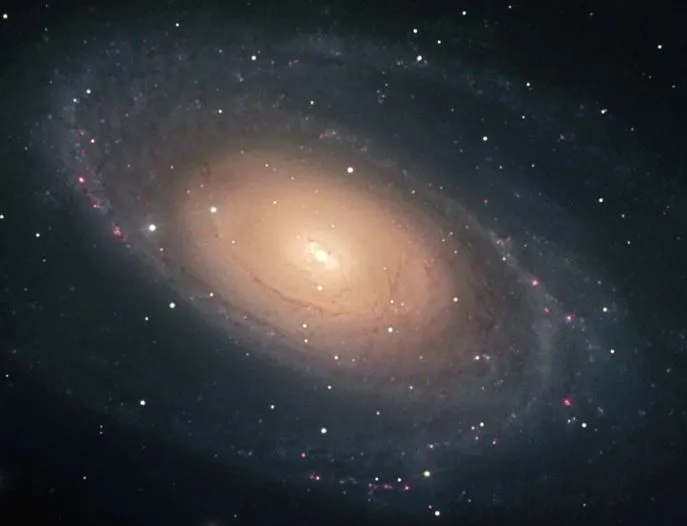
Here we have a beautiful portrait of Bode's Galaxy, also known as Messier 81 or NGC 3031. This spiral is located 12 million light-years away, in Ursa Major. It was named in honor of Johann Elert Bode, who discovered it in the 18th century. M82, the Cigar Galaxy, is a satellite of M81.
This image was achieved by the fantastic photographer Robert Gendler on whose website we can see a cosmic landscape containing both galaxies.
Credits & Copyright: Robert Gendler
It was the Astronomy Picture of the Day for June 20, 2002.
Also on Observatorio.
The solar heliosphere and heliopause
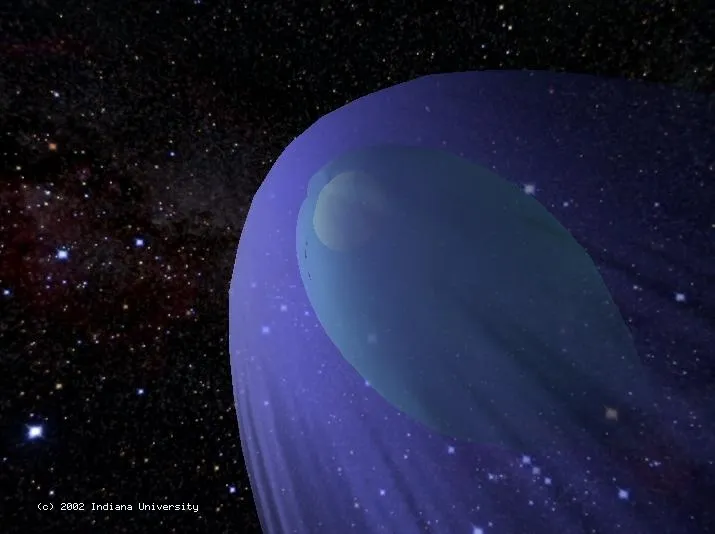
Where does the solar influence end? Nobody is sure.
Beyond the orbits of Neptune and Pluto extends a region called the heliosphere where the solar magnetic field and Solar Wind particles continue to act.
The surface where the Solar Wind falls below the speed of sound is called the termination shock and we can see it marked as the inner oval in the computer-generated illustration above.
The image belongs to NASA's Solar Journey Project. In that work, an animation of the heliosphere was also generated using the Solar Journey software.
As NASA reported recently, data from Voyager 1 indicate that the spacecraft has encountered a region in space where the intensity of charged particles from beyond our solar system has increased quite markedly. Voyager scientists observing this rapid increase are approaching an inevitable, and at the same time historic, conclusion: humanity's first emissary to interstellar space is at the edge of our solar system.
"From January 2009 to January 2012, there has been a gradual increase of about 25% in the amount of galactic cosmic rays Voyager has detected," said Ed Stone, Voyager project scientist at the California Institute of Technology in Pasadena, California. "More recently, we have seen a rapid escalation in that part of the electromagnetic spectrum. Since May 7, cosmic rays have increased 5% in a week and 9% in a month."
The 2002 image, then, corresponds to the work of Andrew J. Hanson and Priscilla C. Frisch of Indiana University and the University of Chicago, respectively.
Credits & Copyright: P. C. Frisch (U. Chicago) et al., U. Indiana
It was NASA's Astronomy Picture of the Day (APOD) for June 24, 2002.
And on Observatorio.
Images of the week
Saturated Moon
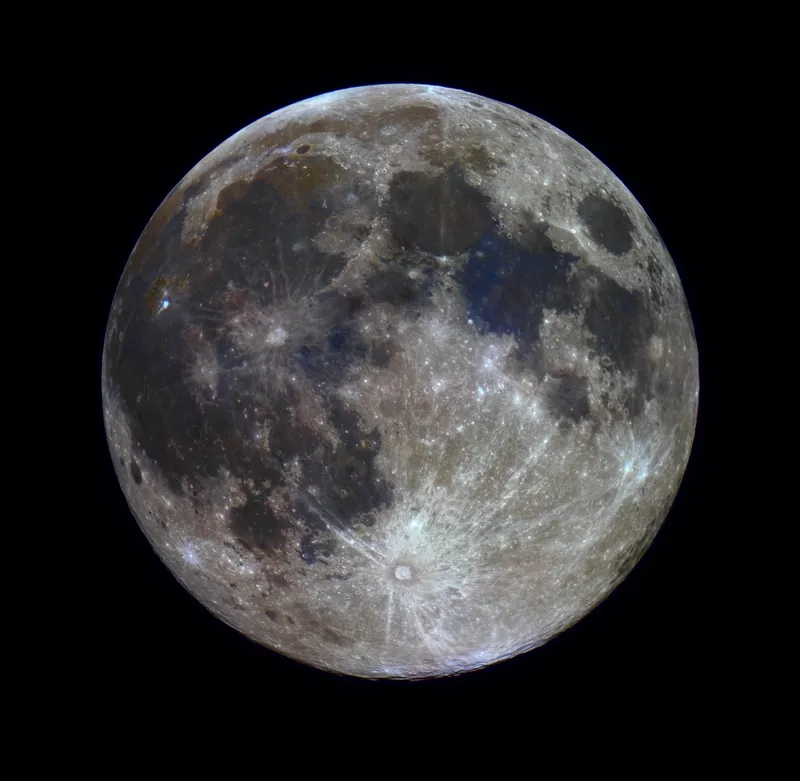
Here we have a new Moon, saturated with light. The image is a mosaic with exposures taken with a Canon EOS 550D and a Meade LX90.
Can the reader tell if the photo was taken from the Northern or Southern Hemisphere, just by looking at the composition? The most notable help is Tycho Crater. If we see it pointing down, the image was taken from latitudes north of the Equator.
The image is by Miguel Nievas, from Alcalá de Henares, Spain. The recording is from October 2011.
It was the Amateur Astronomy Picture of the Day (AAPOD) for June 18, 2012.
The Sun, the Moon and the Lighthouse

This landscape brings together the Sun, which we talked about regarding its influence and the heliopause at the beginning, the Moon, which we just saw recorded in its full phase, and the Lorain lighthouse. The shot was taken on May 20, 2012 during the solar eclipse. It's worth remembering, because some have short memories, that it was prophesied that the world would end on that date...
Credit: John O'Neal, from Spitzer Marina, Lorain, Ohio, USA.
It was the Amateur Astronomy Picture of the Day (AAPOD) for June 23, 2012.
Space Music
Today: To the shadows of the Moon
Until now, in this section, I hadn't put anything by one of my favorite artists: PeerGynt Lobogris. A unique talent. His music is accessible from Jamendo, but also on other networks and on his blog.
Here, his album Desires on the BlueMoon's Shadows. The fifth track, Moon over Calipso, is one of the most listened to on Jamendo.
Animated Science
Luna
This is a short film by Carla Díaz, Oscar Casas, Claudia Yamell and Jesús Granada under the direction of Diana García and with a script by Jesús Sanz.
The story explains itself, but a clarification is worthwhile for readers in this part of the world, Latin America: When the protagonist, Luna, arrives at the Theater to interview the Magician, the voice of a news announcer is heard saying that "The astronomers of the Madrid Observatory, Messrs. Gullón, Martín Lorón and López Arroyo, conducted their research on the image of the Planet Mars through the Grubb Equatorial. On Mars there is plant life and possibly rudimentary animal life...".
As far as I understand, the audio comes from NO-DO (Noticias y Documentales) which was a Spanish broadcasting service created in 1942.
That observation about possible life on Mars was made known to the Iberian public in 1956, during Franco's dictatorship. There is a novel based on those historical events: Los fantasmas de Retiro, by José Vicente Pascual.
On the blog El beso en la Luna, the Observatory was visited and a post shows photographs of the instruments, as well as including the NO-DO fragment from 1956.
But to get a better idea of what those astronomers stated regarding the red planet, I recommend reading the newspaper ABC, in whose archives we can find a report dated September 8, 1956, page 23.
To access previous editions of this section, consult the Multimedia Selection Series. The series attempts to show that the immensity of the universe can be perceived in different ways. I choose some images from a decade ago -so they don't fall into oblivion- and from the current week that ends, as well as sounds/music and videos that are artistic forms of expression with content related to astronomy and related sciences.