A collection of links to music, images and videos relating art and science. Today: Images of Centaurus A; Fireworks and stars; Gale Crater by Curiosity; The Tarantula. Music: Time Travel, by Blouse. Video: The Pier (La Jetée), by Chris Marker.

Images of the decade
X-ray arcs: chaos and beauty
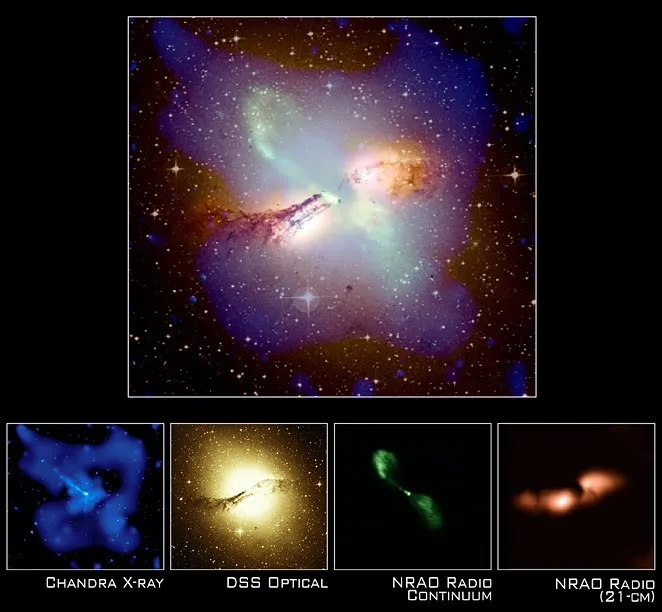
Once upon a time there was a nearby galaxy (11 million light-years away). A long, long time ago (10 million years), a gigantic eruption occurred there. And then everything was chaos.
Recently, scientists from the Harvard-Smithsonian Center reported that two arc-like structures composed of very hot gas in the galaxy Centaurus A appear to be part of a ring 25,000 light-years in diameter.
They then produced an image of the object, composed of radio (in green and yellow), visible (yellow-orange) and X-ray (blue) observations. This reveals a broad band of dust and cold gas split at an angle by opposing jets of high-energy particles emerging from the supermassive black hole in the galaxy's nucleus. In the plane perpendicular to the matter jets, there are two arcs of X-ray emitting hot gas.
"Putting all the images together was key to understanding the observations obtained with the Chandra X-ray Observatory," said Margarita Karovska, lead author of a paper on Centaurus A. The team proposed that the orientation of the gas arcs perpendicular to the jet and the symmetry of the projected ring with respect to the galaxy's center could be evidence that the ring is the result of a gigantic eruption in the galaxy's nucleus 10 million years ago. That calculated time is consistent with other observations indicating that the star formation rate increased dramatically at that time.
Other astronomers suggested that all this activity might have begun with the merger of a small spiral and Centaurus A (NGC 5128) about 100 million years ago.
All that chaos was, at the same time, destruction of pre-existing structures and creation of new stars. No one would want to live there. You couldn't. But the images that fill our sight never cease to seem beautiful to us, for their symmetry in principle, and then, artificially, for their color palette.
As indicated, it is a composition created with different observations at different wavelengths and at the moment of assembling everything, colors were chosen to encode those wavelengths. The choice is human, capricious and... aesthetic.
Credits: X-ray (NASA/CXC/M. Karovska et al.); Radio 21-cm image (NRAO/VLA/J.Van Gorkom/Schminovich et al.), Radio continuum image (NRAO/VLA/J. Condon et al.); Optical (Digitized Sky Survey U.K. Schmidt Image/STScI)
The image was published on the Chandra site on August 7, 2002.
Fireworks and shooting stars
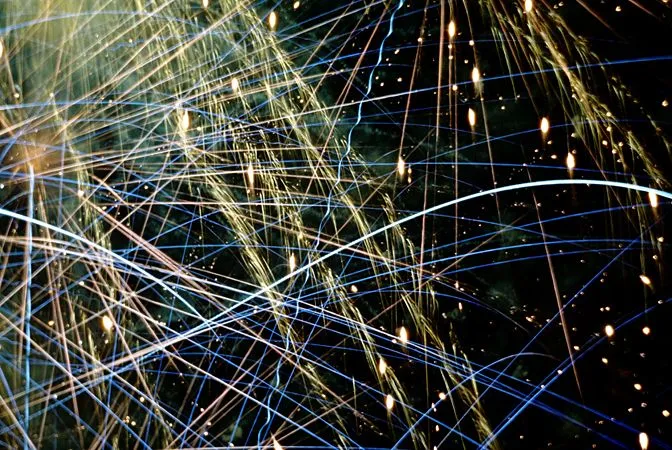
Experimenting with a new telescope and a camera, photographer Jim Steele captured this incredible and festive image of fireworks on the night of July 4 over Ashland, Oregon, during the celebration of United States independence.
Another type of trail from an also annual event will visit the night skies this coming weekend, which we all know as the Perseid Meteor Shower. They are the remnants of comet Swift-Tuttle and once a year the planet, in its orbit around the Sun, crosses them. As these remnants enter the atmosphere, the particles vaporize and leave a glow. From a very dark sky, and if the weather cooperates, it will be possible to observe these "shooting stars," whose peak will be between the 12th and 13th of this month.
Credits & Copyright: Jim Steele
It was NASA's Astronomy Picture of the Day (APOD) on August 9, 2002. Also on Observatorio.
Images of the week
View of Gale Crater by Curiosity
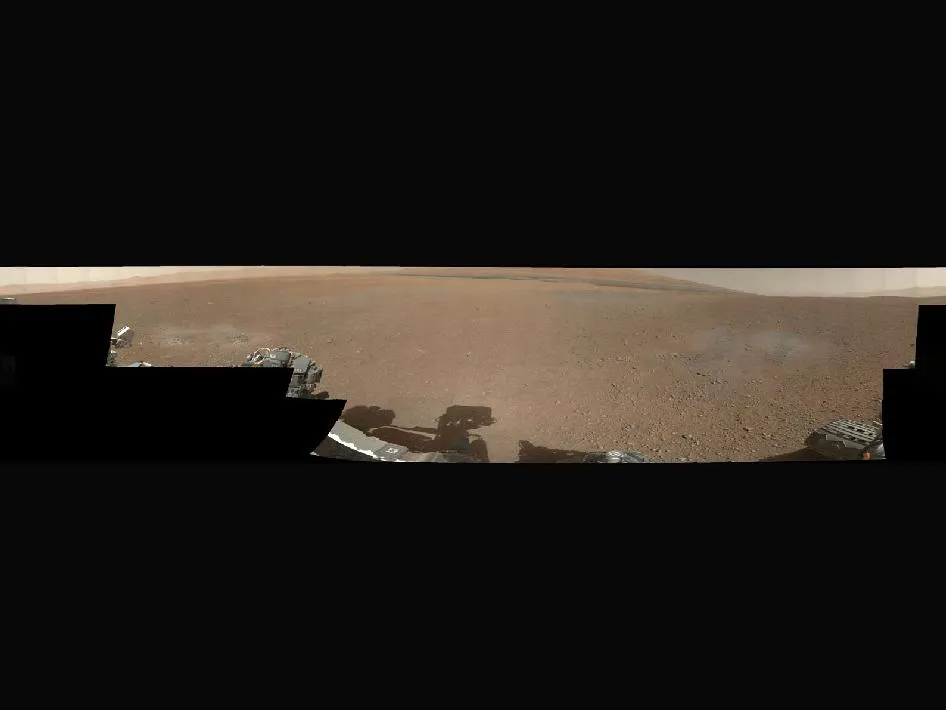
This is the first 360-degree color panorama of Gale Crater, Curiosity's landing site. The image was created by adding 130 smaller images (144x144 pixels) taken with the Mast Camera. Soon, much higher resolution images will be transmitted to Earth. The image was brightened in later processing. It must be considered that Mars receives half the sunlight of Earth and the photos were taken at Martian dusk.
Credit: NASA/JPL-Caltech/MSSS
It was NASA's Image of the Day on August 9, 2012.
Encounter with the Tarantula
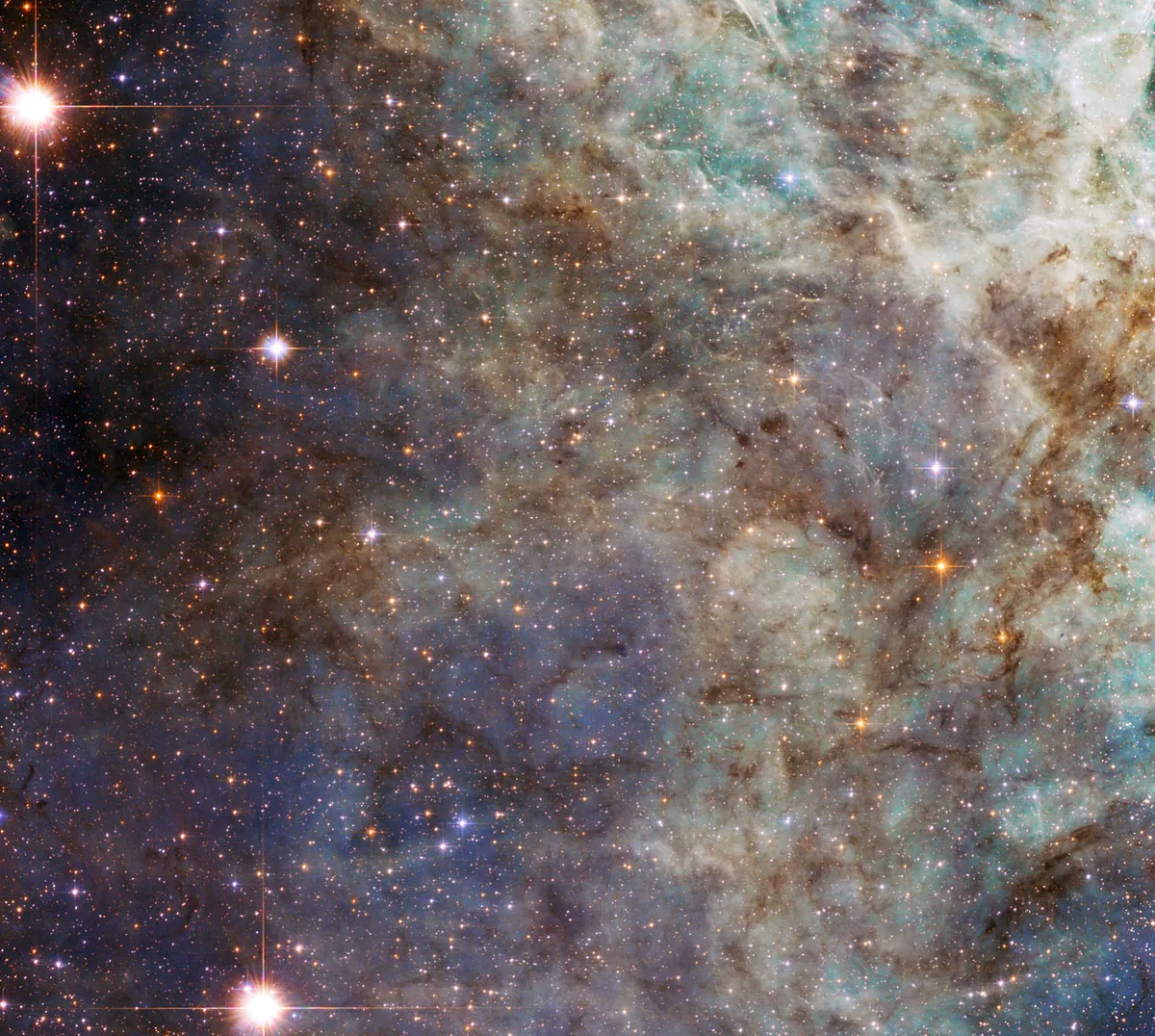
This image corresponds to the Tarantula Nebula (NGC 2070), taken by the Hubble Space Telescope.
The photo reveals structures rich in ionized gas, called HII by astronomers. Due to the choice of filters and colors in the image, which includes exposures in visible and infrared, the gas appears greenish, instead of red.
These regions contain recently formed stars that emit ultraviolet radiation that ionizes the surrounding gas. The powerful stellar winds of the newborn stars and the ionization process will sweep away the tenuous clouds, leaving star clusters like the Pleiades.
Located in the Large Magellanic Cloud about 170 thousand light-years away, the Tarantula (30 Doradus) is one of the brightest nebulae in the Local Group. It is also the largest (650 light-years in diameter). The cluster at the center of the nebula (R136) is relatively young and bright. It is not seen in this shot, which is of the outskirts of the nebula, but the energy from those stars is responsible for the nebula's brightness.
Credit: ESA/NASA Hubble & Judy Schmidt.
It was the Space Telescope Image of the Week.
Space Music
Time Travel
We are always "traveling in time." That's because the speed of light is finite. What we observe takes time to reach our senses. In everyday life we don't notice it because light travels at almost 300,000 km/s. However, when we look at the Sun, we see it as it was 8 minutes ago, since it is, on average, 150 million km away. The present is ephemeral, and that becomes evident in astronomy. But time can also be predictable. We know about the past of Centaurus A, but we also know that around this time we will pass through the "Tears of Saint Lawrence", the Perseids.
In a certain sense, knowledge is a pier that allows us to travel backward or forward.
Today I share with you the song Time Travel by Blouse. It's a band that started recently in Portland, Oregon. It's a classic lineup: guitar, drums, and keyboards. It is made up of Charlie Hilton, Patrick Adams, and Jacob Portrait. I love Hilton's voice. The song reminds me of when I was a kid and you would ask: Mom, is today tomorrow? Yesterday I was in the future, sing to us the Blouse.
On Vimeo there is a video of the song. You can find them on Bandcamp and Captured Tracks.
Animated science
La Jetée (1962), by Chris Marker
"The Pier", as the original title is translated, is a 28-minute French science fiction film shot in black and white. It narrates the story of a time travel experiment during a nuclear war.
Within cinema, it is a classic, among other reasons because it is actually a photo-novel, that is, it was made with a series of photos accompanied by a narration.
It is said that the film "12 Monkeys" (1995), by Terry Gilliam, was inspired by La Jetée. David Bowie was also inspired by this film for the music video of the song Jump, They Say (1993), directed by Mark Romanek. That video also shows three telescopes.
Committed to the radical left, a lover of girls and cats, and frequently using still photography, Marker made short films such as "Dimanche à Pekín" (1956) or "¡Cuba sí!" (1957) and began some formal explorations that anticipated the "New Wave" (Nouvelle Vague).
Other works linked to science fiction are the short film "2084" (1984), or E-CLIP-SE (1999).
The Frenchman was born on July 29, 1921 and died 91 years later, on the same day in 2012.
More in Notes from the Era of Imperfect Memory and on Artsy.net.
http://youtu.be/He8uZLPOT7A
To access previous editions of this section, consult the Multimedia Selection Series. The series attempts to show that the immensity of the universe can be perceived in different ways. I choose some of the images from a decade ago -so they don't fall into oblivion- and from the current week that ends, as well as sounds/music and videos that are artistic forms of expression with content related to astronomy and related sciences. I am also collecting these materials on the Pinterest account.