A collection of links to music, images and videos relating art and science. Today: Images of Cassiopeia A; NGC 3603; Zodiacal Light; An Isolated Island. Music: Seasonable Project. Video: Lights of Nostalgia.

Images of the decade
Cassiopeia A
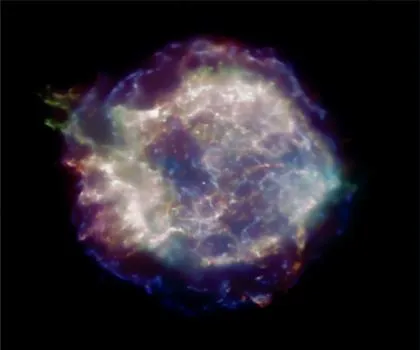
In August 1999, NASA published an image of Cassiopeia A, a supernova remnant revealed in X-rays like never before. The image of "Cas A" shows a remarkable structure in the debris of a gigantic explosion, as well as an enigmatic source at the center, which would be a neutron star or a black hole. That image obtained with the Chandra X-ray Observatory marked the beginning of an X-ray era in astronomy. The image above was produced to celebrate an anniversary of the observatory's first light, which was launched on July 23, 1999. The energies of the rays in the Chandra data are encoded as red for low energy, green for medium, and blue for higher energy.
The image was published on the Chandra Observatory website on August 19, 2002.
Credits: NASA/CXC/SAO.
NGC 3603 in infrared
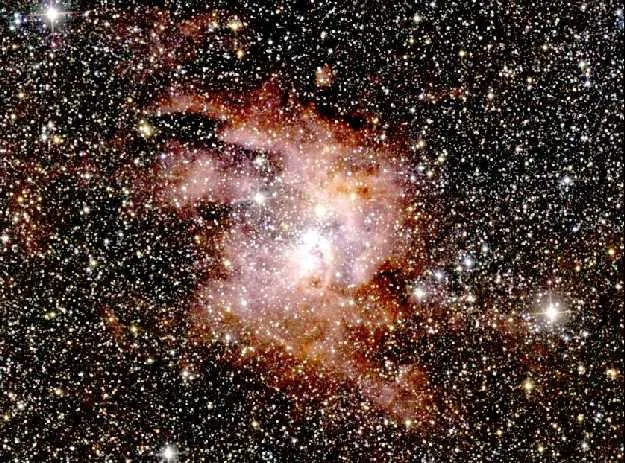
This emission nebula is the largest region of glowing gas in our galaxy. With more than 20 light-years on a side, this HII region is home to globular clusters, dust pillars and a star about to explode: HD 97950, an EA-type eclipsing binary with a period of 3.7 which is actually a multiple Wolf-Rayet system.
The nebula is located 20,000 light-years away from Earth, in Carina, the Keel.
Credits: 2MASS Project, UMass, IPAC/Caltech, NSF, NASA.
It was NASA's Astronomy Picture of the Day (APOD) for August 14, 2002. And at Observatorio.
Images of the week
Zodiacal light in Verónica
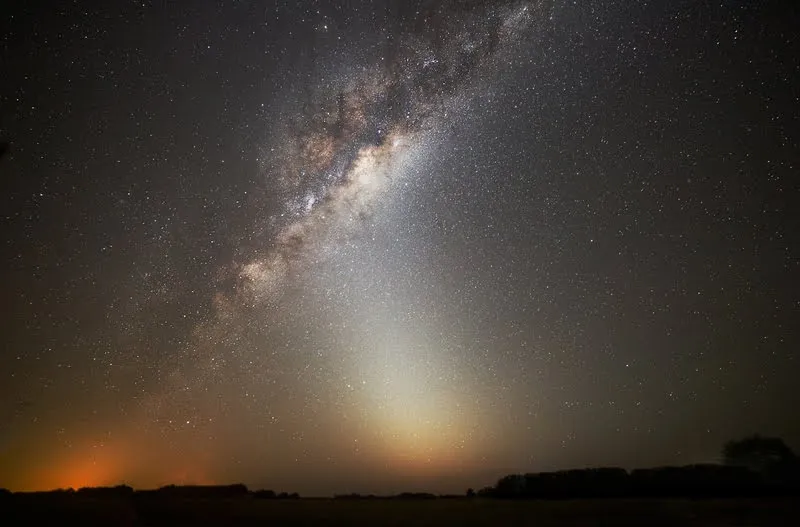
A bright cone of zodiacal light can be seen here intercepting the Milky Way. Zodiacal light, in the southern hemisphere, can be seen before sunrise in autumn or later, in spring. In this photo, it was the first case. The bright light is also known as "false dawn".
Zodiacal light is a band of light that can be seen in the night sky along the plane of the ecliptic, where the constellations of the Zodiac are located.
The record was achieved on March 3, 2012, from the town of Verónica, Buenos Aires, Argentina, by photographer Luis Argerich.
It was the Amateur Astronomy Picture of the Day (AAPOD) for August 12, 2012.
An isolated island
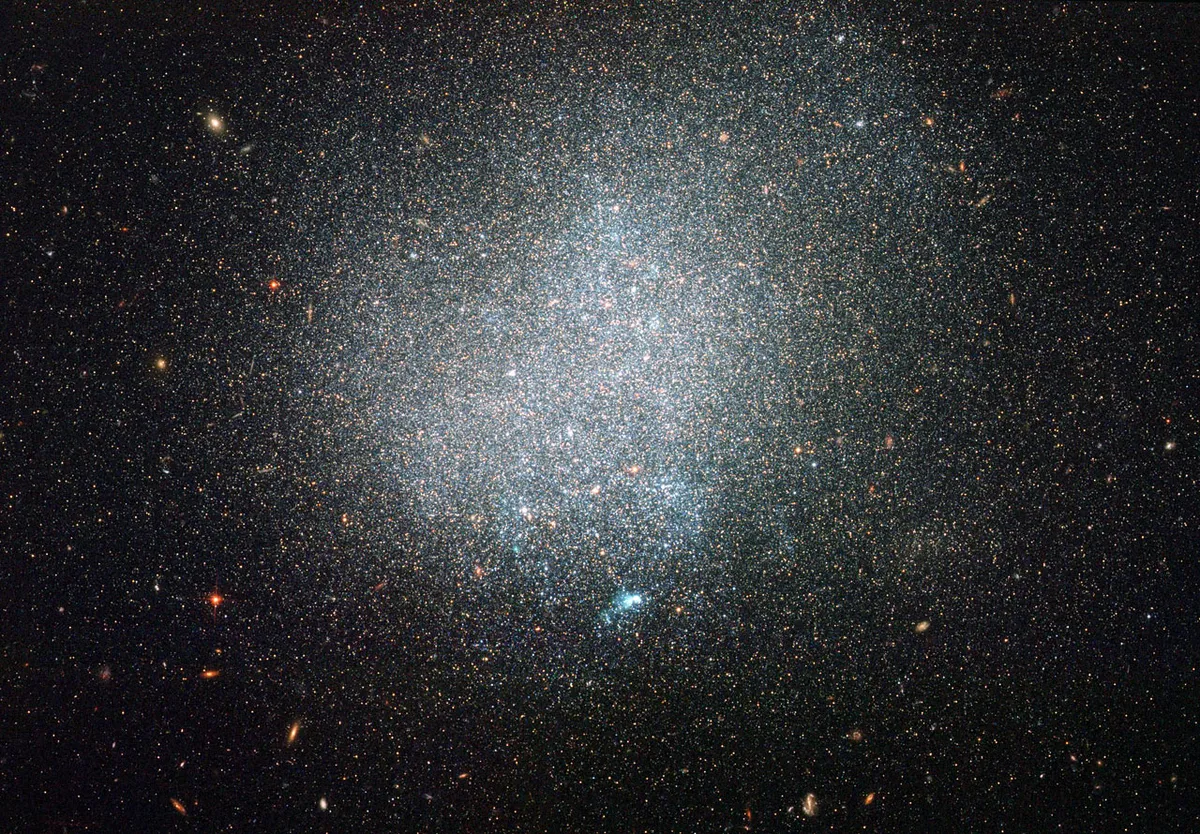
Although an island is surrounded by water, we would not consider it "isolated" if there are other islands nearby. But the case of DDO 190 shows that it is possible for "island-universes" to be quite isolated. This irregular dwarf is relatively small, mainly populated by old and reddish stars on the outside and by younger and bluer stars on the inside. Some "pockets" of ionized gas heated by the stars appear here and there, like the one observed at the bottom of this Hubble image.
DDO 190 lies about 9 million light-years away from the Solar System. It is considered part of the Messier 94 group of galaxies. Canadian astronomer Sidney van der Bergh was the first to record this object in 1959 as part of the DDO catalog, the roster of the David Dunlap Observatory of dwarf galaxies.
Although it would be part of the Messier 94 group, DDO is alone. The closest neighbor, DDO 187, is 3 million light-years away. In contrast, the Milky Way has much closer neighbors, such as the Large Magellanic Cloud about 160,000 light-years away.
A version of this image entered the Hubble Hidden Treasures contest by contestant Claude Cornen.
It was the Hubble Space Telescope Image of the Week.
Credit: ESA/NASA Hubble.
Space Music
To Cassiopeia constellation
Seasonable Project is the project of Russian Vladimir Shtykov on SoundCloud.
Animated Science
Lights of Nostalgia
"We are all at the bottom, but some of us still look at the stars," Alejandro Herdocia tells us, an audiovisual creator born in Mexico City in 1983. A contemporary reflection on our relationship with the stars and on our legacy in the Cosmos.
To access previous editions of this section, consult the Multimedia Selection Series. The series attempts to show that the immensity of the universe can be perceived in different ways. I choose some images from a decade ago -so they don't fall into oblivion- and from the current week that ends, as well as sounds/music and videos that are artistic forms of expression and with content related to astronomy and related sciences. I am also collecting these materials in the Pinterest account