A collection of links to music, images and videos relating art and science. Today: NGC 300, a very normal galaxy; Nova Cygni lights up; Triple Lunar; The Pleiades from the South. Music: Nova, by Dirty Dan Lewis. Video: Nova 3D, by Florian Eggers.

Images of the decade
The Spiral Galaxy NGC 300
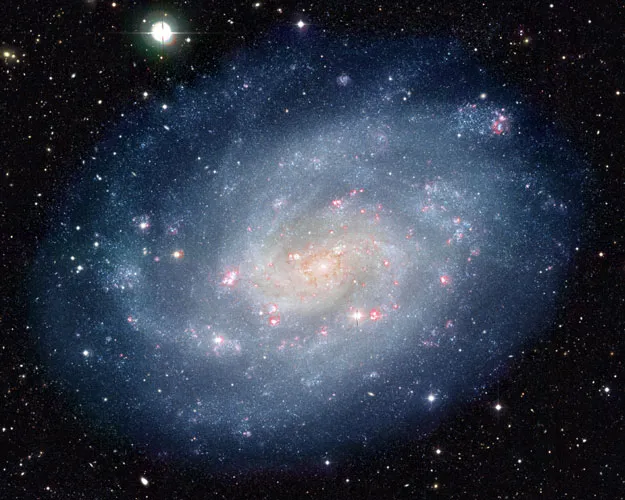
NGC 300 is a Sc-type spiral galaxy, lying in the nearby Sculptor group of galaxies. It presents the typical blue spiral arms, a predictable compact nucleus and the expected amount of stars, star clusters and nebulae. What is interesting about this galaxy is that it is very normal, that is, it combines several typical characteristics of spiral galaxies. It is located 7 million light-years away, and can be seen with a small telescope in the constellation Sculptor.
Credit: M. Schirmer (IAEF, Bonn), W. Gieren (Univ. de Concepción, Chile), et al., ESO.
It was NASA's Astronomy Picture of the Day (APOD) for August 21, 2002. Also in Observatorio.
The Nova Cygni nebula lights up
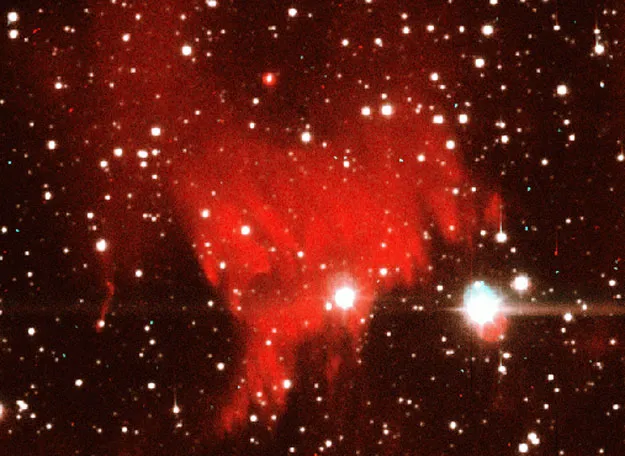
Old photographs show no evidence of the nebula in the photograph. In 1992, a white dwarf in the constellation Cygnus expelled its outer layers in a classic nova: an event called Nova Cigni 1992 (the term Cigni is the demonym for Cygnus meaning swan). It is also known as V1974. The nova was discovered by Peter Collins. At that time it was magnitude 6, although it reached 4.4. The light flooded the interstellar neighborhood, illuminated this existing gas cloud and excited the hydrogen causing a reddish emission. That is to say, this nebula was pre-existing, but it had not been observed because it had not been illuminated as it was after the nova. The only gas expelled by the nova can be seen as a small red ball just above the center of the photograph. Over time, the light from the nova will fade and the nebula will again become invisible to our eyes. Hubble shows how the shell of gas around the Nova changed in 1994.
Nova Cigni 1992 is located 10,430 light-years from Earth.
Credit: Peter Garnavich (Notre Dame), 1.2-m Telescope, Whipple Observatory.
It was the Astronomy Picture of the Day (APOD) for August 25, 2002. In Spanish at Observatorio.
Images of the week
Triple Lunar
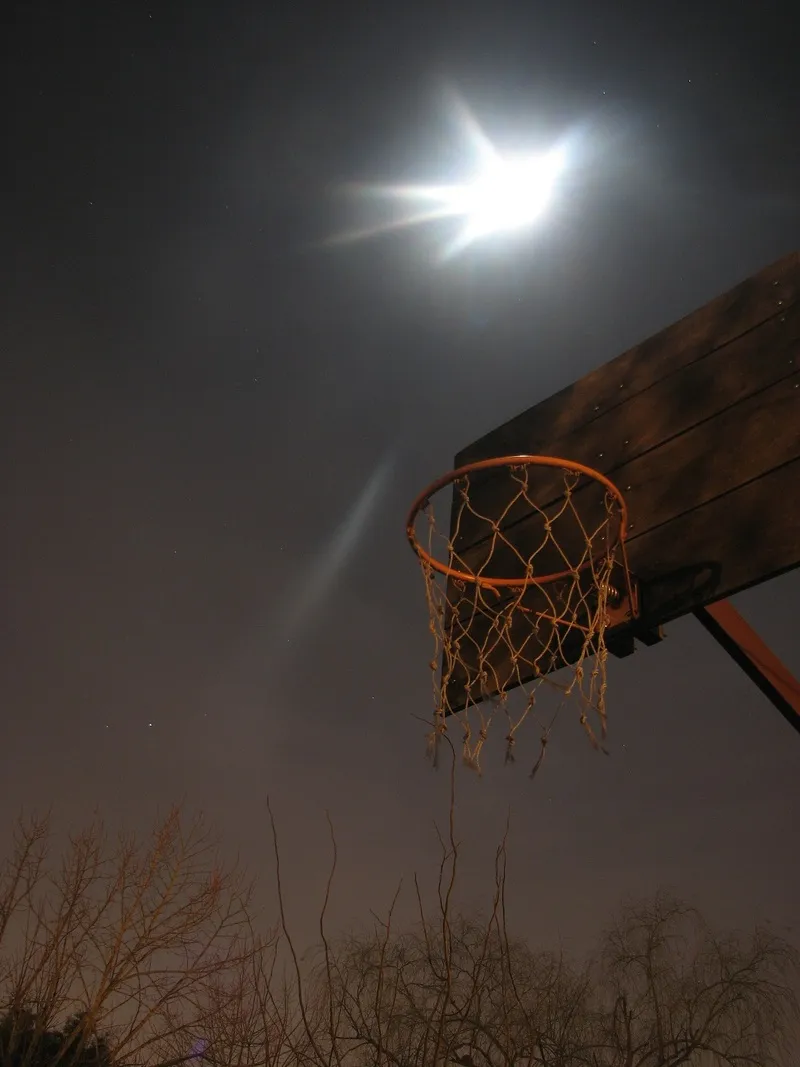
The nearly full Moon advances across the dark sky. A thin layer of clouds tries to intercept it, but the light manages to escape and it goes for three! Yes! Triple!, an Argentine basketball commentator would say.
The image was achieved, from the patio of his house, in Ezeiza, Buenos Aires, by an Argentine amateur, with a Canon S31S (ISO 400, 15s). The record is from August 2011, but it was chosen as the
Amateur Astronomy Picture of the Day (AAPOD) for August 20, 2012.
The author of the record uses the pseudonym Zefram Cochrane, a Star Trek character.
The Pleiades from the South
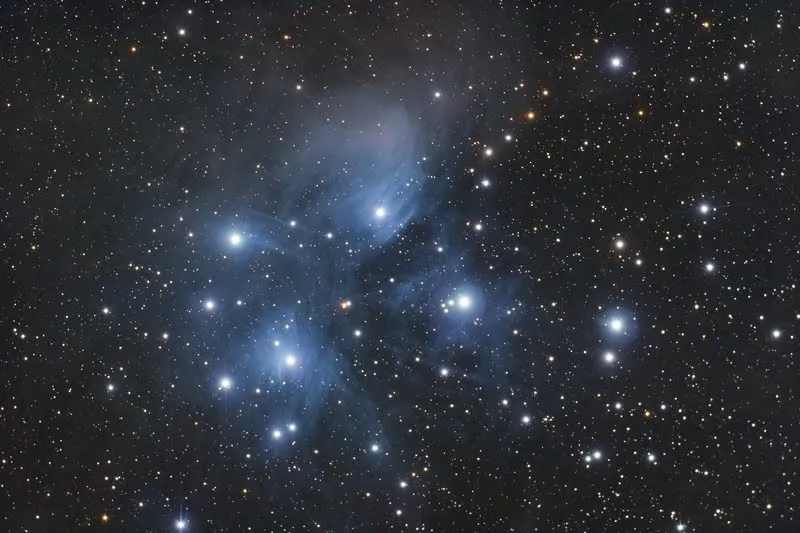
Ignacio Díaz Bobillo is the author of this record from San Antonio de Areco, Buenos Aires, on October 27, 2011. He used an AP 130 EDF GT and Canon 1000D.
The "doves", also called Seven Sisters, and cataloged as Messier 45 are an open cluster in Taurus, about 400 light-years from Earth.
Credit: Ignacio Díaz Bobillo, PampaSkies
It was the Amateur Astronomy Picture of the Day (AAPOD) August 21, 2012.
Nova, Dirty Dan Lewis
Dirty Dan Lewis, from Hollis, New Hampshire, USA, created the following sounds under the title Nova. In astronomy, a nova refers to a thermonuclear explosion in a binary system composed of a white dwarf and a red giant. The first accretes mass from the other which triggers fusion that releases large amounts of energy in a very bright process.
Space Music
Animated science
Nova 3D
The following video is an animation by Florian Eggers.
The music, used with permission, is by Gelany Beno Meir. It is music composed for the soundtrack of The Tree of Life, a film by Terence Mallick. Clarification: the theme is NOT part of the aforementioned film, but Gelany was inspired by the film to create suitable sounds, in an amateur way.
The animation is 3D, that is, to be viewed with anaglyph glasses. Although there is also a 2D version.
To access previous editions of this section, consult the Multimedia Selection Series. The series attempts to show that the immensity of the universe can be perceived in different ways. I choose some images from a decade ago -so they don't fall into oblivion- and from the current week that ends, as well as sounds/music and videos that are artistic forms of expression with content related to astronomy and related sciences. I am also collecting these materials in the Pinterest account