A collection of links to music, images and videos relating art and science. Today: Images of Gravity rivers; Gómez's hamburger; The Carina Nebula; A Red cocoon of stars. Music: Journey to Mars. Video: First.

Images of the decade
Gravity rivers
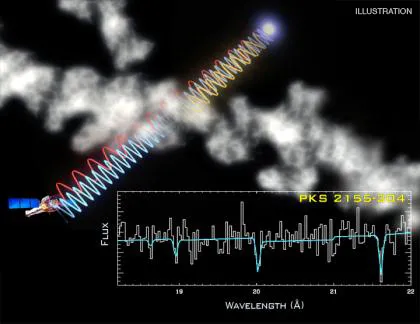
Observations made by a group of astronomers using the Chandra X-ray Observatory found a network of gas and dark matter. Four independent teams of scientists used Chandra to detect intergalactic gas (at 800 million light-years away) with temperatures between 300,000 and 5 million degrees Celsius. Two techniques were used to investigate the gas. One uses the absorption effects of the gas on X-rays from distant galaxies: as they travel toward Earth, the X-rays from a distant quasar vary, as their detection decays when passing through a cloud of intergalactic gas. By measuring those variations, due to the absorption of the gas, astronomers were able to estimate the temperature, density and mass of the absorbing gas. Two quasars were used, PKS 2155-304 by the MIT and Harvard-Smithsonian group, and H1821+643 by the group of researchers from Ohio.
These results were confirmed by another group led by scientists from Michigan who thought about things the other way: the hot gas itself is a source of X-rays. Those rays vary when passing through the gas of a galaxy that is closer to us. The second team, then, evaluated that absorption of the X-rays from the hot gas by a nearby galaxy.
All that gas seems to lie like a fog in channels carved by rivers of gravity.
Like the erosion patterns of a river, this gas and dark matter form channels in the geometry of space. Most galaxy clusters lie at the junction of these channels. Here, an animation that illustrates the process.
The image is an artistic composition of the gas along with an inset with the spectrum of one of the studied quasars.
Credit: NASA/CXC/A.Hobart; Spectrum: NASA/MIT/T.Fang et al.
The image and video were published on the Chandra site on July 31, 2002.
Gómez's hamburger
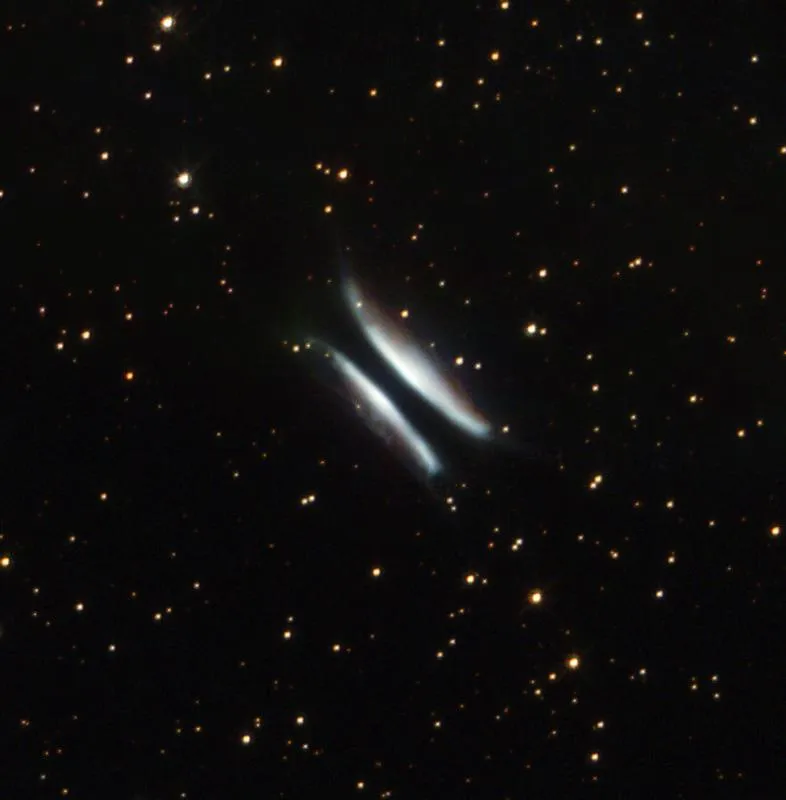
IRAS 18059-3211 is a proto-planetary nebula in Sagittarius. It is a Sun-like star near the end of its life that has already expelled large amounts of gas and dust and is about to become a planetary nebula. This hamburger doesn't have a quarter pound, but gas, dust and energy. What is observed, the bread of the cosmic sandwich, is nothing but light reflected by the dust. When a star of mass similar to our sun ends its life it expels its outer layers into space. The ultraviolet radiation from the exposed core makes the expelled gas glow. In this case, the star is in that process. The core still emits visible light and not so much ultraviolet, so the surrounding gas does not glow. But the expelled material containing dust reflects the starlight.
The object was discovered in 1985 by the Chilean astronomer Arturo Gómez at Cerro Tololo.
Daniel Verschatse from Chile has photographed the object, very diffuse and difficult to record (magnitude 14.4), as noted by friend Pastor Galáctico on his blog. I recommend reading an article by Barbara Wilson about observing this fascinating object.
Credit: NASA and The Hubble Heritage Team (STScI/AURA), A. Gomez (Cerro Tololo Inter-American Observatory).
The image was published on HubbleSite on August 1, 2002.
Images of the week
The Carina Nebula (NGC 3372)
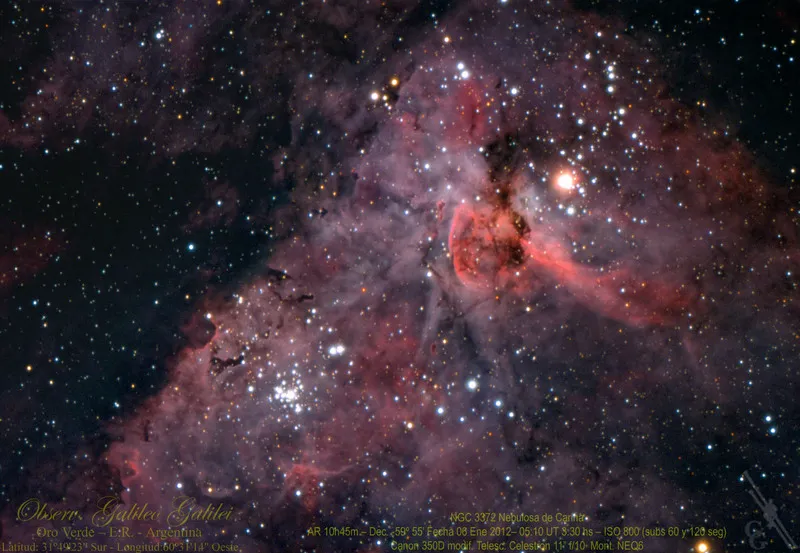
With a Canon 350D, Celestron 11" on NEQ6, and a lot of patience and knowledge, César Fornari and Germán Savor achieved this magnificent shot of the Carina Nebula from the Galileo Galilei Observatory, in Oro Verde, Entre Ríos, Argentina.
The emission nebula is located 6,500 light-years from Earth.
It was the Amateur Astronomical Picture of the Day (AAPOD) August 1, 2012.
Red cocoon of stars
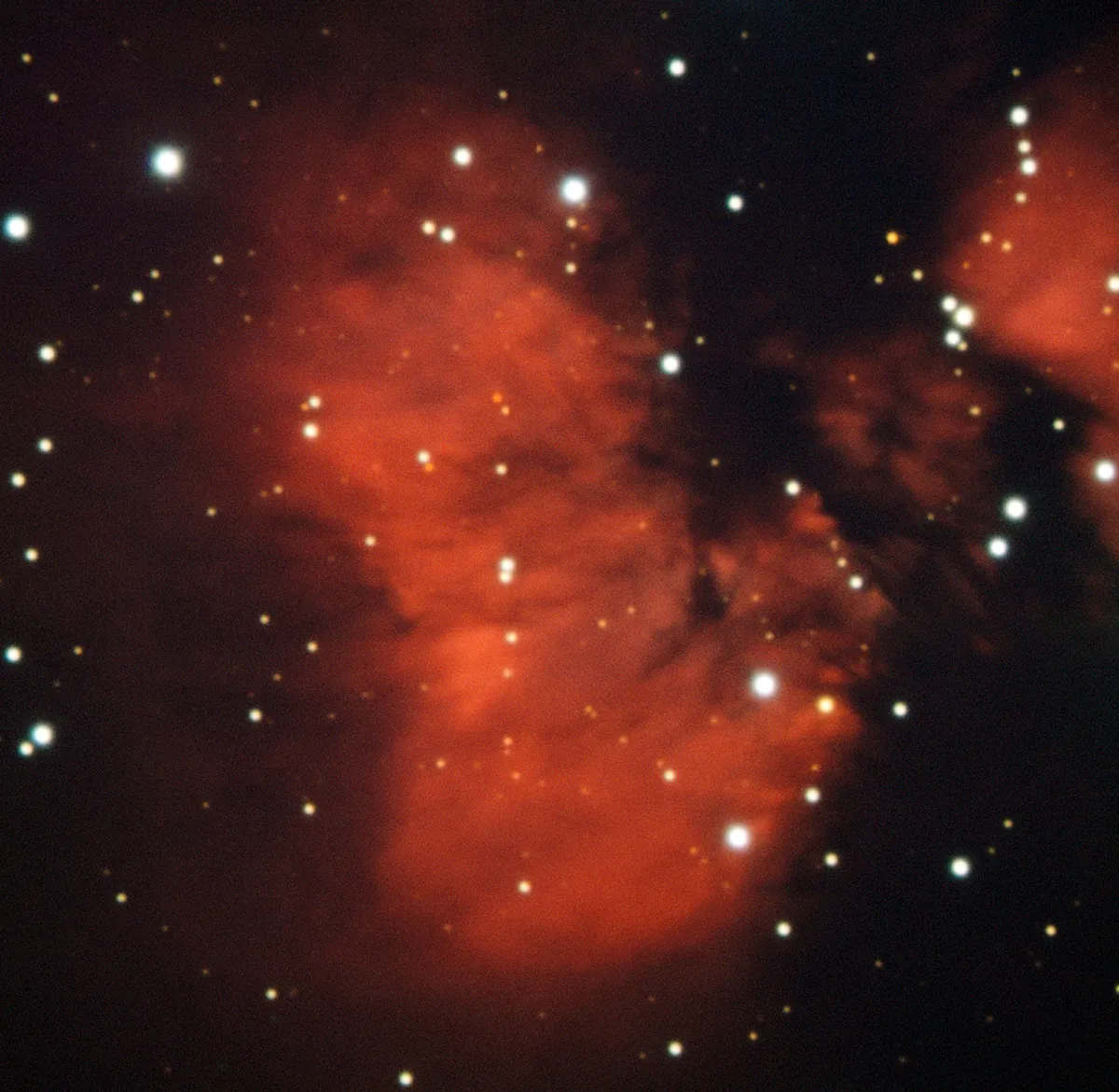
To say that something is "in cocoons" means it is beginning. The reddish cloud in the image is an example of a star-forming region, where new stars are being formed. It is known as RCW 88 and is located 10 thousand light-years from Earth. It has almost the same length in diameter (9 al) and glows with the hydrogen gas surrounding the nascent stars.
The image was formed with the EFOSC2 instrument on the ESO NTT telescope.
HII regions like this one have been recorded in several catalogs such as Sharpless or Gum. There is also the RCW catalog by astronomers Rodgers, Campbell and Whiteoak, which is an extension of Gum's.
Credit: ESO.
It was the ESO Picture of the Week.
Space Music
Awaiting MSL and Curiosity
I have commented here about Loomeer's music on Jamendo, in particular his album Nebulas which contains a track about the Carina Nebula.
On SoundCloud, there is another track, more rock-oriented, referencing the same object.
However, today's music is about Mars, anticipating the arrival of MSL and the rover Curiosity to the red planet. Here, eight tracks + 1 an interview with an Argentine who is part of the mission (in English).
Animated Science
First
This is a short film by the Portuguese Diogo Barbosa and Joana Pinto. Diogo is also known as Razorback. He is an animation student who makes video games and also shorts. The idea of the short, made with a Canon 550D, is crazy, but it has already been proposed: that the trip to Mars be one-way only.
The video seemed appropriate to me for this date, given the proximity of the arrival of the Mars Science Laboratory, with Curiosity, to the red planet, expected next Monday, August 6. The mission launched on November 26, 2011, meaning it will have taken 254 days (that's 8 months or 36 weeks) to reach our neighboring planet.
As NASA has done on previous occasions, it is sending a probe that will be able to inspect the planet's surface with a new rover and send the data back to Earth remotely. Although it may not seem like it, it is a titanic task: the launch must be made when both worlds are relatively close and it must be considered that both planets will continue moving, so it's almost like American football players throwing a ball: they have to calculate where the receiver will be. Furthermore, the probe must pass through the Martian atmosphere in an infernal descent and arrive intact on the surface.
There will be a broadcast on NASA TV (at 03:30 UTC, past midnight on Monday in Argentina).
To access previous editions of this section, consult the Multimedia Selection Series. The series attempts to show that the immensity of the universe can be perceived in different ways. I choose some images from a decade ago -so they don't fall into oblivion- and from the current week that is ending, as well as sounds/music and videos that are artistic forms of expression with content related to astronomy and related sciences.