A collection of links to music, images and videos relating art and science. Today: Images of Hoag's Object; The Cat's Eye Nebula; Arp 116; Messier 4. Video: YouTube Space Lab. Music: Encke.

Images of the decade
Hoag's Object
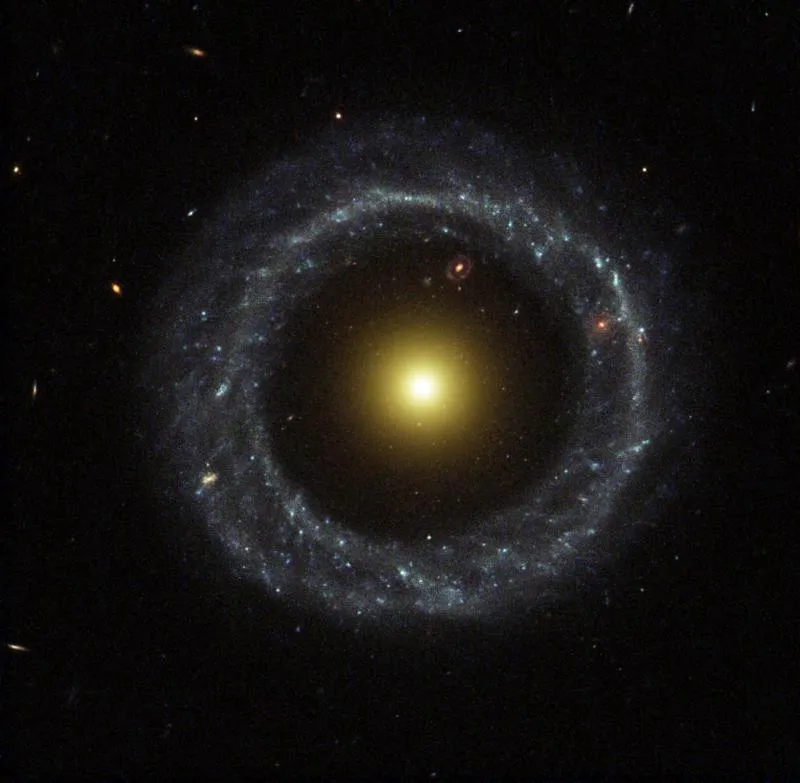
A ring of hot, blue stars circles the yellow nucleus of an unusual galaxy known as Hoag's Object in honor of Arthur Allen Hoag (1921-1999), an American astronomer who made the discovery in 1950. The galaxy is 120,000 light-years in diameter, that is, a bit more than the Milky Way. The blue ring is dominated by clusters of young, massive stars, while the nucleus is composed mainly of old stars. In between, the apparently empty region shaped like a donut (or a torus), would actually contain stellar clusters too faint to be seen. Curiously, an object can be seen in that region in the position close to 13:00. The object is probably a background ring galaxy.
Hoag's Object (PGC 54559) lies 600 million light-years away (180 million parsecs) in Serpens.
The image was published on HubbleSite on September 5, 2002.
Credits: NASA and The Hubble Heritage Team (STScI/AURA)/Ray A. Lucas (STScI/AURA)
The Halo of the Cat's Eye
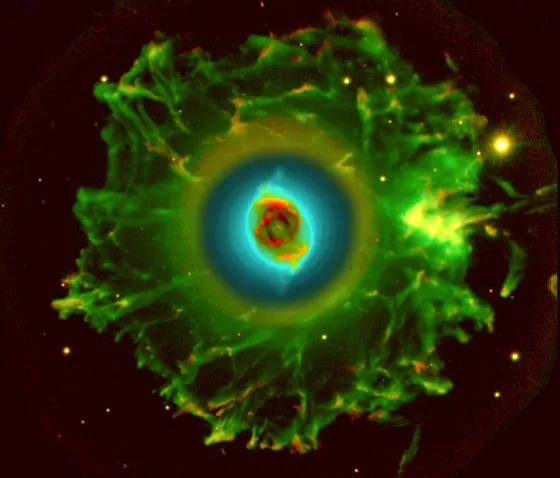
The Cat's Eye Nebula (NGC 6543) is one of the best-known planetary nebulae in the sky.
Its symmetries can be seen in the central part of this false-color image, which reveals the enormous and extensive halo of gaseous material, over 3 light-years in diameter, surrounding the bright and familiar planetary nebula.
Made with data from the Nordic Optical Telescope in the Canary Islands, the image composite shows the emission of nitrogen atoms in red, and of oxygen atoms in green and blue.
Planetary nebulae are a phase of evolution, near the end of life, of a star similar to our Sun.
However, only very recently have some planetaries been found with halos like this one, probably formed from material ejected in earlier moments of the star's evolution.
While the planetary nebula phase is believed to last about 10,000 years, astronomers estimate that the age of the outer filaments forming the halo may last from 50,000 to 90,000 years.
It was the Astronomy Picture of the Day (APOD) for September 4, 2002. Also on Observatorio.
Credits: R. Corradi (Isaac Newton Group), D. Goncalves (Inst. Astrofisica de Canarias)
Images of the week
Arp 116: an unmatched pair
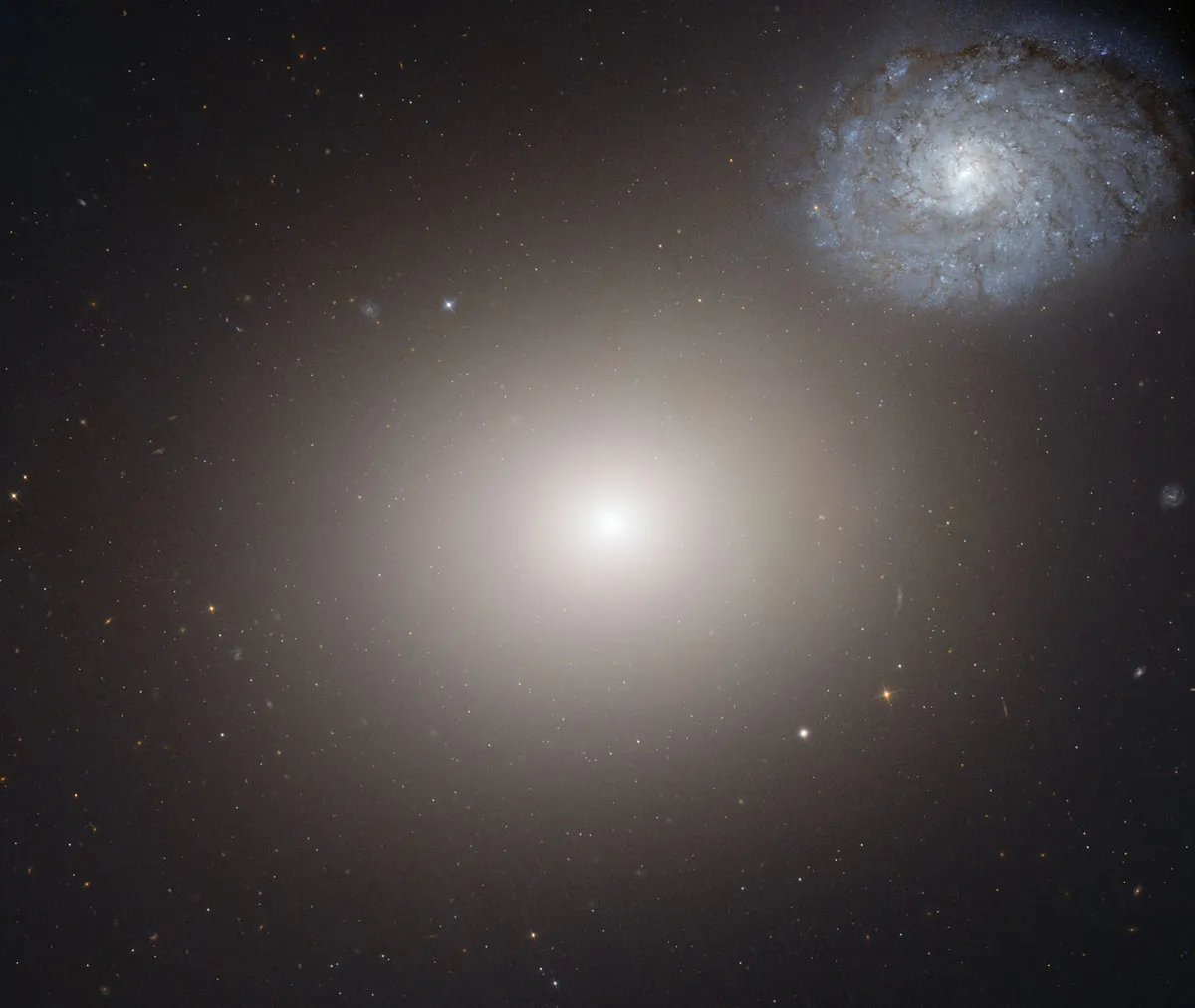
Two very different galaxies form this portrait taken with Hubble. This peculiar duo is known as Arp 116, composed of a giant elliptical galaxy, Messier 60, and a much smaller spiral, NGC 4647.
M60 is very bright, the third brightest in the Virgo galaxy cluster, a collection of over 1,300 galaxies. They differ not only in size and shape, but also in color. The elliptical has a golden hue as it contains many old, cold, red stars. In contrast, the spiral hosts many young, hot stars that give it a bluish tint.
For astronomers, there is no clear evidence that both galaxies are interacting, although it may seem so from our point of view, but the topic is still under discussion. However, they are close neighbors, which allows for a good comparison between both types of galaxies: M50 lies almost 54 million light-years from Earth. NGC 4647, at 63 million light-years.
The name Arp 116 given to the pair came from the catalog made by astronomer Halton Arp called Atlas of Peculiar Galaxies, in 1966.
Credits: NASA, ESA, and the Hubble Heritage (STScI/AURA)-ESA/Hubble Collaboration
The image was published on HubbleSite on September 6, 2012. And on SpaceTelescope.
A cluster and a secret
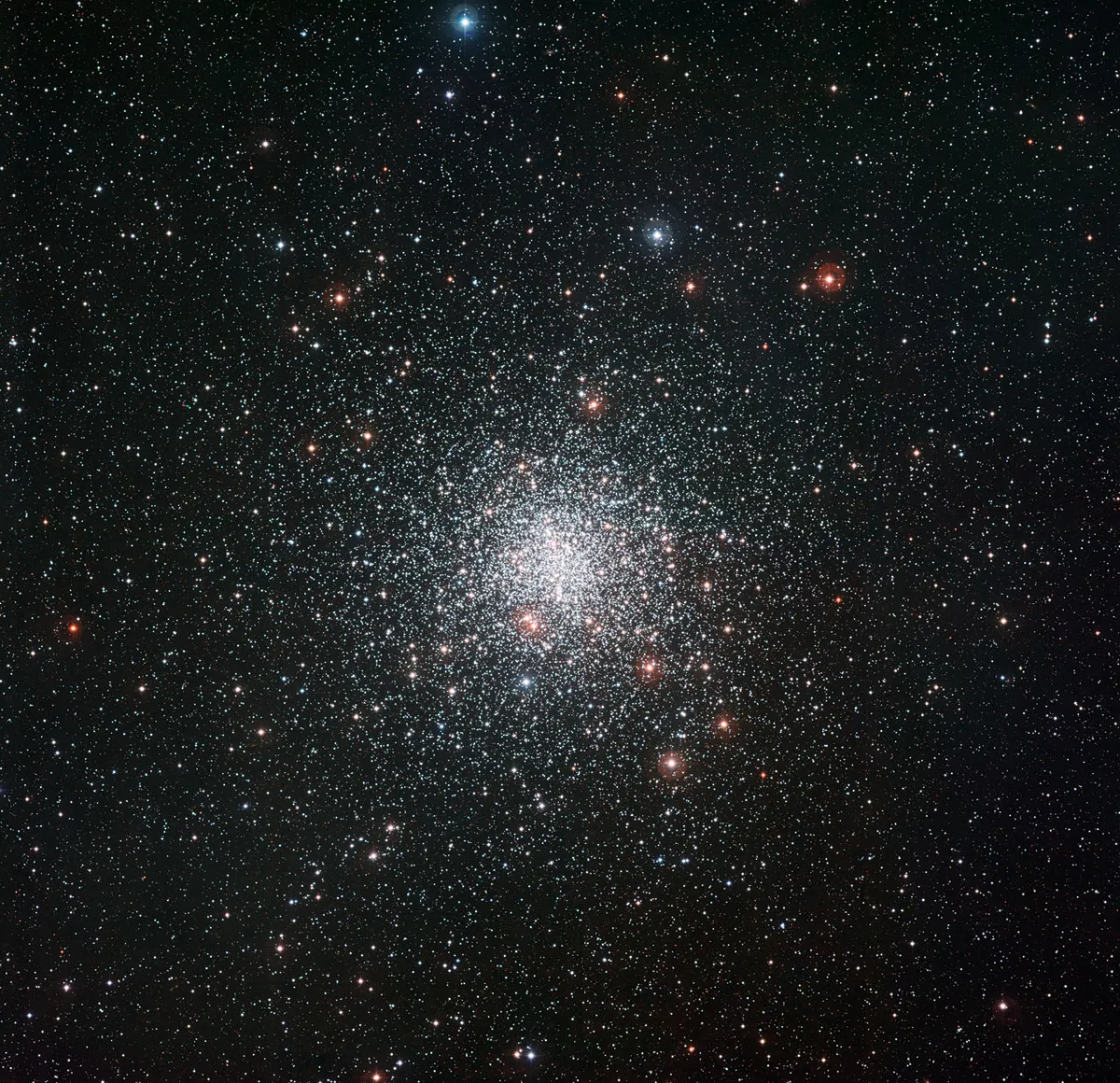
Around the Milky Way orbit more than 150 globular clusters of stars that date back to the distant past of the Universe. One of the closest to Earth is the cluster Messier 4 (also known as NGC 6121), located in the constellation Scorpius (The Scorpion). This bright object can be easily observed with binoculars, near Antares, a red supergiant star, and a small amateur telescope can show some of the stars that constitute it.The new results from the stars of Messier 4 are surprising. The stars that are part of globular clusters are very old, so they are not expected to possess a large amount of heavy chemical elements.
This was precisely what was found, however, in one of the stars analyzed recently, and astronomers also detected a much greater amount of lithium (a rare element belonging to the group of the lightest elements) than expected. The origin of this lithium is a mystery. Normally this element degrades gradually over billions of years, throughout the life of a star, but this particular star seems to hold the secret of eternal youth. Somehow, it has been able to preserve its original lithium levels, or has found a way to increase its own levels with newly generated lithium.
This image from the WFI (Wide Field Imager) of the MPG/ESO 2.2-meter telescope located at ESO's La Silla Observatory, provides a panorama of the cluster, as well as its abundant surroundings. A complementary, more detailed view exclusively of the central region, taken from the Hubble Space Telescope (a joint project of NASA and ESA), was also published this week as part of the series of Images of the Week from the telescope.
On ESO: A Star Cluster Holds a Secret
Credits: ESO
Animated Science
SpaceLab on YouTube
On Thursday, September 13, Bill Nye will host the live broadcast between Earth and the International Space Station (ISS). The young scientists from YouTube Space Lab and a NASA astronaut 250 miles (402 km) from Earth will be performing the winning experiments from the competition launched by YouTube and Lenovo last year.
What is YouTube Space Lab?
YouTube launched a challenge: propose a scientific experiment for space and upload it to YouTube. Among thousands of teams, a group of pioneers in science and space selected six regional winners with the help of the YouTube community. Finally, two global winners were selected for their experiments to be carried out on the International Space Station and broadcast live on YouTube for the whole world to see.
Amr, Dorothy and Sara, who were chosen as the global winners of YouTube Space Lab in March, will join Bill and special guests to talk about the winning experiments and why science in space is so important for our future.
After NASA Mission Control gives its go-ahead to proceed, NASA astronaut Sunita Williams will communicate with people on Earth, live from the International Space Station for a unique interview. You will also have the opportunity to send your questions to Sunita via Google+, Twitter or Facebook, using the hashtag #SpaceLab.
More info at: http://www.youtube.com/spacelab?feature=inp-pr-space
Space Music
Encke: Near the Nebula
From Córdoba, Spain, and via Jamendo, I share the music of Encke, especially his album Near the Nebula, which contains tracks linked to astronomy. For example, the first track is about Gliese 581C; it is followed by a track about the EPR Paradox and the rest of the work follows the same line, with themes such as magnetic monopoles, Dyson Spheres, hydrosphere, spontaneous symmetry breaking, vacuum energy and finally, the last track, about Zero Gravity.
To access previous editions of this section, consult the Multimedia Selection Series. The series attempts to show that the immensity of the universe can be perceived in different ways. I choose some of the images from a decade ago -so they don't fall into oblivion- and from the current week that ends, as well as sounds/music and videos that are artistic forms of expression with content related to astronomy and related sciences. I am also compiling these materials in the Pinterest account