A collection of links to music, images and videos relating art and science. Today: Images of The Crab Pulsar; A very, very distant galaxy; NGC 3576. Music: Earth, by Jaime Heras. Video: SpaceCop, a space chase.

Images of the decade
The Crab pulsar reveals its secrets
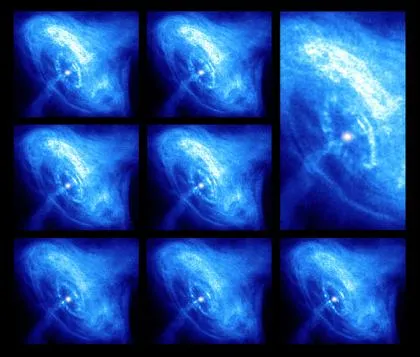
A set of observations made with the Chandra X-ray Observatory and Hubble show the activity of the inner region of the Crab Nebula Pulsar, a rapidly rotating neutron star seen as a bright point near the center of these images.
The series of images was taken over several months and is ordered from left to right. Through this "movie" "the Crab Nebula came to life," said Jeff Hester, an astronomer at Arizona and lead author of a study conducted with this data (J. Hester et al. 2002 Astrophysical Journal Letters, 577, L49).
The Crab Nebula (the object Messier 1, also cataloged as NGC 1952) is a supernova remnant seen by Chinese and Arabs in 1054. It is located 6,300 light-years from Earth, in Taurus.
In the images, "wisps" of matter can be seen moving at half the speed of light to form an expanding ring visible in X-rays and optical images.
Another feature is the turbulent jet of matter that lies perpendicular to the inner and outer rings.
The research was published for the general public from the Chandra and HubbleSite websites on September 19, 2002. Both sites have abundant material, with animations.
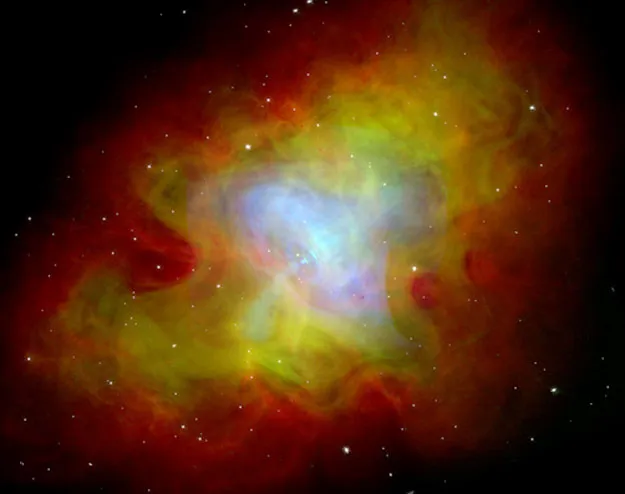
This composite contains X-ray, optical, and radio data.
Credits X-ray: NASA/CXC/ASU/J. Hester et al.; Optical: NASA/HST/ASU/J. Hester et al.; Radio: NRAO/AUI/NSF
Images of the week
Astronomers spy very distant galaxy
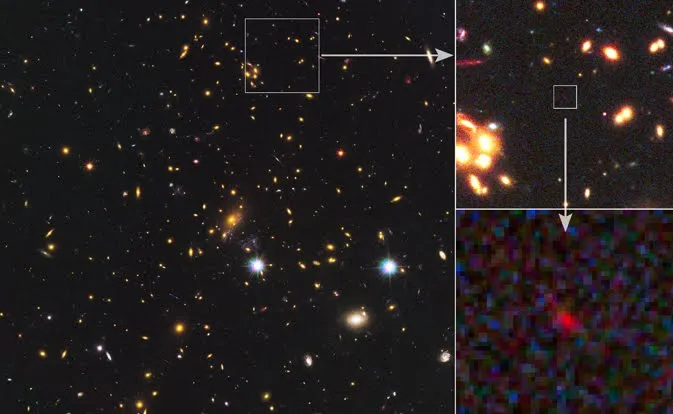
With Spitzer and Hubble, and using a gravitational lensing effect, astronomers were able to observe what could be the most distant galaxy to date. The light from the young galaxy is from when the universe was only 500 million years old. The galaxy existed when the universe was beginning to emerge from the so-called "dark ages." During that period, the universe went from being a dark expansion without stars to a cosmos full of galaxies.
"This galaxy is the most distant object we have observed with high confidence," said Wei Zheng, a researcher in the department of physics and astronomy at Johns Hopkins University.
The light from the primordial galaxy traveled approximately 13.2 billion years before reaching NASA's telescopes. In other words, the starlight captured by Spitzer and Hubble left the galaxy when the universe was 3.6 percent of its current age. Technically speaking, the galaxy has a cosmological redshift (redshift or "z") of 9.6.
Unlike other galaxies observed at such an ancient time (and space), these observations were made at several wavelengths. Although very powerful telescopes are now available, these objects are so distant that they are unreachable by purely technical means. That is why astronomers use the gravitational lensing effect to find them. This phenomenon, predicted by Albert Einstein a century ago, allows massive objects to magnify the light of background, more distant objects, with the former acting as lenses.
In the large image on the left, the many galaxies of the cluster MACS J1149+2223 dominate the scene. The galaxy cluster acts as a lens, magnifying background objects, such as the newly found galaxy, named MACS 1149-JD.
At the top right, we have a close-up of the galaxy and below another larger close-up. In these visible and infrared images, the galaxy barely appears as a red dot. Its light was stretched to longer wavelengths by the expansion of the universe.
Credits: NASA/ESA/STScI/JHU
NASA announced the discovery on its main site on September 19, 2012. The information also appears on the Spitzer site and on HubbleSite.
NGC 3576
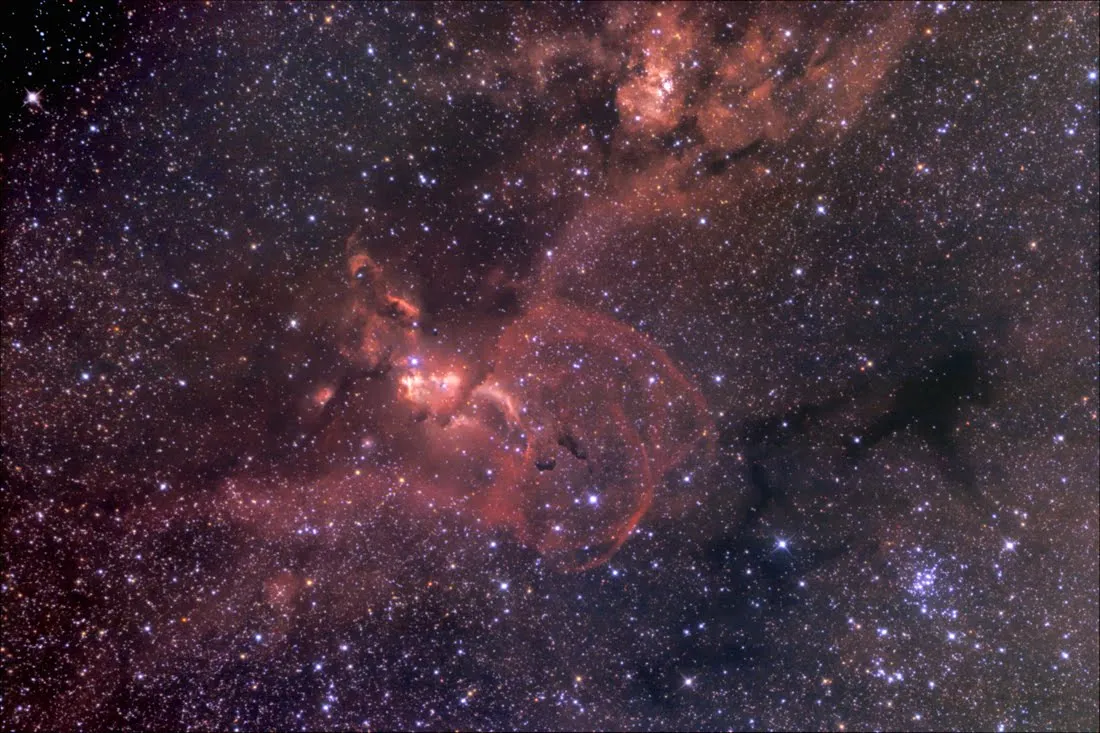
An intriguing and beautiful nebula in the constellation Carina, NGC 3576 travels along the Sagittarius arm in our spiral galaxy the Milky Way.
Within the region, the different episodes of star formation contribute to its suggestive and complex shapes.
The powerful winds from its young and massive stars shape the recurring filaments.
The contributions of hydrogen, sulfur and oxygen generate the nebular glow, whose energy is intensified by ultraviolet radiation.
But this glow also outlines dense clouds of gas and dust.
For example, the two condensed dark clouds near the top of the image offer very suitable places for the formation of new stars.
NGC 3576 as such, occupies about 100 light-years in diameter and is located about 9,000 light-years away in the southern constellation Carina, not far from the famous Eta Carinae nebula.
Image details
Telescope: Sky Watcher 254/1200 Newtonian Reflector
Camera: Canon EOS 350D Refrigerated and Modified
Exposure: 1 Hour RGB + 3 hours 44 minutes HA
Sub exposures between 90 and 120 seconds ISO 1600 for RGB and between 240 and 300 seconds for HA
Filter: Astronomik CLS CCD Clip
It was the Amateur Astronomical Picture of the Day (AAPOD) on September 21, 2012. On AAPOD there is the "hydrogen alpha only" version. The color composition shown here appears on Omar Mangini's website: Nebula 1.
Animated Science
Spacecop: Space chase
This animated short was made by Karl Davis. It's a sort of Tom and Jerry or Road Runner and Coyote, but with spaceships.
http://youtu.be/pMt7OWbcr5s
Space Music
News: From the ashes of the virtual group "Ear3" arises "Singing Sands".
BlondBlood lets me know that "In a wave of experimental progressive rock with multiple influences, we have written and composed the Rock Opera "The Inmutant" (The Immortal), a passionate story in a science fiction key made music. With about 15 tracks and an approximate duration of 80 minutes this work promises to satisfy lovers of the genre".
The musicians:
BlondBlood: Producer, Drums and Percussion, Acoustic Guitars, Bass and Arrangements. Jaime Heras: Keyboards, Synthesizers, Xaphoon, Flute and Arrangements.
PeerGynT LoboGris: Electric Guitars.
Lyrics by Jaime Heras in the voices of: Ricardo Texidó Conde Juanjo Meroño Lara Castro And perhaps some more guest...
"The Inmutant Opera" will be published at the end of 2012.
Soon you will receive more news and previews of the music.
There is a trailer on YouTube.
Jaime Heras: Earth
A new album by Jaime, the first of a series of three that will cover the concepts of Earth, Sky and Hell. Earth is a musical journey that takes us from the Big Bang to our birth. It is composed of three "movements": Earth, Life, Human. Each movement is in turn subdivided as Jaime indicates on Jamendo:
Earth (20:45)
I) Big Bang / Expansion
II) Space and Time Part 1
III) Space and Time Part 2
IV) Earth formation
V) Entropy / Finale
2) Life (19:20)Contains a voice fragment by Neil de Grasse Tyson.
I) Chemistery
II) Life finds a way
III) Life on Earth
IV) Evolution
3) Human (4:03)
To access previous editions of this section, consult the Multimedia Selection Series. The series attempts to show that the immensity of the universe can be perceived in different ways. I choose some images from a decade ago -so they don't fall into oblivion- and from the current week that ends, as well as sounds/music and videos that are artistic forms of expression with content related to astronomy and related sciences. I am also collecting these materials on the Pinterest account