A collection of links to music, images and videos relating art and science. Today: 3D images of Mars; The Pelican in Cygnus; A supernova in NGC 5806; NGC 1333 in dust; and A bright superbubble, NGC 1929. Sound: Rhayader goes to town: The star sower. Video: Trailer for The Star-Making Machine.

Images of the decade
Mars 3D: Terra Meridiani
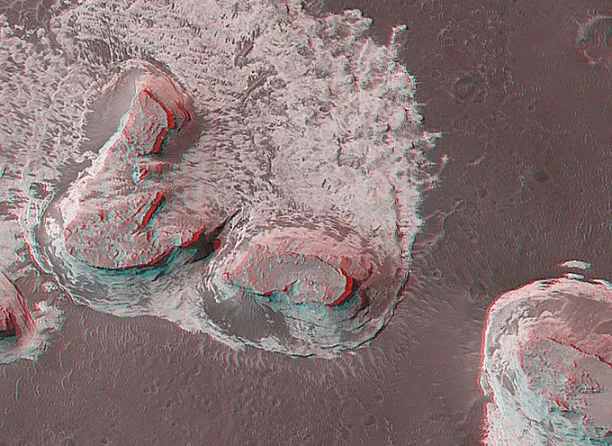
This incredible stereoscopic view belongs to the region known as Terra Meridiani, on Mars. The region is near the intersection of the Martian equator with the prime meridian: Lat.: 1.4714 Long: 0.5322. In this rocky area, the Phobos 2 probe took a thermal image in 1989 showing that these materials were too cold during the day. The Mars Global Surveyor, later, showed that these rocks formed cliffs, hills and plateaus that, in some way, recall northern Arizona and southern Utah in the United States, which is why this region is also known by the name Monument Valley just as the great depression in Utah is named.
The photographed area is about 3 kilometers. For terrestrial climbers, the place would be a delight, considering that due to the gravity of the red planet they would weigh one third.
The image we see here (and which can be downloaded in full from the MSSS site) is a composition achieved with shots from 2000 and 2001. But it was chosen as the Astronomy Picture of the Day (APOD) for August 28, 2002. In Spanish at Observatorio.
In June 2002, another photograph of the place was released by Themis. Remember that you can see Mars on Google.
Credits: Malin Space Science Systems,MGS,JPL, NASA
The Pelican in Cygnus
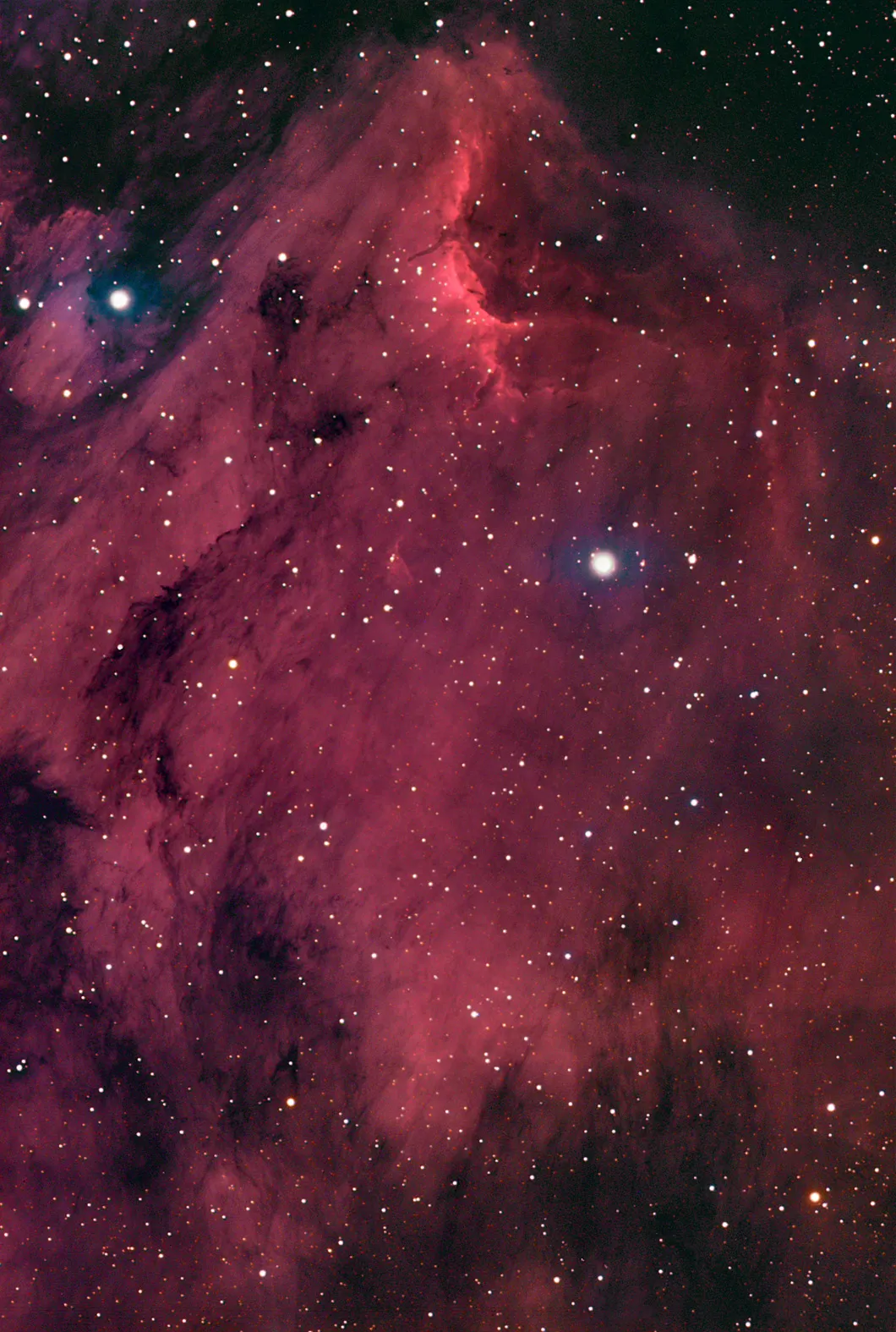
The Pelican Nebula, also known as IC 5070, lies 2,000 light-years away in the constellation Cygnus. This image shows a portion of the nebula that is about 30 light-years wide. The pelican is located near the North America Nebula (NGC 7000). The two nebulae appear separated from our point of view by a large dark cloud that crosses the image towards the upper left corner in this picture.
The wonderful photograph is by Robert Gendler on whose site we can find a wider image of the area to more easily locate both nebulae.
It was the Astronomy Picture of the Day (APOD) for August 29, 2002. And at Observatorio.
Images of the week
A supernova in NGC 5806
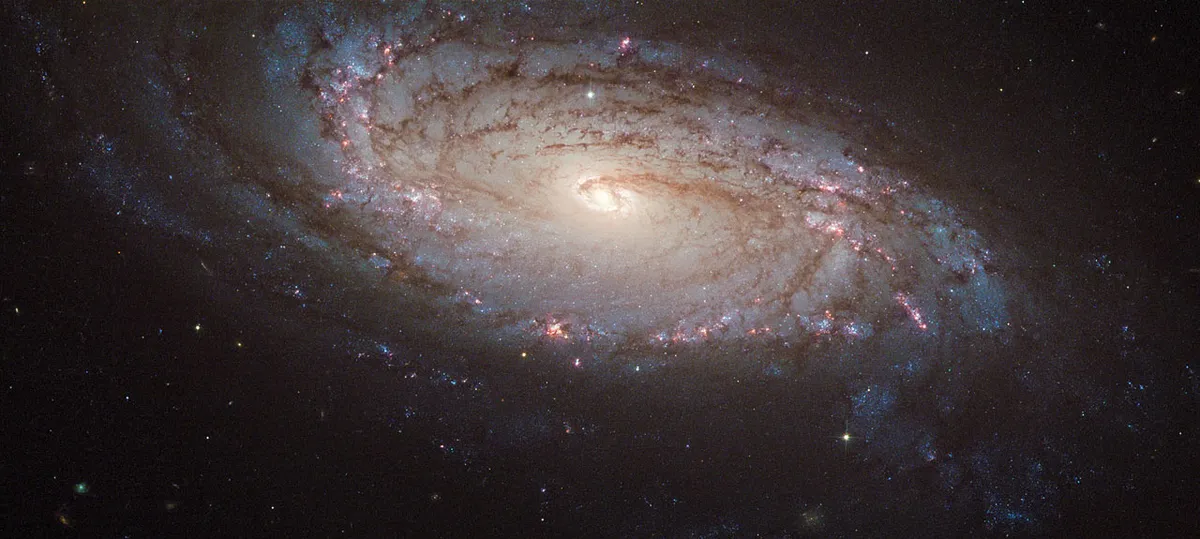
With the Hubble telescope, astronomers captured this image of the spiral galaxy NGC 5806 in Virgo*. It lies about 80 million light-years from Earth. The exposures that were combined to form the image were taken in 2005 to help determine the location of supernova SN 2004dg that exploded in 2004. The glow, caused by the explosion of a giant star at the end of its stellar life, can be seen as a faint yellowish glow near the bottom of the galaxy (**read below).
NGC 5806 was chosen as part of a study on supernovae because the archive of images taken with the space telescope contained photographs prior to the explosion.
In CBAT, IAUC 8375, the discovery of the supernova is reported by D. De Pasquale, F. Guerri, G. Guerri, M. Cristofanelli, S. Romanelli, and A. Vagnozzi on July 19, 2004, with magnitude 17.1.
The center of the galaxy is an active nucleus, where a supermassive black hole resides.
*Somewhere it is indicated that the supernova, and therefore the galaxy, resides in Serpens Caput (the Head of the Serpent). It is, however, within the boundaries of Virgo, near the "border" with that other constellation.
**In the same galaxy, another possible supernova was reported this year, PSN 2012p, also by Italians. Photo on Flickr. Both supernovae can be viewed in CDS Simplay, to facilitate location in relation to the image above.
Credits: ESA/NASA & Andre van der Hoeven.
It was the Image of the Week from the Space Telescope.
NGC 1333 in dust
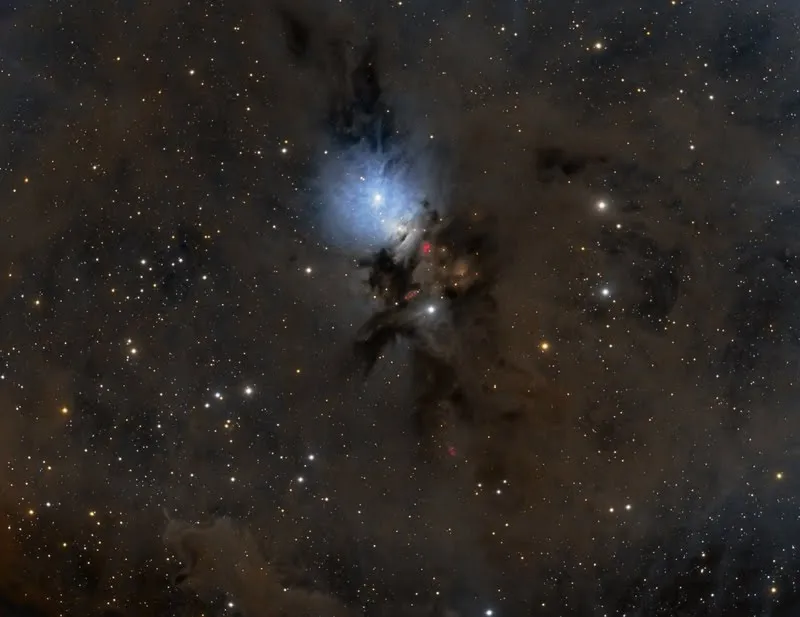
This reflection nebula in Perseus lies 1000 light-years away. The image was achieved after 33h, 20m of exposure (almost a day and a half) with a Skywatcher Black Diamond ED120 APO mounted on NEQ6 Pro SynScan and a Moravian G2 8300 camera.
The registration was achieved by Dieter Beer & Patrick Hochleitner from Bruck an der Glocknerstrasse, Austria.
This star-forming region was recorded, incredibly, by Spitzer.
The photograph was selected as the Amateur Astronomy Picture of the Day (AAPOD) for August 27, 2012.
A bright superbubble
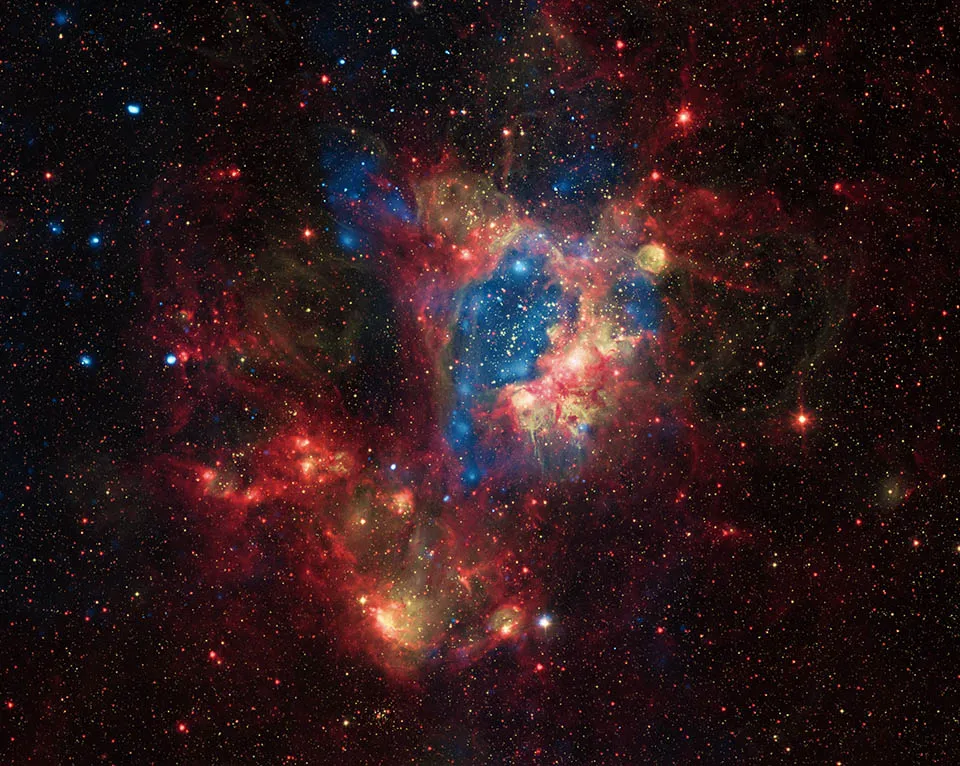
The star cluster NGC 1929 contains massive stars that produce radiation, expel matter at high speeds and evolve rapidly until they explode as supernovae. Winds and shock waves excavate the dust forming "cavities" in the surrounding gas.
X-rays from Chandra (in blue) in this false-color composite reveal regions created by those winds, while data from Spitzer (in red) define regions where dust and colder gas are found. Optical light from ESO (in yellow) shows where ultraviolet radiation from young stars makes the gas glow. NGC 1929 is located in the Large Magellanic Cloud, 160,000 light-years away. We previously mentioned the record achieved by ESO in relation to the Argentine Manu Mejías.
Credits: X-ray: NASA/CXC/U.Mich./S.Oey, IR: NASA/JPL, Optical: ESO/WFI/2.2-m.
The image was published on the Spitzer site on August 31, 2012.
Space Music
Rhayader goes to town: The star sower
Rhayader goes to town is the musical alter-ego of Pedro Roldán Perea, veteran player of guitars, basses, keyboards and occasionally voice.
On his MySpace site, Pedro tells what is obvious to those of us who like progressive rock, but which will not be noticed by those who do not know that music: The artistic name comes from an old Camel track belonging to one of the peaks of progressive or symphonic rock: The Snow Goose, a superlative work by his favorite group that is based on a poem by Paul Gallico (a true gem). Rhayader has returned to the city and in his saddlebags he carries an old piano and a million ideas. Make way for fantasy.
Animated Science
The Star-Making Machine
Pilo is a boy who lives with his mother in a small house on one of the asteroids in the belt surrounding a huge bluish planet. Every night he goes out to his balcony hoping that the stars have disappeared from the sky. According to his grandfather, there is a machine that generates the stars every night and, if one day it fails and the stars disappear, a member of his family will be in charge of repairing it.
I commented here, in February, what seemed to be the imminent release of this Argentine 3D animated film some months ago. For various reasons, the release was postponed and this week it finally arrived in Argentine theaters. I haven't seen the film yet, but I think it's timely to promote it for several reasons. The trailer is very good and indicates an excellent production, the kind you don't see, especially in animation in our country. The theme is related to astronomy. One of the actors, that is, a voice actor, is a friend of the house: Alejandro Outeyral. I hope to see the production soon, but in the meantime, I leave the trailer here, as well as point out the official site and the Facebook page for this production.
To access previous editions of this section, consult the Multimedia Selection Series. The series attempts to show that the immensity of the universe can be perceived in different ways. I choose some images from a decade ago -so they don't fall into oblivion- and from the current week that ends, as well as sounds/music and videos that are artistic forms of expression with content related to astronomy and related sciences. I am also collecting these materials on the Pinterest account