A collection of links to music, images and videos relating art and science. Today: Images of Abell 2104; the Tycho supernova remnant; The Pencil Nebula; Messier 8 in Hubble palette. Music: Supernova, by Pablo Gómez. Video: The lights of the Planetarium.

Images of the decade
Abell 2104
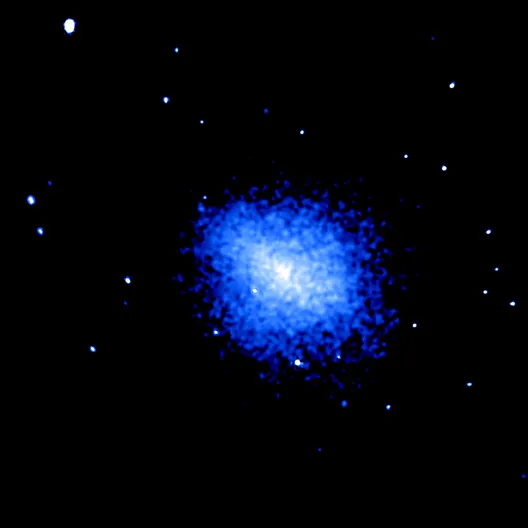
Abell 2104 is a galaxy cluster lying almost 2 billion light-years from Earth. Observations made by astronomers on this object turned existing ideas about ancient galaxies and black holes upside down. The research was conducted by researchers from the Carnegie Observatories in Pasadena and Las Campanas and the Chandra X-ray Observatory.
The idea was like this: galaxies, over billions of years, come together, approaching each other. They begin to interact until they finally group into clusters. That interaction, at high speed, strips them of their interstellar gas, just as a strong wind leaves a tree with few leaves. Since they no longer have that gas, they cannot form new stars. The stellar population ages and the galaxy turns red. For the same reason, the nuclei of these galaxies, which in many cases have black holes that "feed" on gas, become less active.
But observations of Abell 2104 found many more supermassive black holes in that cluster than expected. Previous studies with optical telescopes found that only one percent of galaxies in a cluster had an Active Nucleus (AGN). But if the Chandra observation could be extrapolated, the count would have to be increased to 5 percent.
The team found six red galaxies with high X-ray activity during the nearly 14 hours of observation of Abell 2104.
The image was published on the Chandra site on September 13, 2002.
Credits: Credit: NASA/CXC/OCIW/P.Martini et al.
X-rays from the Tycho supernova remnant
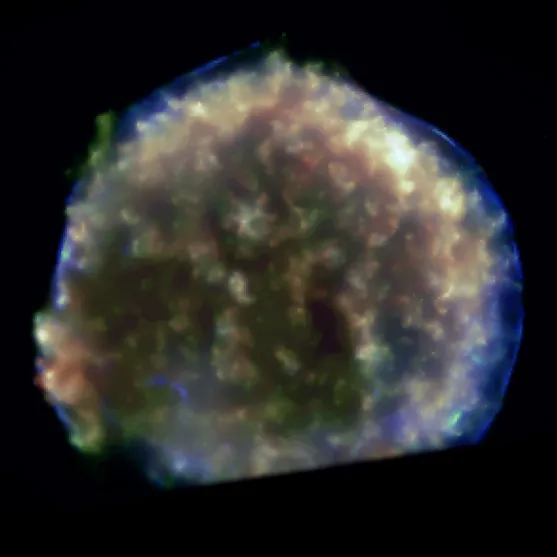
This image, obtained with the Chandra X-ray Observatory, reveals the details of the turbulent debris created by the supernova observed by Danish astronomer Tycho Brahe in 1572. The colors show different X-ray energies, with red, green and blue representing low, medium and high energies, respectively.
This remnant presents several contrasts with the Cassiopeia A (Cas A) remnant, for example the lack of a point source in Tycho, unlike Cas A, is evidence that this remnant is the product of a Type Ia supernova, resulting from the destruction of a white dwarf. At a distance of 7,500 light-years, this stellar debris expands about 20 light-years in diameter.
Credits: SAO, CXC, NASA
The image was published on the Chandra site on September 6, 2002.
And it was chosen as the Astronomy Picture of the Day (APOD) for September 12, 2002.
Also on Observatorio.
Images of the week
New image of the Pencil Nebula
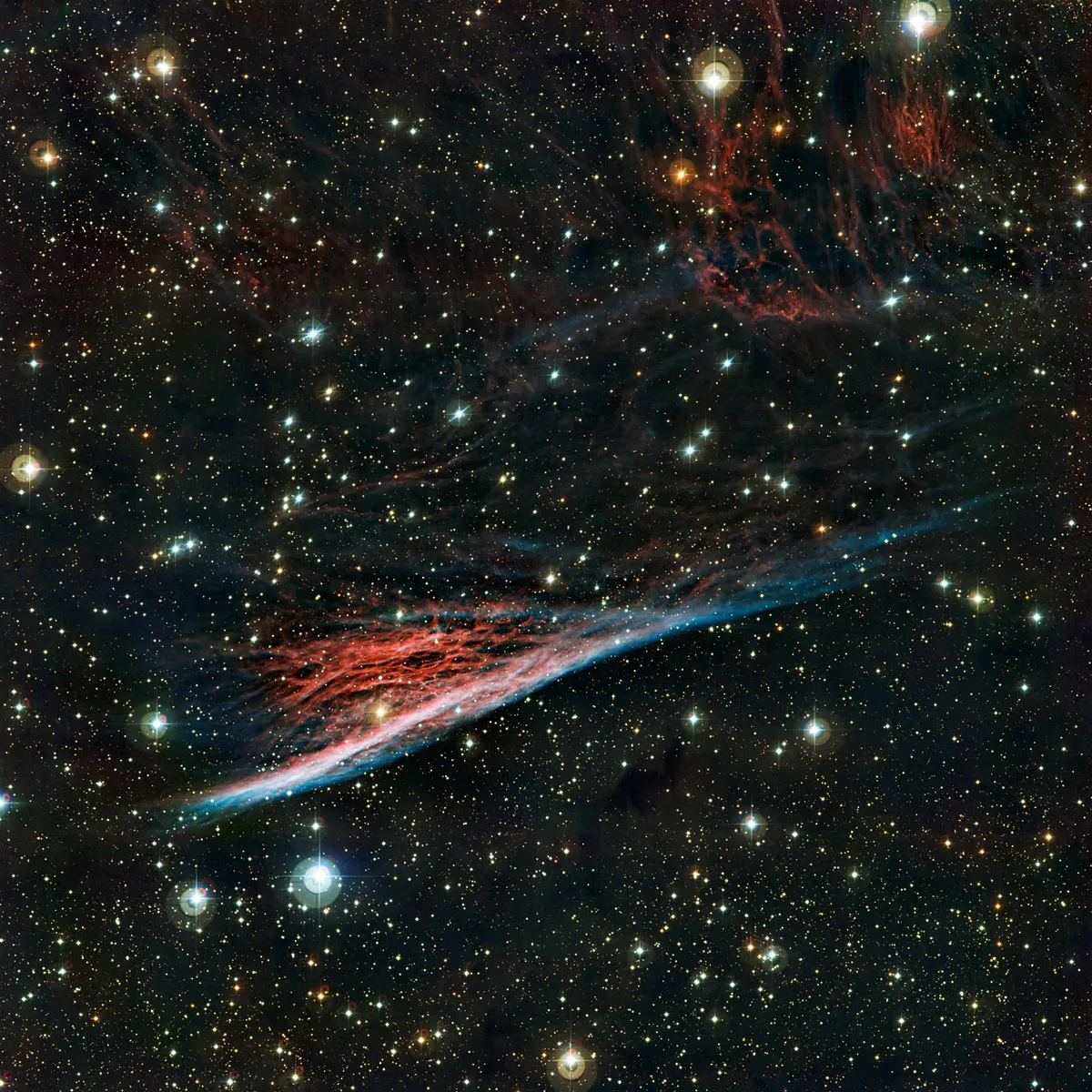
This is a new image of the Pencil Nebula (NGC 2736), obtained from the La Silla Observatory in Chile. This peculiar cloud of glowing gas is part of a huge ring of debris, resulting from a supernova explosion that took place about 11,000 years ago. The detailed image has been captured by the Wide Field Imager camera, installed on the MPG/ESO 2.2-meter telescope.
The Pencil Nebula measures about 0.75 light-years and moves through the interstellar medium at about 650,000 kilometers per hour. Surprisingly, although it is located at a distance of about 800 light-years from Earth, this means it will change its relative position with respect to the background stars noticeably over the course of a human lifetime. Even after 11,000 years the supernova explosion continues to change the appearance of the night sky.
Credit: ESO.
The press release, more complete and detailed, can be read on the ESO site.
M8 in Hubble palette
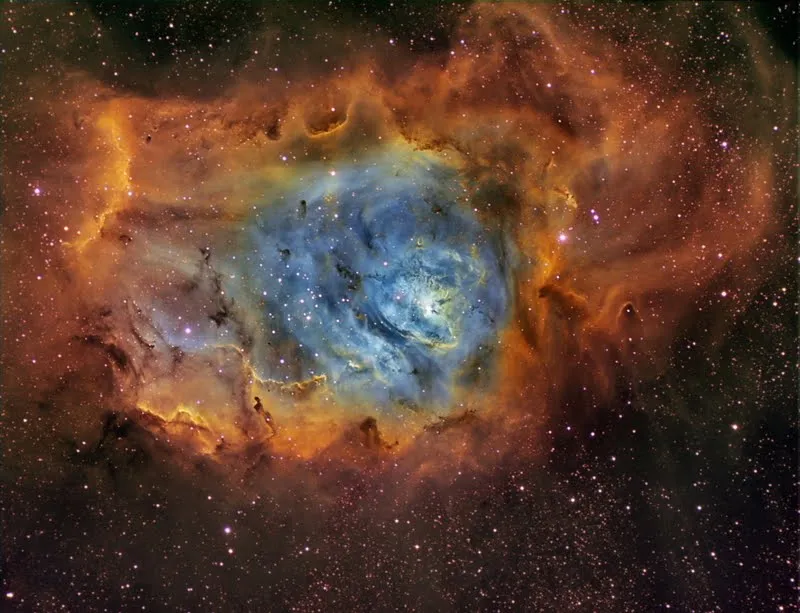
With a 152/900 achromatic refractor, an SBIG st8300 CCD and 7.5 hours of integration, Francesco Tallarico, from Paternò, Italy, achieved this beautiful portrait of the Lagoon Nebula, the Messier 8 object located 5,000 light-years away, on May 30, 2012.
But, are these the "real" colors of the nebula?
What the astrophotographer did was map the emission of hydrogen alpha, oxygen III and sulfur II with the colors red, green and blue.
That is, with the ccd camera he used filters to capture different wavelengths. It is known that certain wavelengths correspond to the emission of hydrogen, others to that of oxygen and sulfur. Then each shot was associated with a red, green and blue color.
The so-called "Hubble palette" is the way this "mapping" or association of data with colors is done in the published images from Hubble photographs.
How is that achieved?
I leave here two links, the first in Spanish (with a simple and detailed explanation), and another in English, basically about how to achieve the color palette:
NGC 3372 and narrowband
Hubble Palette Color Map Images w/ PhotoShop
It was chosen as the Amateur Astronomy Picture of the Day (AAPOD) for September 15, 2012.
Space Music
Supernova by Pablo Gómez
From Munich, Germany, Pablo Gómez produced this track titled Supernova, as part of a three-track self-titled album, available on SoundCloud and Jamendo.
Animated Science
The lights of the planetarium
In 2012, the Second Kosice Biennial is presented, again featuring Graciela Taquini, Rodrigo Alonso and Objeto a as jury and Maestro Gyula Kosice as its president. On this occasion, the concept and spirit of La Ciudad Hidroespacial was taken as the inspiring axis for the competing projects.
The Kosice Biennial arises as a logical consequence of the path of exploration initiated by Objeto a in the field of fusion of Art and New Media. From the beginnings of the project, Objeto a presented and became involved with actions and proposals that in one way or another were related to this field.
About the Kosice Biennial
Planetario Galileo Galilei
Planetario Galileo Galilei 1024x768 Mpg from maria lujan oulton on Vimeo.
About the Lights of the planetarium
In this Second Biennial Kosice participates as a partner RGB equipping with a special led system the Helicoidal Garden of Jorgelina Herrero Pons, winner of one of the mentions. The choice of RGB as a partner company, leaders in their field, is not accidental, as they were chosen by the Planetarium to take care of the current lighting of its facade, which earned them the title of winners of the II Prize Category Work of the V ELI Award Competition (Efficient Lighting Initiative) 2011, for having a high energy efficiency lighting and being a national exponent of “Media Architecture”.
To access previous editions of this section, consult the Multimedia Selection Series. The series attempts to show that the immensity of the universe can be perceived in different ways. I choose some images from a decade ago -so they are not forgotten- and from the current week that ends, as well as sounds/music and videos that are artistic forms of expression with content related to astronomy and related sciences. I am also collecting these materials in the Pinterest account