A collection of links to music, images and videos relating art and science. Today: Images of The Missile and the Dove; X-ray Rainbow; Hubble's eXtreme Deep Field; NGC 3372 from Entre Ríos. Sound: Esteban Palladino; Music for the planets. Video: The solar system from home.

Images of the decade
The missile and the dove
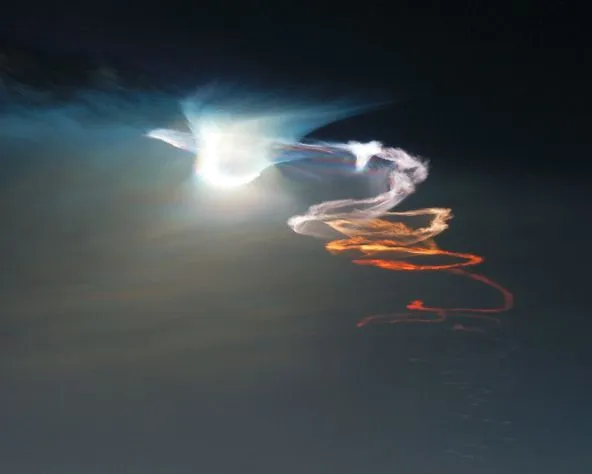
Look at the photograph and think about what is portrayed in this shot. Could it be a ghost? Perhaps a UFO? I bet many would say the latter...
The light of the setting sun and the glow of the rising moon contribute to this incredible image of the exhaust trail of a rocket spinning and changing direction in the evening sky.
The photograph was taken from the Table Mountain Observatory, California, United States, on September 19, 2002.
The rocket, a solid-fuel Minuteman III missile, was not in sight when the image was taken.
The reddish-orange color of the setting sun is greatly intensified in the front of the rocket's trail, while below the sunset line, the end of the trail is faintly illuminated from the east by the full moon.
Even in full sunlight, the bright diffuse cloud at the front of the trail, caused by the separation of a rocket stage, is tinged with rainbows, presumably created by ice crystals formed in the high-altitude exhaust plume.
Astronomer James Young commented that the cloud looks like a white dove flying across the sky from right to left.
Credit: James W. Young ( TMO, JPL, NASA)
It was NASA's Astronomy Picture of the Day (APOD) for September 26, 2002. In Spanish at Observatorio.
X-ray Rainbow
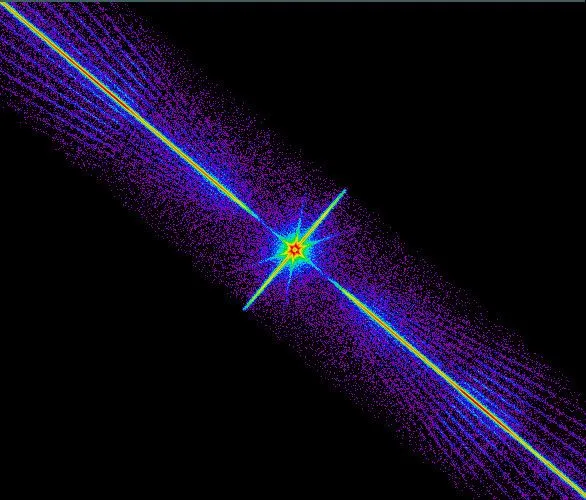
A water droplet or glass prism can scatter visible light into a rainbow. In order of increasing energy, the familiar spectrum of colors in a rainbow is red, orange, yellow, green, blue, indigo, and violet. X-ray light can also be scattered into a spectrum ordered by energy... but not by water droplets or glass. Instead, the Chandra Observatory uses an array of 540 finely ruled gold gratings to separate the X-rays, recording the results with digital detectors. The resulting spectrum reveals much information about the composition of cosmic X-ray sources. In this false-color Chandra image, the spectrum of the stellar system XTE J1118+480 in Ursa Major is shown, consisting of a star like our Sun orbiting a black hole. Unlike usual rainbows, the energies here are ordered along radial lines with the highest-energy X-rays near the center and the lowest-energy ones at the edges. The central region appears that way because the rays there were not separated by the grating array.
The instrument used with Chandra is called the Low Energy Transmission Grating (LETG), which was used by a group of scientists led by Jeffrey McClintock (Harvard-Smithsonian Center for Astrophysics) to observe this "X-ray Nova", so called because there are occasional eruptions followed by long periods of "quiet". The object is located 5,000 light-years from Earth. The observations were made in April 2000, were published on Chandra in May 2001 and were chosen as the Astronomy Picture of the Day (APOD) for September 28, 2002. And at Observatorio.
Credit: J. McClintock et al. (CfA), CXC, NASA
Images of the week
Hubble's eXtreme Deep Field
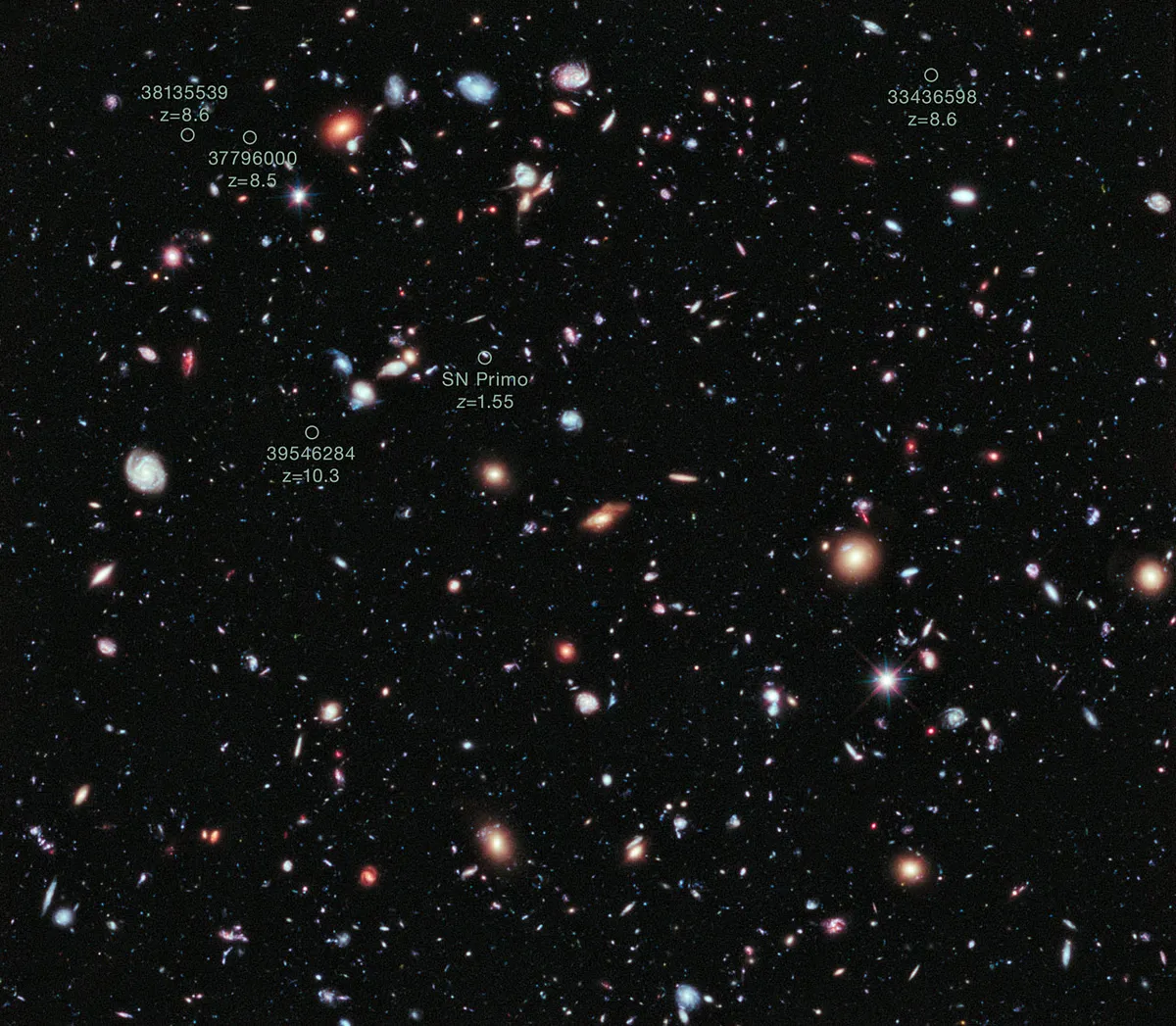
Like photographers when they combine their best shots, astronomers assembled a new portrait of our deepest view of the Universe. Thus was born what is called the eXtreme Deep Field (XDF) by combining ten years of Hubble observations of a small patch of sky within the Ultra Deep Field.
The chosen region was in the constellation Fornax (the Furnace) with Hubble data from 2003/2004, from the Ultra Deep Field, as well as from 2009 with infrared field observations. In that small area, a fraction of the angular diameter of the Full Moon (30 millionths of the sky), Hubble found about 5,500 galaxies.
The eXtreme Deep Field contains some of the most distant objects such as:
UDFj-39546284, with a redshift (z) of 10.3 is possibly the most distant galaxy found so far (confirmation is awaited).
Supernova Primo, z=1.55, the most distant type Ia event ever observed.
UDFy-38135539, z=8.6, the most distant galaxy with distance confirmed by spectroscopy.
UDFy-33436598, another galaxy also at z=8.6.
Credit: NASA, ESA, G. Illingworth, D. Magee, and P. Oesch (University of California, Santa Cruz), R. Bouwens (Leiden University), and the HUDF09 Team.
The image was published on SpaceTelescope on September 25, 2012.
Eta Carinae Nebula - NGC 3372
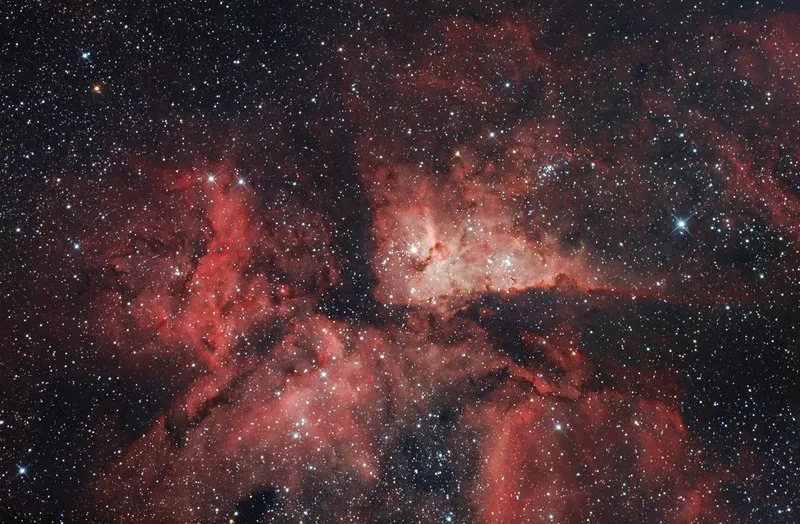
Photograph taken from Gualeguay, Prov. de Entre Ríos, on Saturday, April 30, 2012. NGC 3372 is located about 10,000 light-years away.
Shooting data:
Telescope: Sky Watcher P150/750 - NEQ3 - GoTo Synscan
Camera: Canon EOS 1000D, unmodified + MPCC + Astronomik CLS Filter
Guiding: Galileo 70/400 - Philips SPC900 NC unmodified - PHD Soft
Frames: 24 x 240 sec - ISO 800 + 12 dark + 20 flat + 20 bias
Total exposure: 1 Hour 36 Min.
Processing: Stacked in DSS, adjustments in Photoshop CS5
The record belongs to Alejandro Antognoni (www.sonovasco.com.ar) and the photograph was chosen as the Amateur Astronomy Picture of the Day (AAPOD) September 29, 2012.
Space Music
Esteban Palladino: Music for the planets
This set, which is available on SoundCloud, was created in the year 2000, when its creator, Esteban Palladino, was 19 years old. Palladino is a freelance designer and animator whose work can be seen at http://www.epaldesign.com.ar/.
Animated Science
The Solar System from home
Want to navigate the Solar System without having to buy that expensive spacecraft? Jon Nguyen demonstrates the use of "Eyes on the Solar System", from NASA's Jet Propulsion Laboratory. It is a software program for exploring the planets, moons, asteroids, and spacecraft orbiting our Sun in real time. (Filmed at TEDxSanDiego). Here I also commented on "Eyes on the Solar System".
To access previous editions of this section, consult the Multimedia Selection Series. The series attempts to show that the immensity of the universe can be perceived in different ways. I choose some images from a decade ago -so they don't fall into oblivion- and from the current week that ends, as well as sounds/music and videos that are artistic forms of expression with content related to astronomy and related sciences. I am also collecting these materials on the Pinterest account