A collection of links to music, images and videos relating art and science. Today: Images of NGC 6369; The hexagon, the triangle and the "Great G"; Cosmic sprinklers; Cygnus OB2. Music: Cignus by Tree Shepherd // Gooyz. Video: The Solar Gradient.

Images of the decade
NGC 6369
This planetary nebula lies in the constellation Ophiuchus. A star like our Sun, towards the end of its life, will expand enormously in what is called the red giant phase, after which it will expel its outer layers into space and a nebula will form. In the past, the observation of these nebulae made astronomers think they were planets, hence their generic name.
This particular object, in addition to its catalog designation, is commonly known as the "Little Ghost Nebula". For the RAE, a ghost is the image of an object imprinted on the imagination. The nebula lies more than 2,000 light-years away. The ghost lies in our imagination.
Credit: NASA and The Hubble Heritage Team (STScI/AURA).
The image was published on HubbleSite on November 7, 2002. More at El Sofista.
The hexagon, the triangle and the "Great G"
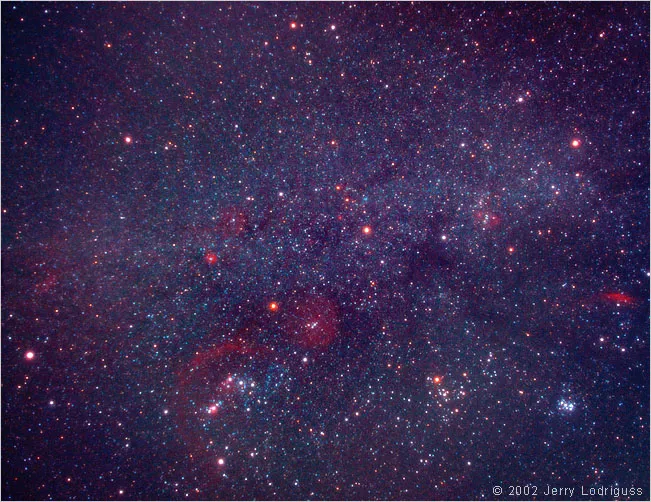
In ancient times, without GPS or maps, stars served as reference points in the skies for navigating the seas. It proved very useful to invent shapes associated with the brightest stars to remember them (especially when there was no writing).
Since then it has been possible to see in the sky what we feel like seeing.
For example, the hexagon composed of the bright stars Aldebaran, Capella, Castor-Pollux, Procyon, Rigel and Sirius. (Placing the cursor over the image will show another image that identifies the stars).
This shape arises from combining stars from different constellations. These groups of stars, which in most cases have no relation to each other, are called asterisms or pseudoconstellations. This hexagon, as noted in the image below, also contains a triangle, formed by Sirius, Procyon and Betelgeuse (in green).
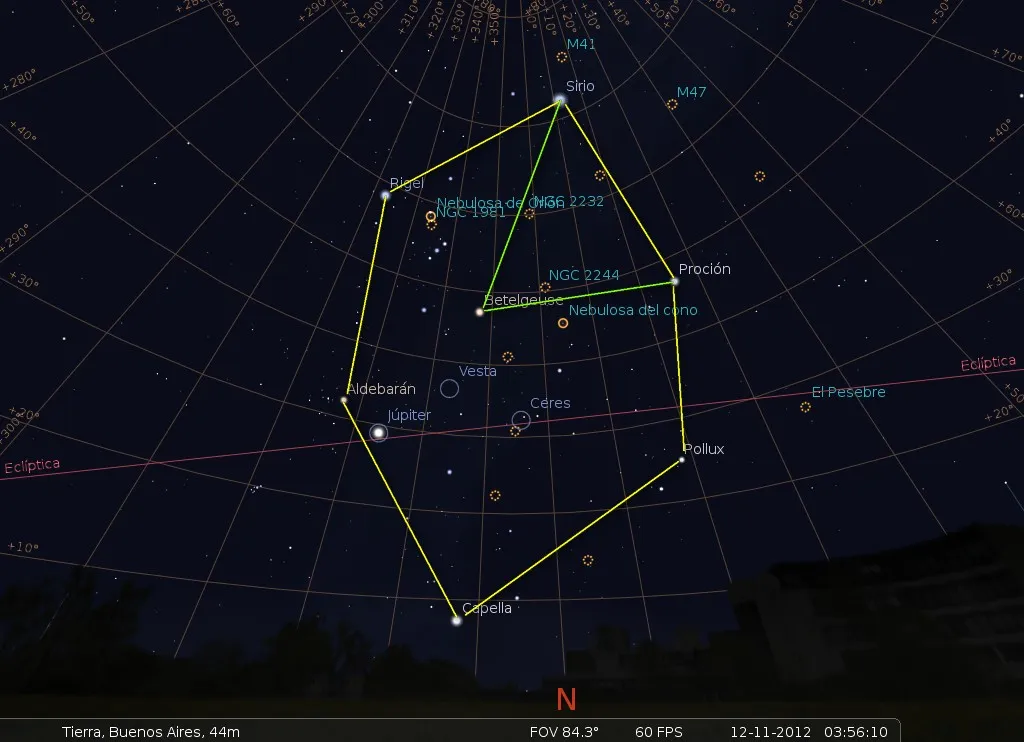
Another asterism, using the same group of stars, is the so-called "Heavenly G" or "G of the heavens": If we use the hexagon as a base in the order Sirius, Rigel, Aldebaran, Capella, Pollux-Castor, Procyon and then draw a line to Betelgeuse, we will have the "Great G".
In the skies of the Northern Hemisphere the constellations appear inverted in relation to what we observe in the Southern Hemisphere, so at positive latitudes, the letter is formed in another way.
In Buenos Aires, as seen in the image generated with Stellarium, it is possible to visualize these asterisms, from dark skies, around 04:00 hours at this time of year.
It was the Astronomy Picture of the Day (APOD) on November 6, 2002. Also at Observatorio.
Credit & Copyright: Jerry Lodriguss
Images of the week
Cosmic sprinklers
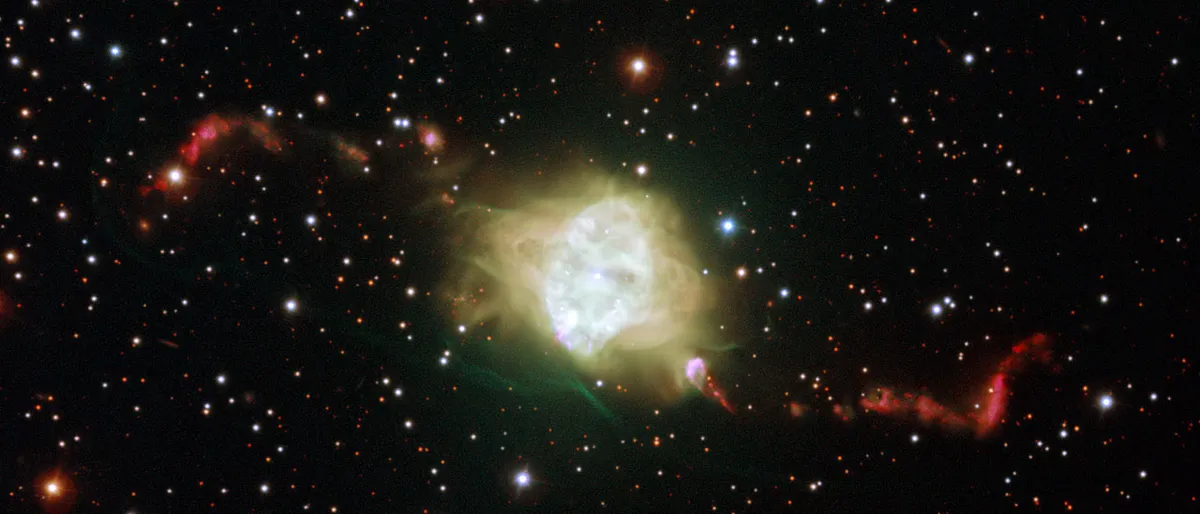
Using ESO's VLT (Very Large Telescope), a team of astronomers has discovered a pair of stars orbiting each other at the center of one of the most emblematic planetary nebulae. These new results confirm a long-debated theory about what controls the spectacular and symmetrical appearance of the material ejected into space.
Fleming 1 is a beautiful example with surprising symmetric jets weaving intricate curved patterns. It is located in the southern constellation of Centaurus (The Centaur) and was discovered exactly a century ago by Williamina Fleming, a housekeeper hired by Harvard Observatory after showing her aptitude for astronomy.
This impressive object is a bright cloud of gas around a dying star. New observations have shown that it is very likely that, at the center of this object, there is a strange pair formed by two white dwarfs. Their orbital motions can explain the surprising symmetric structures of the jets in the gas clouds surrounding this and other similar objects.
Credit: ESO/H. Boffin
The image was published on ESO on November 8, 2012.
Cygnus OB2
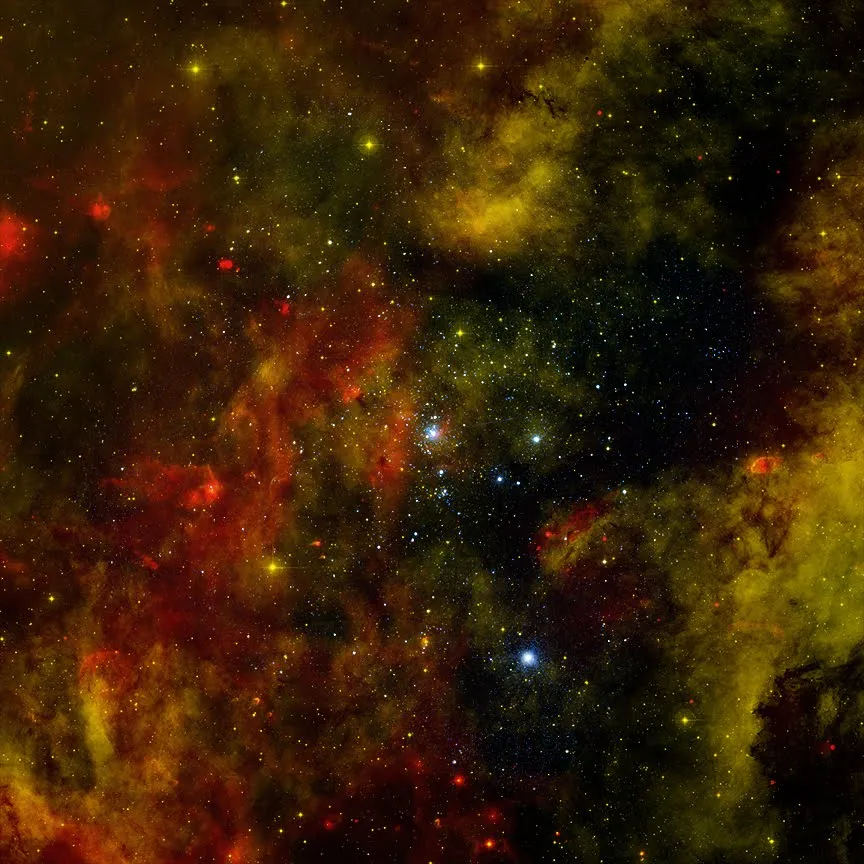
The Milky Way and other galaxies host many clusters of young stars and associations containing hundreds to thousands of massive, hot stars known as O-type and B-type stars (hence these groups are called OB Associations). The Cygnus OB2 star cluster contains more than 60 O-type stars and about a thousand B-type stars. At a relatively close distance to Earth, 5,000 light-years, it is one of the closest massive clusters. Observations made with the Chandra X-ray Observatory detected X-ray emission from the outer layers of the atmospheres or coronas of young stars in the cluster. About 1700 X-ray sources were detected. In the image above, X-rays detected by Chandra (blue) were combined with infrared data from Spitzer (red) and optical data from the Isaac Newton Telescope (orange).
Credit: X-ray: NASA/CXC/SAO/J.Drake et al, Optical: Univ. of Hertfordshire/INT/IPHAS, Infrared: NASA/JPL-Caltech
The image was published on the Chandra site on November 7, 2012.
Space Music
Cignus by Tree Shepherd // Gooyz
From Lisbon, Portugal, the artist Gooys tells us that Cygnus (Swan) is an easily recognizable constellation of the Northern sky that has the asterism Northern Cross.
He also indicates one of the stories about the origin of the constellation, about two friends, Cygnus and Phaeton who competed to see who could run faster to the Sun and back. To cut the path they got too close to the Sun and their chariots burned. Both fell to Earth, but Phaeton got trapped by the roots of a tree at the bottom of the river Eridanus. Unable to rescue him, Cygnus implored Zeus who told him that if he turned him into a swan he could dive, but would lose his immortality.
According to Robert Graves in The Greek Myths in the chapter on Helios (42) "one morning Helios yielded to the pleas of his son Phaethon who constantly bothered him asking for permission to drive the Sun's chariot". He indicates that Phaethon wanted to dazzle his sisters Proto and Clymene, who had yoked the white horses of the chariot. But as he did not have enough strength, he drove it (the chariot-Sun) high above the Earth and the whole world trembled and then very close to the Earth which scorched the fields. Zeus, then, killed him with a thunderbolt and he fell into the river, as Graves recounts in 42,b.
But then he adds, in 42.2, that this fable has been spread with the moral that parents should not spoil their children by heeding female advice. However, the historian adds, it is not so simple: it has a mythical reference in its allusion to the annual sacrifice of a royal prince, on the only day calculated as belonging to the terrestrial year and not the sidereal year, namely the one following the shortest day.
Robert Graves, The Greek Myths, Editorial Alianza, Volume 1, pp. 190-194, Buenos Aires, 1996.
Animated science
The Sun gradient
"Watching a particularly beautiful movie of the Sun helps to show how the boundaries between science and art can sometimes blur. But there is more connection between the two disciplines: techniques in science and art are frequently very similar, in fact, one learns from the other. One technique is known as a gradient filter, recognized by many people as an option available in photo editing software. Gradients are a mathematical description that enhances the places of greatest physical change in a space. A gradient filter, in turn, enhances places of contrast," NASA states in a recent release.
http://www.youtube.com/watch?v=dS5-ekgX7nM
As can be inferred from the images, sounds, videos, our senses deceive us. Planetary nebulae have nothing to do with planets, nor are there polygons in the sky (which is not a plane). However, sometimes, a distortion of our gaze, aided by instruments, enables us to better understand "objective reality," as well as to interpret it with greater artistic subjectivity.
To access previous editions of this section, consult the Multimedia Selection Series. The series attempts to show that the immensity of the universe can be perceived in different ways. I choose some images from a decade ago -so they don't fall into oblivion- and from the current week that ends, as well as sounds/music and videos that are artistic forms of expression with content related to astronomy and related sciences. I am also collecting these materials in the Pinterest account