A collection of links to music, images and videos relating art and science. Today: Images of M94; Two supermassive black holes in the same galaxy; Double solar prominence; ESO 499-G37. Music: The "song" of Earth. Video: "Magic" water.

Images of the decade
Star Explosion in Galaxy M94
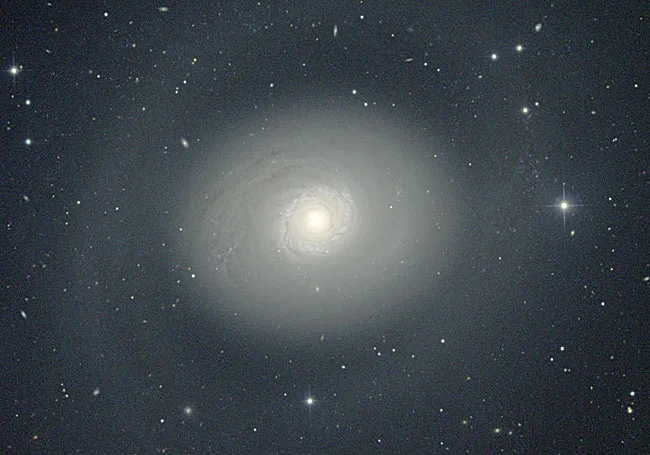
What could cause the center of M94 to be so bright?
The spiral galaxy M94 has a ring of recently formed stars surrounding its nucleus, giving it not only an unusual appearance but also a strong inner glow.
One leading hypothesis holds that a knot of stars or a bar rotates in M94 and has spawned an explosion of star formation in the form of a moving outer ring.
M94, in the image above, spans about 30 light-years, is located approximately 15 million light-years away and can be seen with a small telescope in the direction of the constellation Canes Venatici (The Hunting Dogs).
Credits & Copyright: Hillary Mathis & N.A.Sharp (NOAO), AURA, NSF
It was the Astronomy Picture of the Day (APOD) of November 21, 2002. Also on Observatorio.
Two supermassive black holes in the same galaxy
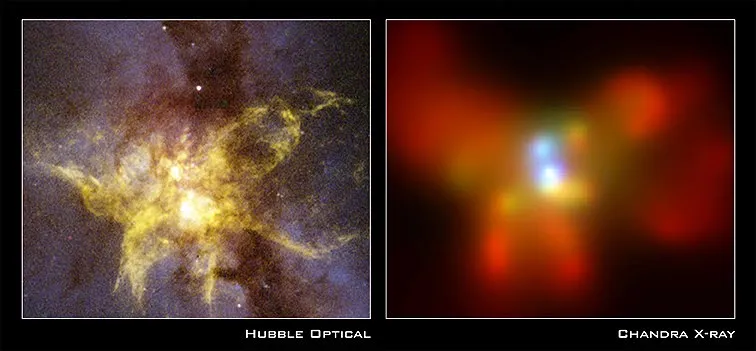
In 2002, for the first time, astronomers proved the existence of two supermassive black holes in the same galaxy through the Chandra X-ray Observatory.
In the future, scientists say, the black holes will merge into an even more massive object.
The image shows the bright nucleus of galaxy NGC 6240, about 3,000 light-years away, in optical wavelengths (by Hubble, left) and X-rays (by Chandra, right.) Chandra data are color-coded red, green and blue for lower, medium and higher energy X-rays, respectively
Credit: X-ray: NASA/CXC/MPE/S.Komossa et al.; Optical: NASA/STScI/R.P.van der Marel & J.Gerssen.
The images were published on the Chandra site on November 19, 2002.
Images of the week
Double Solar Prominence
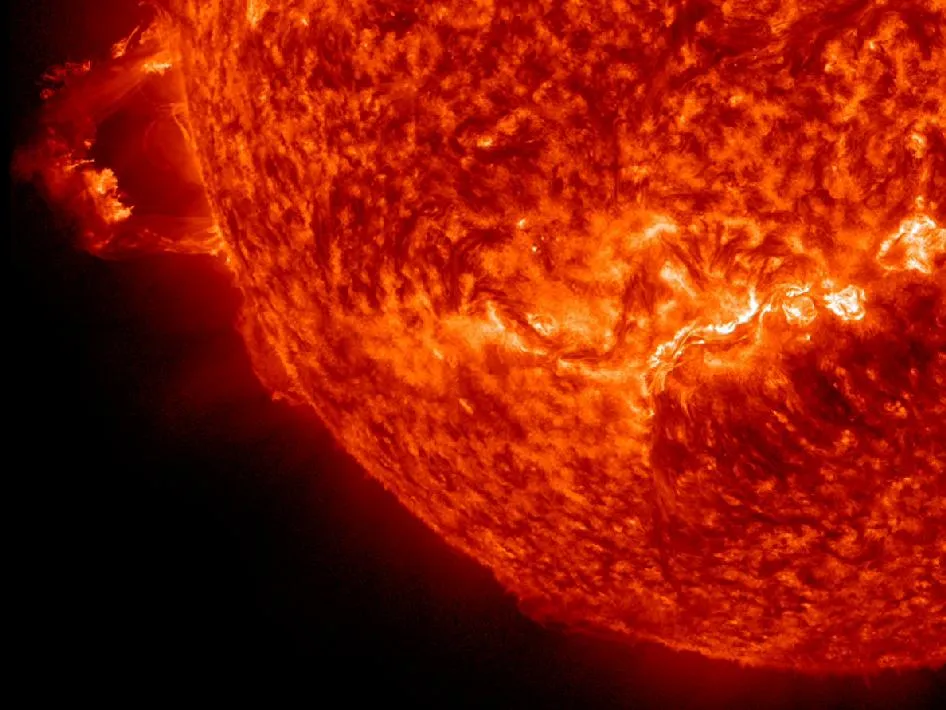
The Sun produced two prominences, one after another over a four-hour period on November 16, 2012. The action was captured in the 304 Angstrom wavelength, in the extreme ultraviolet. The bright, "curled" red material is plasma, a hot gas of charged hydrogen and helium particles. Plasma flows along the magnetic fields generated by the Sun's internal dynamo. An eruption occurs when that structure becomes unstable. The action was captured by NASA's Solar Dynamics Observatory (SDO). The expansive cloud of particles ejected into space does not appear to be directed at our planet.
Credit: NASA/SDO/Steele Hill
There is a video associated with the NASA release.
The image was published on the NASA site on November 20, 2012.
ESO 499-G37
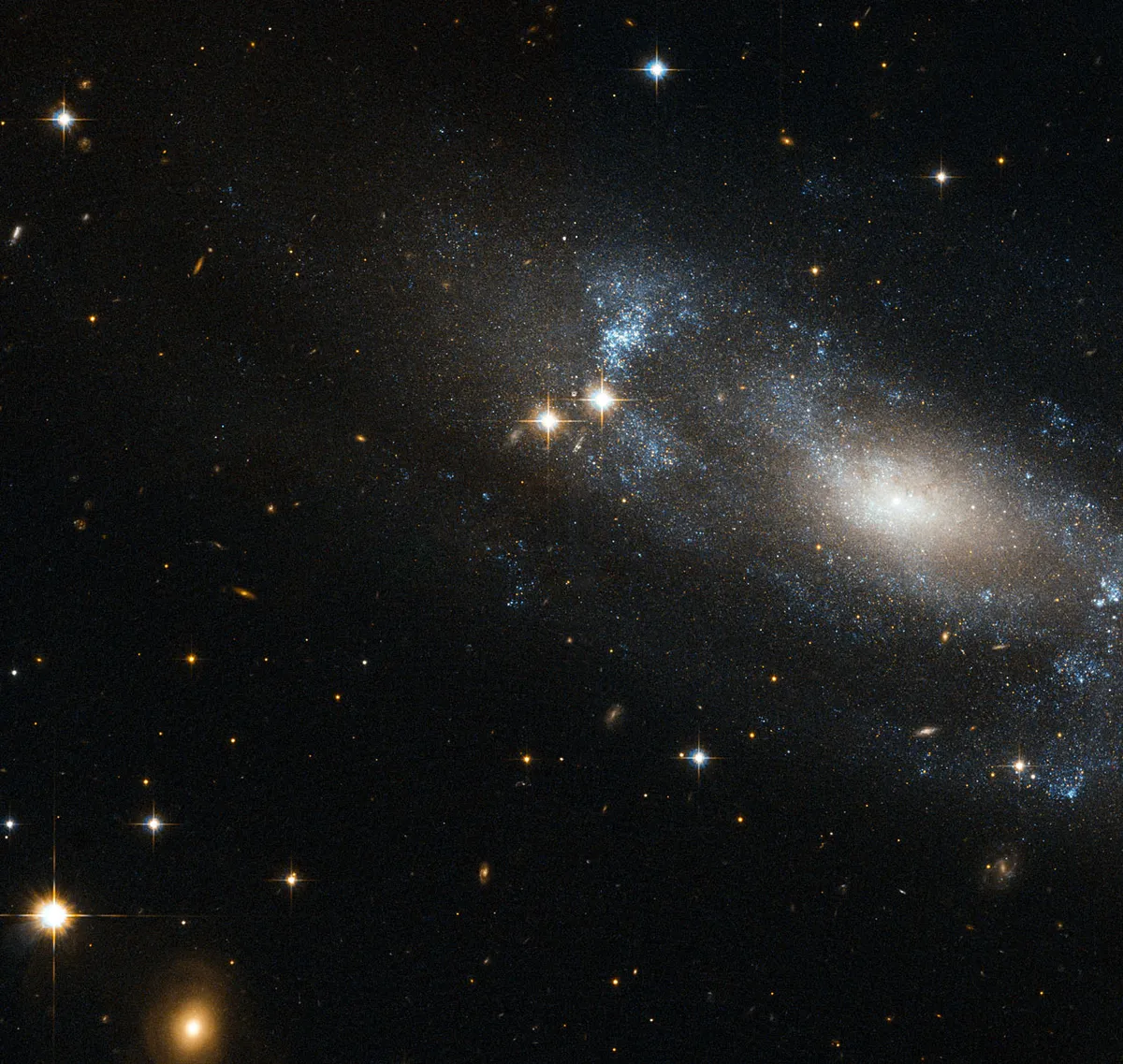
The Hubble Space Telescope captured this image of galaxy ESO 499-G37. The galaxy is viewed from an angle that allows its spiral structure to be clearly revealed. The faint arms are distinguished by a bluish tint around the bright nucleus. Recent studies suggest this galaxy has a small central bar, much smaller than other galaxies.
ESO 499-G37, 59 million light-years away in Hydra, was first observed in the late 1970s in the ESO/Uppsala Survey, a project that joined the European Southern Observatory (ESO) with Uppsala Observatory and used the Schmidt telescope at La Silla, Chile, to map a large portion of the southern sky.
Credit: ESA/Hubble & NASA
It was the Hubble Space Telescope Image of the Week.
Space Music
The "song" of Earth
"This is what we call chorus," explains Craig Kletzing of the University of Iowa. "This is one of the clearest examples we have heard."
Chorus is an electromagnetic phenomenon caused by plasma waves in Earth's radiation belts. For years, radio amateurs on Earth have been listening to it from afar. Now, NASA's Twin Radiation Belt Storm Probes, or Van Allen Probes, are traveling through the region of space from where the chorus truly originates. And the recordings are absolutely incredible.
"This is what the radiation belts would sound like to humans if we had radio antennas instead of ears," says Kletzing, whose team at the University of Iowa built the "EMFISIS" receiver (Electric and Magnetic Field Instrument Suite and Integrated Science), which is used to capture the signals.
More information at Ciencia@NASA
https://soundcloud.com/gebla/el-canto-de-la-tierra
Animated Science
Magic water
Often, a simple experiment dazzles more than a theory, no matter how elegant the latter may be.
In this video we will see how to turn over a bottle full of water without spilling the liquid and without using a cap, only by physical principles.
It is demonstrated by the Department of physics and chemistry of IES "Antonio María Calero" in Pozoblanco, Córdoba, Spain.
On their blog, the physical principles of this and other experiments.
To access previous editions of this section, consult the Multimedia Selection Series. The series attempts to show that the immensity of the universe can be perceived in different ways. I choose some images from a decade ago -so they don't fall into oblivion- and from the current week that ends, as well as sounds/music and videos that are artistic forms of expression with content related to astronomy and related sciences. I am also collecting these materials on the Pinterest account