A collection of links to music, images and videos relating art and science. Today: Images of Asteroid AnneFrank; Fleeting Lights; One Image, Many Stories; Cosmic Fireflies. Music: Stardust, by Garza Polaca. Video: A History of the World in 3 Minutes.

Images of the decade
Asteroid AnneFrank
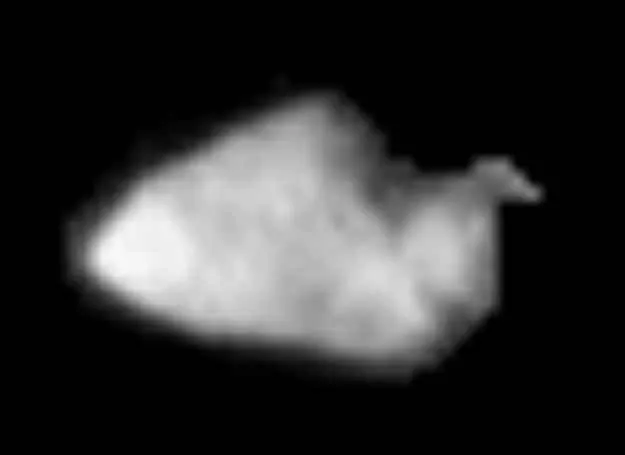
NASA's STARDUST probe passed by asteroid 5535 Annefrank in late 2002 on its way to comet Wild 2, which it reached in January 2004. Annefrank, named for that victim of the Holocaust, Anne Frank in Spanish, who wrote a famous diary, is a member of the main asteroid belt between Mars and Jupiter. Just before its closest approach at about 3,300 kilometers away, the spacecraft took the photograph above. Although the images obtained are not detailed enough to know much about the asteroid's surface, its size, reflectivity and general shape could be recorded. At 6 kilometers in size, asteroid Annefrank has turned out to be larger and darker than previously thought.
The asteroid was discovered in 1943 and was named as it is known today in 1995.
It was the Astronomy Picture of the Day (APOD) for November 13, 2002. And on Observatorio.
Credit: STARDUST Team, JPL, NASA
Fleeting Lights

The Peekskill meteor was captured in 1992 by 16 independent videos, and later impacted a car. This spectacular fireball, whose brightness was documented as similar to that of the full moon, crossed parts of several U.S. states during its 40 seconds of glory, before crashing in Peekskill, New York. The resulting meteorite, pictured here, is composed of very dense rock, and has the size and mass of an extremely heavy bowling ball. In tonight's Leonid meteor shower (which has nothing to do with the leader of the Spartans) very few meteors are expected to reach the ground, if any do. Observations can be reported at MeteorWatch.
Credit & Copyright: Pierre Thomas (LST), ENS Lyon
It was the Astronomy Picture of the Day (APOD) for November 18, 2002. In Spanish on Observatorio.
Images of the week
One Image, Many Stories
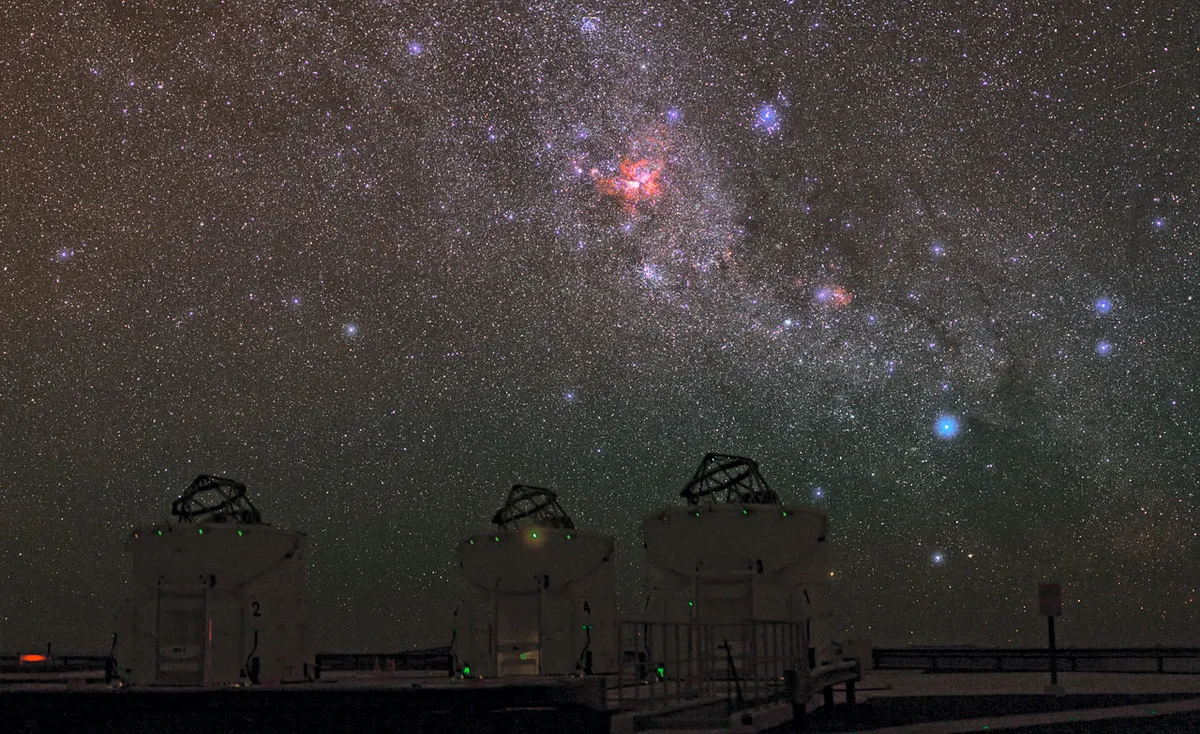
The ESO Photo Ambassador, Babak Tafreshi, has captured a striking image of the sky over ESO's Paranal Observatory, filled with a treasure trove of deep-sky objects.
The most obvious of all is the Carina Nebula, glowing intensely red in the center of the image. The Nebula is located in the constellation Carina (The Keel), about 7,500 light-years from Earth. This incandescent cloud of gas and dust is the brightest nebula in the sky and contains some of the most luminous and massive stars known in the Milky Way, such as Eta Carinae.
Below the Carina Nebula we see the Wishing Well Cluster, NGC 3532. This open cluster of young stars gets its name because, through a telescope's eyepiece, it looks like a handful of silver coins shining at the bottom of a wishing well. Further to the right, we find the Lambda Centauri Nebula (IC 2944), a cloud of incandescent hydrogen and newborn stars, sometimes nicknamed the Running Chicken Nebula, due to the chicken shape some have discerned in this bright region. Above this nebula, and slightly to the left, we find the Southern Pleiades (IC 2632), an open star cluster similar to its more familiar northern namesake.
In the background we see three of the four Auxiliary Telescopes of the VLTI (Very Large Telescope Interferometer)
Credit: ESO/B. Tafreshi (twanight.org)
It was the ESO Picture of the Week.
Cosmic Fireflies
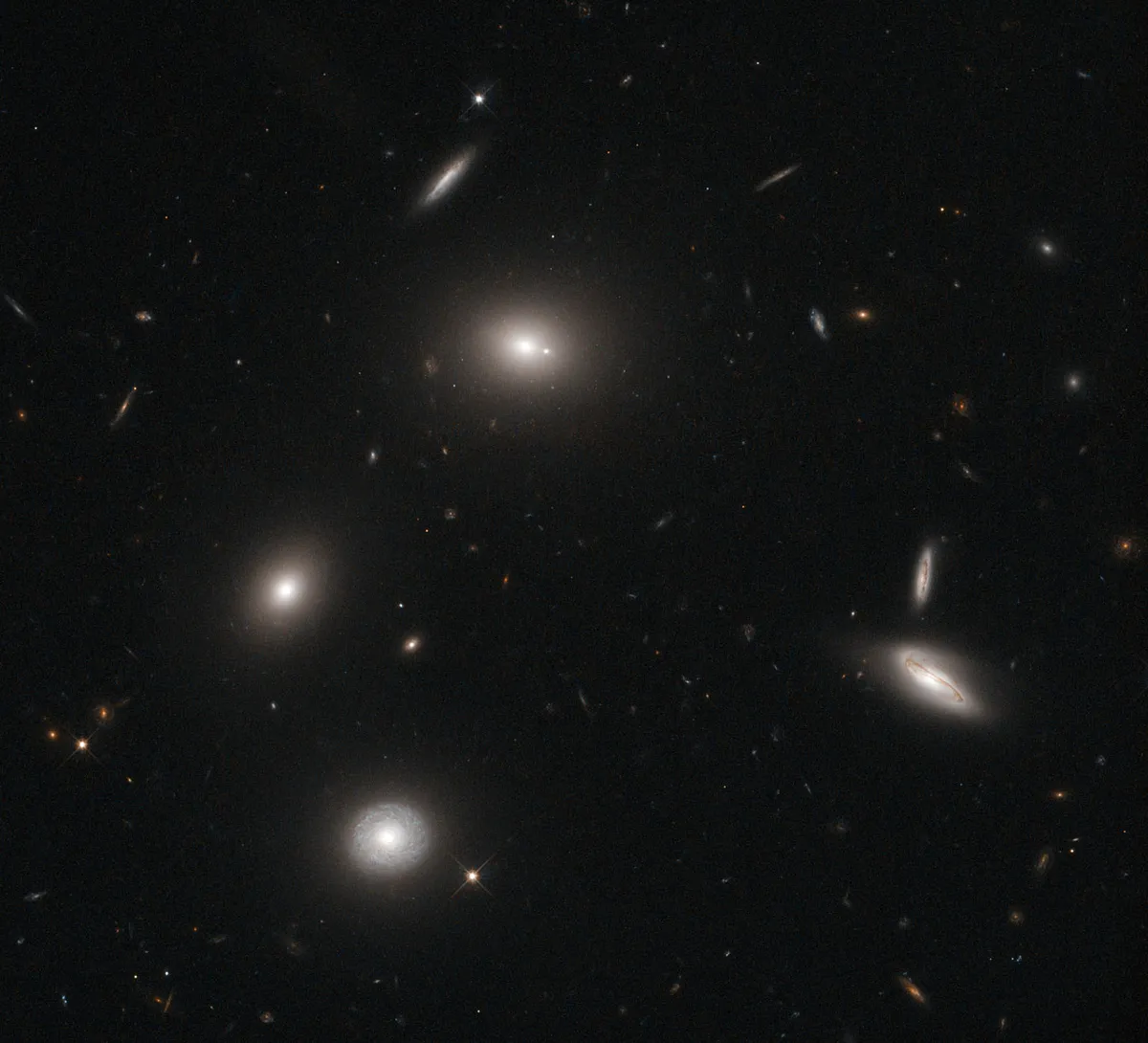
Luminous galaxies glow like fireflies in a dark sky in this image achieved through Hubble. The central galaxy in the image is the giant elliptical known as 4C 73.08. A prominent spiral seen from below features at the bottom of the image and other galaxies populate the frame.
At optical and near-infrared wavelengths the elliptical galaxy does not appear so beastly, but seen at longer wavelengths it looks different. Radio waves reveal plumes emanating from the core where a supermassive black hole lies, spewing jets of matter. 4C 73.08 is a radio galaxy about 270 Mpc (880 million light-years) away from Earth.
It was the Hubble Space Telescope Picture of the Week.
Credit: ESA/Hubble & NASA.
Animated Science
A History of the World in 3 Minutes
Power of synthesis, sense of humor, talent for animation and knowledge embodied in a video that doesn't show everything that a human being is, but many things we do...repeatedly!
The creator is Nico Olivera.
Footnote: I suppose there's no need to detail the influence of Monty Python...
To access previous editions of this section, consult the Multimedia Selection Series. The series attempts to show that the immensity of the universe can be perceived in different ways. I choose some images from a decade ago -so they don't fall into oblivion- and from the current week that ends, as well as sounds/music and videos that are artistic forms of expression with content related to astronomy and related sciences. I am also collecting these materials in the Pinterest account