A collection of links to music, images and videos that relate art and science. Today: Images of M35 and NGC 2158; The Pleiades; Two planet hunters, photographed; GB 1428+4217: The most distant X-ray jet. Music: Pablo Awad. Video: Guillermo Abramson and In the sky...clusters.

Images of the decade
The Open Clusters M35 and NGC 2158
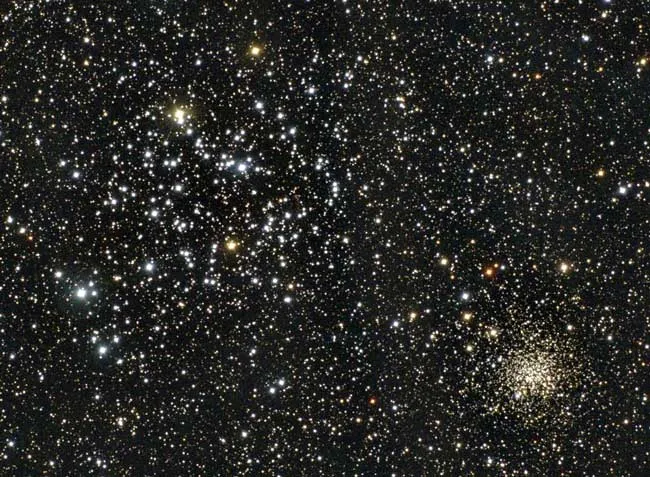
Open clusters can be near or far, young or old and diffuse or compact. Open clusters can contain from 100 to 10 thousand stars, all were formed at the same time. Bright blue stars are frequently distinguished in the younger open clusters. M35, photographed in the image above, in the upper left, is relatively close at 2,800 light-years away and is relatively young: 150 million years old and relatively diffuse with about 2,500 stars scattered in a volume of 30 light-years. Old and more compact is the open cluster NGC 2158, in the lower right of the image.
NGC 2158 is four times farther than M35, is more than 10 times older and much more compact, containing many more reddish stars in the same volume of space.
Both clusters are visible towards the constellation of Gemini.
Copyright: N. A. Sharp (NOAO), AURA, NSF
It was the Astronomy Picture of the Day (APOD) for November 29, 2002. And in Observatorio.
The Pleiades
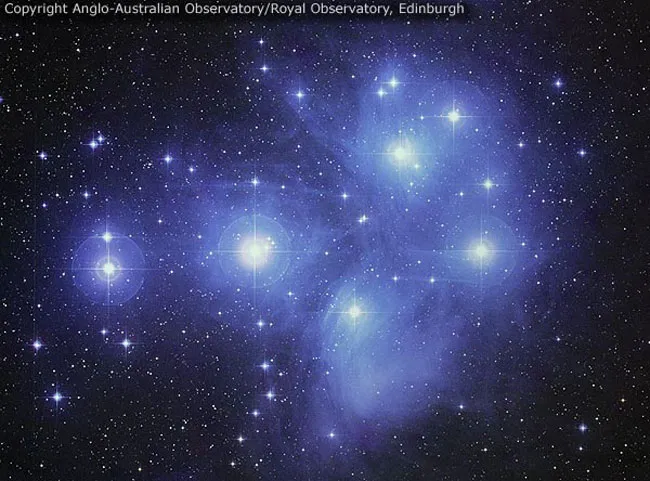
This is the most famous cluster in the sky. The Pleiades can be seen without binoculars and even from cities with light pollution.
Also known as the Seven Sisters or by their Messier number M45, the Pleiades is the brightest and nearest open cluster.
The cluster contains more than 3 thousand stars, is located about 400 light-years away and is only 13 light-years wide.
Quite evident in this photograph are the blue reflection nebulae that surround the star cluster.
Copyright: David Malin (AAO),ROE,UKS Telescope
It was the Astronomy Picture of the Day (APOD) for December 01, 2002. And in Observatorio.
Images of the week
Two planet hunters, photographed at La Silla
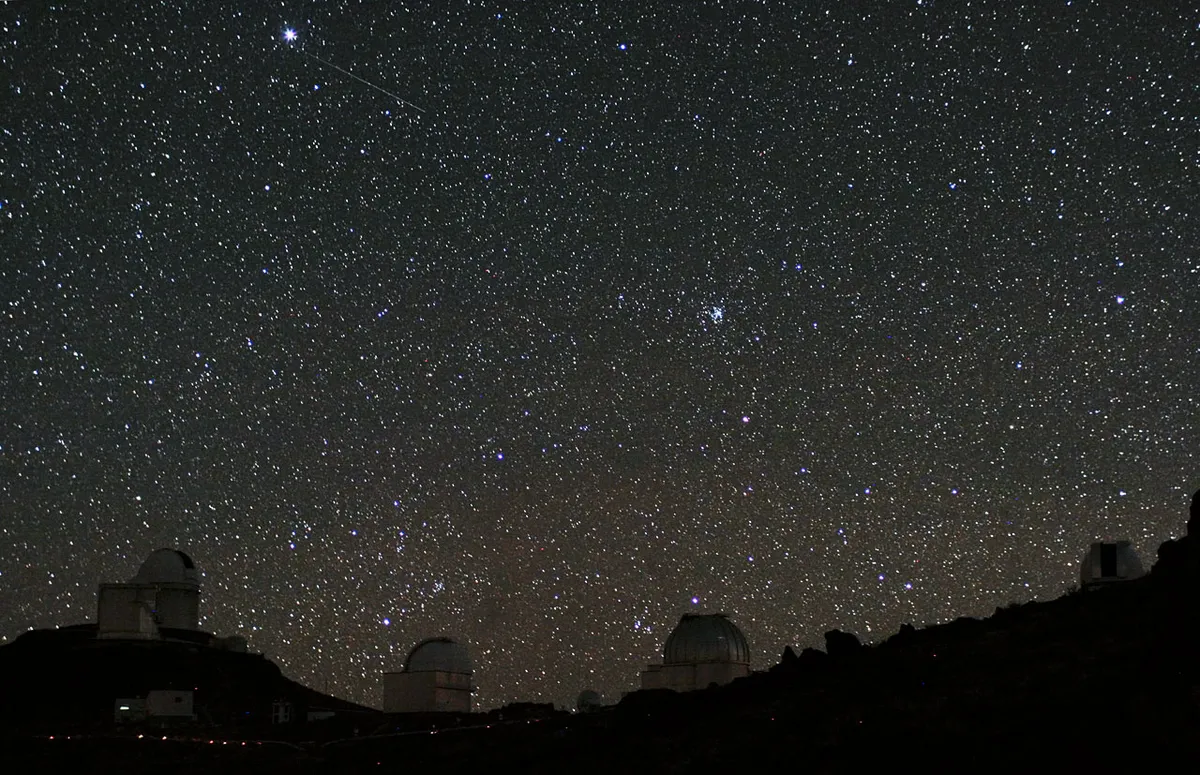
This unusual photograph captures two telescopes using two different methods to search for exoplanets, ESO's 3.6-meter telescope, which houses the HARPS spectrograph, and the CoRoT space telescope. The photograph was taken by Alexandre Santerne, an astronomer who, in turn, studies exoplanets.
The HARPS spectrograph (High Accuracy Radial velocity Planetary Search), the world's foremost planet hunter, is an instrument installed on ESO's 3.6-meter telescope. On the left of the image, the open dome of this telescope can be seen, behind the angular dome of the NTT (New Technology Telescope). HARPS finds planets by detecting the tiny changes in a star's motion as it wobbles due to the gravitational influence of the planet orbiting it. This is known as the radial velocity technique for detecting exoplanets.
The faint streak of light seen in the top of the sky in this 20-second exposure is not a meteor, but CoRoT (Convection Rotation and planetary Transits space telescope). CoRoT searches for planets by observing the dip in a star's light intensity caused by a planet passing in front of it — the transit method.
Unfortunately, in November 2012, CoRoT suffered a computer problem, which meant that — although it still works — it can no longer retrieve data from its telescope (see the news on the CoRoT website, or for example this Nature News article). The CoRoT team has not given up, and is working to resurrect the systems. Whether they resurrect CoRoT or not, there is no doubt that the mission has been a great success!
Alexandre submitted this photograph to the Flickr group "Your ESO Picture". The Flickr group is regularly reviewed, and the best photos are selected to be featured in our well-known Image of the Week series, or in our gallery. In 2012, as part of ESO's 50th anniversary, historical ESO images are also welcome. Since submitting this image, Alexandre has become an ESO Photo Ambassador.
Credit: ESO/A. Santerne
The image was published on the ESO website on November 26, 2012.
GB 1428+4217: The most distant X-ray jet.
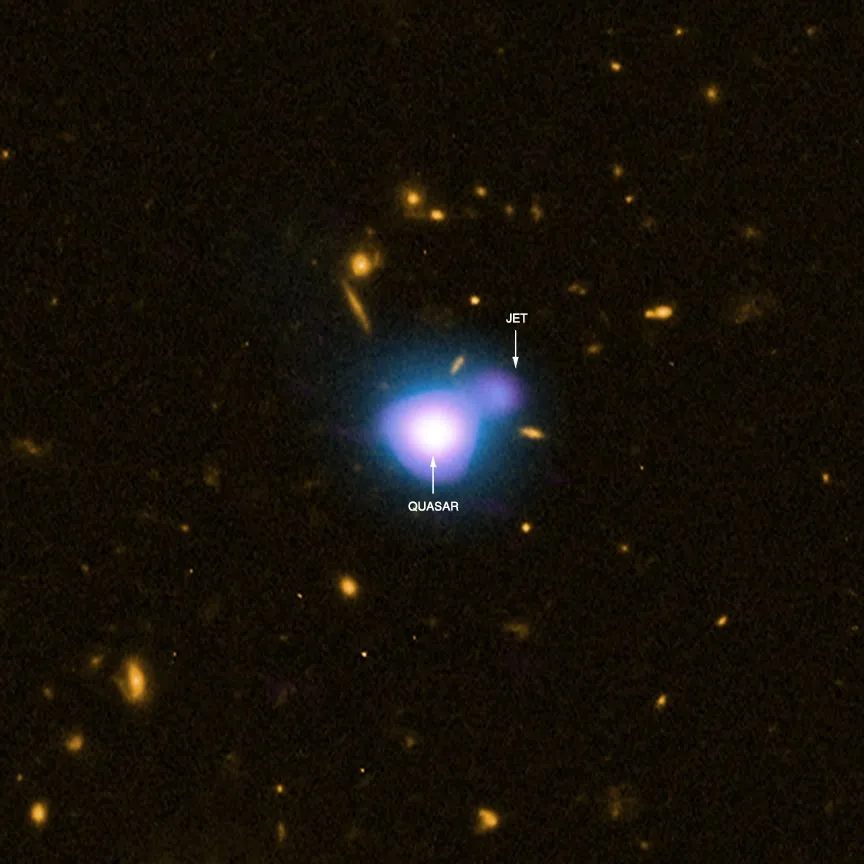
This composite image shows the most distant X-ray jet observed to date. Data from the Chandra X-ray Telescope are shown in blue, radio data from the Very Large Array are seen in purple, and optical data from Hubble, in yellow.
The jet of material was produced by a quasar called GB 1428+4217, at 12.4 billion light-years away. Massive black holes at the centers of galaxies can pull in material at a very rapid rate, producing the quasar phenomenon. The energy released as particles fall toward the black hole generates intense radiation and powerful beams of high-energy particles at high speed. When electrons in the material jet leave the quasar, they move through a sea of background photons, left over from the Big Bang. When a fast-moving electron collides with photons from the background radiation, it adds energy to them in the X-ray band. Since the quasar is seen when the universe was 1.3 billion years old, less than 10% of its current age, the background radiation is a thousand times more intense than now and the material jet is therefore much brighter.
Although it is possible that the X-ray source from that material jet is another, the authors of the study favor the background radiation idea. The researchers calculated that the length of the material jet or jet in GB 1428 is at least 230,000 light-years, that is twice the diameter of the Milky Way. The research was published in AJL in September (Cheung, C. et al, 2012, ApJ, 756, L20) and on the Chandra website on November 28, 2012.
Credits: X-ray: NASA/CXC/SAO/J.Drake et al, Optical: Univ. of Hertfordshire/ INT/IPHAS, Infrared: NASA/JPL-Caltech
Teddy Cheung commented on his discovery on the Chandra blog.
Space Music
Pablo Awad: Exoplanets
This Colombian musician has a set of six tracks, titled Exoplanets, on SoundCloud.
On his blog Audiogama he tells us that he has been making music since 2002 and that he runs the DXT Records label.
Animated science
In the sky...star clusters
Guillermo Abramson, from the Instituto Balseiro, together with Matías Saccomano, made a series of videos on astronomical topics.
In the fifth part of that series, he talks about open and globular clusters.
On his blog En el cielo las estrellas, the Doctor of Physics provides enjoyable explanations on topics of his interest and expertise.
To access previous editions of this section, consult the Multimedia Selection Series. The series attempts to show that the immensity of the universe can be perceived in different ways. I choose some images from a decade ago -so they don't fall into oblivion- and from the current week that ends, as well as sounds/music and videos that are artistic forms of expression with content related to astronomy and related sciences. I am also collecting these materials on the Pinterest account